The original 6 readings are retained in full. A supplement below adds 4 additional readings; the contents cover both parts.
Coverage: six papers first posted on October 7–11, 2026.
Highlights of this edition
Two agent-reliability studies lead this edition. The communication-fault study explains how damaged evidence can affect a final decision even when messages remain parseable and execution raises no immediate error. Cadence examines how to intervene when execution goes off track and when to inspect again. The first helps explain failure propagation; the second provides a mechanism for correcting execution as it proceeds.
Four shorter updates cover other developments. Resilience-code generation asks LLMs to add recovery capabilities to real MPI programs. MORA uses temporal context to distinguish normal change from anomalies. NosRacer demonstrates targeted concurrency testing in an industrial system. MASS trains multi-agent collaboration experience back into a shared model.
Why these two lead: the communication study provides empirical evidence about propagation and recovery boundaries, while Cadence offers a control mechanism that can be compared with existing monitors. The remaining papers contribute feasibility evidence, a detection method, industrial testing experience, and an exploration of self-improvement.
Select a figure to view the larger original.
In depth
01 · Communication faults: tracing corrupted evidence across agents
When Messages Go Wrong: Understanding Communication Faults in LLM-Based Multi-Agent Systems · Code and experimental artifacts
In depth · AgentOps / Communication reliability · October 11
This study examines whether downstream agents receive enough trustworthy evidence to support their decisions. Successful delivery and a parseable message can still hide a task that has already diverged from a correct outcome.
A failure that lets execution continue
In one example, a Worker returns the requested book titles, but the message delivered to the Verifier lacks three required evidence fields. The Verifier accepts it without an immediate failure signal. The answer string even matches the expected answer, yet fails the task’s evidence contract. Monitoring only crashes, timeouts, or the final answer can therefore miss information failures within the collaboration.
Retries, timeouts, and deduplication primarily address delivery. Agent messages also carry constraints, observations, and evidence. In their discussion of related work, the authors distinguish AgentChaos, which injects faults into LLM API responses, from MAS-FIRE, which includes communication faults in a broader multi-agent fault taxonomy. This study concentrates on how communication faults reach a receiver, affect downstream evidence use, and change the final outcome. Its contribution lies in matched experiments and propagation tracing along that chain, rather than simply expanding a list of fault types.
Making the effects observable
The authors instantiate three AutoGen workflows and inject faults such as non-delivery, partial content, and semantic corruption at request, tool-observation, and evidence-handoff boundaries. They first verify that a fault actually reaches its target, then trace changes in downstream state and behavior, and finally evaluate task success independently. This separates a scheduled intervention that never occurred from an applied fault that the workflow survived.
The important topology difference is the additional green path in Flat. After the Worker generates evidence, one copy travels through the Verifier and another directly to the final decision-maker. If the first handoff fails, the second can retain intact information. If the fault occurs before the Worker obtains that evidence, neither downstream path can help.
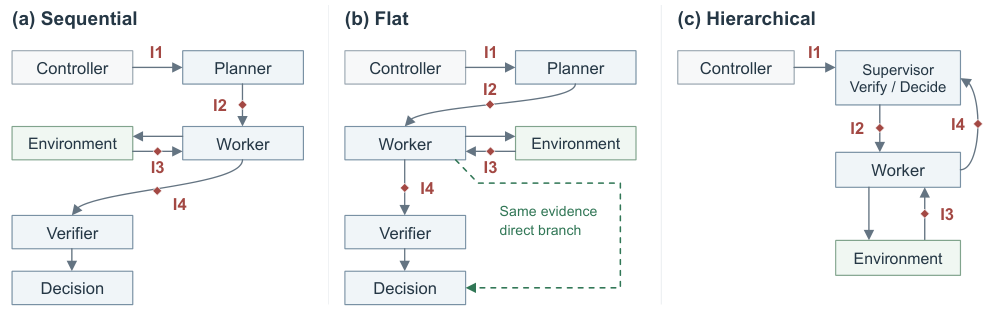
Reading the diagram: the Worker produces evidence, one path passes through the Verifier, and the green path goes directly to the Decision agent. Information lost before the paths diverge cannot be restored by that bypass.
What the experiments found
The evaluation covers 100 tasks from five domains, three workflow structures, and three model configurations. Two findings are particularly useful:
- Among 8,335 failed executions with complete detection records, 20.7% had no immediate failure signal. That share reached 76.2% for partial-content faults. These faults can propagate because the receiver can still process the message.
- Flat’s paired advantage is concentrated at the evidence-handoff stage. For non-delivery there, task success improves by 66.5 percentage points over Sequential; the advantage is small at request or observation boundaries. This supports the value of retaining an unaffected information path, not a general conclusion that flat topologies are inherently more reliable.
Detection and recovery are different problems
The paper distinguishes recovering an operation from recovering its evidence. Retrying can help when an action has not completed. If the action succeeded but its returned evidence is incomplete, repeating the action may create duplicate side effects. Checking required fields and retrieving trustworthy state again is more appropriate in that case. The experiments also show a boundary: recovery stops working when the fault contaminates the recovery path as well.
Reading assessment: a communication-fault study worth reading closely. Its most useful evidence is that the same fault can have different effects and recovery prospects depending on the information dependency it disrupts. Start with the position comparisons and recovery-boundary experiments. Some evaluated tasks additionally require complete supporting evidence, so their failure rates depend on that contract and should not be treated as general production failure rates for agent products.
02 · Cadence: adapting inspection and intervention to execution state
Cadence: Strategic Guidance for Coding Agents · Code
In depth · AgentOps / Runtime intervention · October 8
Cadence puts inspection frequency and corrective intervention into the same feedback loop. It addresses a familiar situation: an agent keeps reading and editing files, but its repair strategy is wrong even though the tool calls themselves succeed.
Where fixed schedules and rules fall short
The paper’s Django example requires clearing an object’s primary key after deletion. The agent edits the ordinary deletion path, while the relevant scenario takes a fast path. The patch is syntactically valid and submission is a legitimate action. Rules for repeated calls or stalled workflow stages alone have difficulty identifying that the wrong path was repaired.
LivePlan already triggers guidance using rules for stalled phases and action loops, and can block actions according to severity. Periodic model-based inspection can cover semantic errors more broadly but uses a fixed frequency. Cadence’s key addition is to use semantic judgment to control both the intervention and the next inspection interval. The paper executes its periodic baseline synchronously to control inspection timing; the results are not a comparison against every asynchronous monitoring implementation.
How one inspection changes the next steps
At an inspection point, the monitor receives the task description, recent trajectory, previous guidance, and the proposed action before it executes. It then chooses between two responses:
- Advisory: allow the action, add guidance for subsequent steps, and increase the inspection interval.
- Replacement: discard the proposed action, provide corrective guidance, ask the agent to regenerate it, and reset inspection to the base interval.
One judgment therefore determines both whether the action proceeds and how closely the agent is monitored afterward. This does not roll back side effects that have already occurred; the opportunity is to catch a deviation before execution. In the Django case, the monitor blocks submission, points out that the fast path remains unhandled, and redirects the agent to the relevant code.
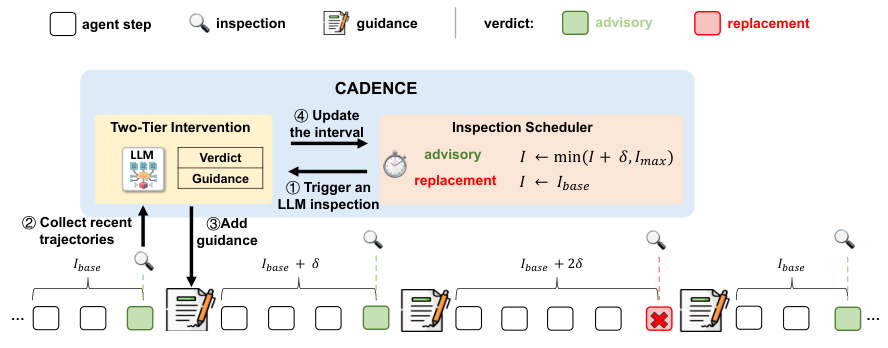
Reading the diagram: the left module chooses advisory or replacement guidance, and the right module updates the inspection interval. A red replacement point blocks the proposed action and restores closer supervision.
What improves, and at what cost?
The main experiment uses 300 SWE-bench Lite tasks, with Gemini 2.5 Flash as the coding model and GPT-5.2 as the monitor. Token counts include both the coding agent and the monitor:
| Agent framework | Resolve rate: vanilla → Cadence | Tokens per task: vanilla → Cadence |
|---|---|---|
| mini-swe-agent | 17.00% → 42.33% | 1.42M → 1.03M |
| Moatless | 24.00% → 39.67% | 0.32M → 0.48M |
Monitoring recovers tasks, but the cost tradeoff depends on the framework. With mini-swe-agent, resolution improves while token use falls. Moatless spends more tokens to achieve a higher resolve rate. These outcomes should not be summarized as a uniform cost reduction.
The scheduling ablation is revealing. Keeping two-tier intervention but inspecting every three steps achieves a 45.67% resolve rate, above the dynamic version, while consuming roughly 15% more tokens. The dynamic schedule offers an effectiveness–resource tradeoff. Its advantage over LivePlan on Moatless also does not reach statistical significance after correction for multiple comparisons.
What this work adds
Reading assessment: a method improvement in allocating supervision resources. Its value is not simply calling a stronger model, but connecting that model’s judgment to action approval and the inspection schedule. The fixed-schedule ablation is particularly useful for understanding what the dynamic policy saves and retains.
Before adoption, remember that “execution health” is itself a model judgment. A misdiagnosis can affect both the current action and future inspections. The paper’s failure analysis records this problem; assuming the monitor is a reliable oracle overlooks a new source of failure. The authors provide implementation and execution resources. This edition does not report an experimental reproduction.
Other developments
03 · Resilience-code generation: adding fault tolerance to MPI programs
LLM Agents as Resilience Engineers for Scientific Applications
Research update · LLM4Ops / Automated resilience engineering · October 8
Adding checkpoint/restart to an MPI program requires identifying all recovery-critical state and choosing consistent save and restore points. The authors remove existing resilience logic, ask coding agents to rebuild it, and inject real failures to test recovery rather than checking only whether the program compiles.

Reading the diagram: start with the original program, have the agent add recovery logic, and validate independently. FAIL feedback returns to the agent; only passing implementations move on to efficiency analysis.
A useful finding is the importance of fragmented state. The paper reports working implementations in 41 of 48 application–model settings. Visible, accessible state is easier to handle; dependencies across modules can lead to repeated unsuccessful repairs. This is coverage across settings, not the success probability of every attempt. The evaluation also uses a single host with four MPI ranks.
Assessment: feasibility evidence with a particularly useful validator design. The study checks actual recovery and guards against passing tests by replaying expected outputs. It establishes feasibility within the tested setting; 41 successful settings do not establish readiness for large-scale production recovery.
04 · MORA: using longer context to correct anomaly scores
MORA: Modeling Observed Changes for Drift-Robust Time-Series Anomaly Detection
AIOps watch · Time-series anomaly detection · October 7
Both changing workloads and genuine faults can move metrics away from historical patterns. MORA uses a short window and a longer history to reconstruct the same local target. When additional history explains the change better, it permits a bounded reduction in the anomaly score. This offers a way to handle drift without updating the model online at test time.
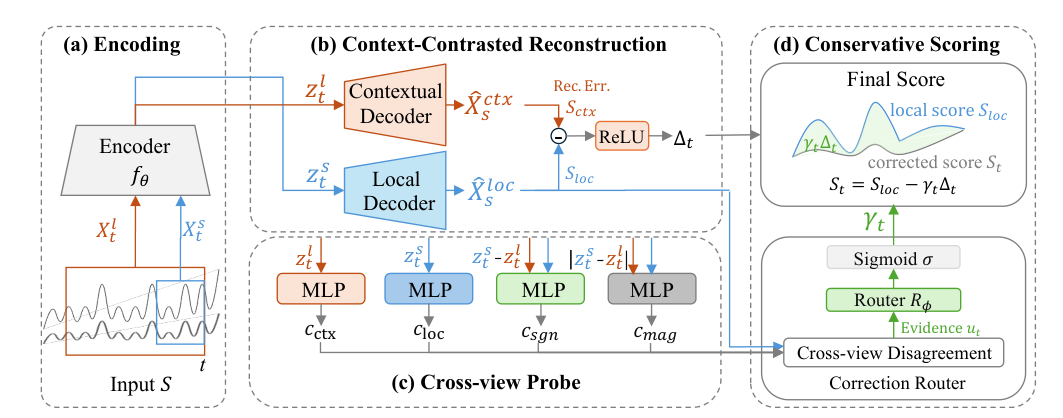
Reading the diagram: a shared encoder reads long and short windows; two decoders reconstruct the same short target; their errors are compared; a router controls how much to subtract from the anomaly score.
The method has a strong average ranking on four time-series benchmarks, but does not win every metric. Assessment: a score-correction method with explicit constraints. Unlike directly fusing scores from long and short windows, it lets context reduce the score only when reconstruction of the same target improves. That mechanism is worth following, but Best RPA-F1 remains an upper-bound metric: it does not establish the change in false alarms or missed faults at an operational threshold.
05 · NosRacer: exposing concurrency bugs through targeted message perturbation
NosRacer: Dynamic Detection of Race Conditions in On-Device Network Operating Systems
Methods watch · Concurrency faults / Targeted perturbation · October 8
The same configuration commands can leave different control-plane states when internal messages execute in a different order. NosRacer narrows the scope to relevant components and crucial variables, then delays selected messages to reverse access order and compare state and subsequent behavior. Across five components of a commercial NOS, it discovers 15 new bugs and reproduces six known ones.

Reading the diagram: identify relevant components, find crucial shared variables, group compatible perturbations, and strengthen unsuccessful perturbations within bounds. The left side narrows the scope; the right side tries to expose different execution orders.
Assessment: targeted testing demonstrated in an industrial system. It reuses existing tests, explores promising message interleavings, and supplies state and behavioral differences with its reports. It does not exhaust all orders: failure to trigger a defect is not proof of safety, and state differences still need to be checked against application requirements. A v2 update appeared on October 15; this discussion is based on v1.
06 · MASS: turning workflow optimization into model self-training
Recursive Self-Improvement through Multi-Agent Self-Supervision
Broader watch · Multi-agent systems / Self-improvement · October 8
MASS first uses copies of one model to search for better task divisions and information handoffs, then trains the resulting collaboration trajectories back into the model before starting another cycle. Its central idea connects workflow improvement with model training: organization of the work is part of what improves.
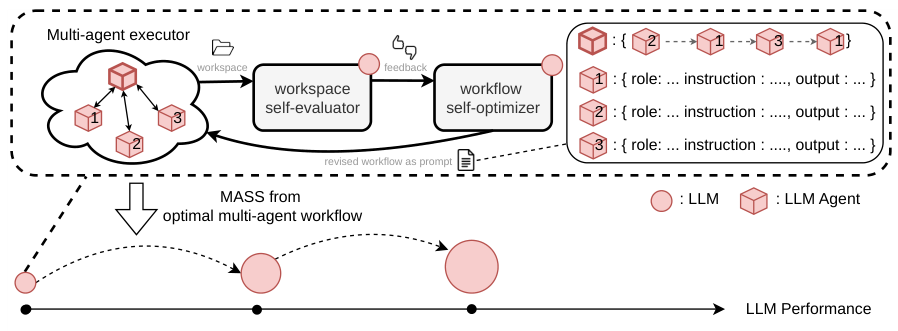
Reading the diagram: inside the dashed box, execution, evaluation, and workflow revision form a loop. Outside it, selected trajectories train the shared model, which then begins the next cycle.
Assessment: early evidence for alternating workflow and model improvement. Unlike optimizing prompts or orchestration with fixed weights, it learns from the collaboration traces and reuses the updated model for execution, optimization, and evaluation. Two cycles improve some research tasks, while terminal and software-repair benchmarks do not improve alongside them. This is a direction to track, not yet evidence of sustained, universal capability growth. Training-token efficiency also excludes the full cost of search and data generation.
Reading the two featured studies together
The communication study asks whether information still supports a decision after passing through a collaborative workflow. Cadence asks whether a proposed action should be allowed to execute. They identify two concrete places to observe and control agent reliability, but use different experimental settings; their results cannot be combined into an already validated end-to-end system.
The main developments to take away are that failure analysis can follow information dependencies and execution supervision can adapt to state. Both require measuring changes inside the workflow separately from final task outcomes.
Additional readings
What matters in this issue
Caching is becoming a systems interface that affects cluster scheduling, model behavior, and state correctness. Start with two papers: a hierarchical KV cluster simulator explains why better cache reuse and less computation may leave user latency almost unchanged; VReparo shows that exchanging caches between related models can change a receiver’s refusal behavior. They extend the question of reuse into resource readiness and behavioral compatibility, respectively.
Two further studies add useful perspectives. Hybrid attention and state-space models must manage several kinds of state, so compact allocation needs completeness checks. Cloud telemetry evaluation shows why alert timing and false-alarm control matter alongside model rankings. The shared question is how a local optimization becomes a benefit for the complete service, and which additional constraints it introduces.
01 · KV cluster simulation: what happens after a cache hit
Compositional Performance Modeling of LLM Inference Clusters with Hierarchical KV Caching
Ruiyang Ma, Sheng Qi, DaiKang Kuang, Teng Ma, Guojie Luo · First arXiv submission: 2026-10-11
A cache hit does not mean computation can start
With prefill/decode disaggregation, a request can find its prefix on one worker and generate its answer on another. A prefix in host memory must first return to the GPU. Adding operator runtimes cannot establish when that data becomes usable: device capacity, transfer queues, and contention determine how much latency the hit actually saves.
The paper separates three concerns. Policies choose work; local models estimate an operation’s duration; shared state determines whether it can begin. Measurement-based calibration supplies the performance models, while logical KV content, reserved capacity, and completed replicas are tracked separately. Discrete events connect them into cluster behavior.
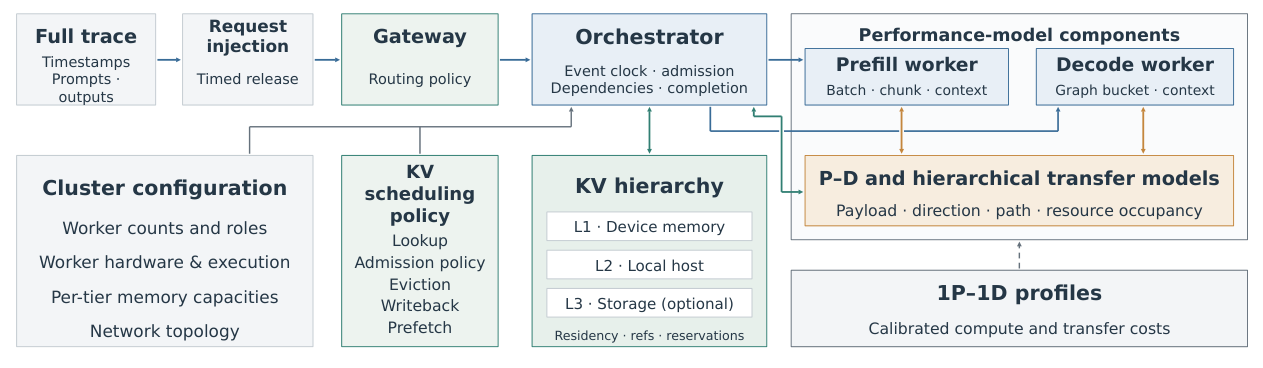
Reading the diagram: traces and routing enter on the left; the central orchestrator checks capacity and dependencies; models on the right estimate computation and transfer durations. Calibration profiles below are reused across compatible workers.
For a host-cache hit, execution first reserves destination device capacity, retrieves the prefix, computes the uncached suffix, and hands KV to the decode worker. A destination replica cannot serve computation until transfer completes, and a source being transferred cannot be reclaimed. Shared prefixes count once toward physical capacity despite multiple references. These dependencies produce queueing and overlap without fitting a new end-to-end latency model for every deployment.
Reusable calibration still needs end-to-end evaluation
The authors validate SGLang running Qwen3-8B/32B on RDMA-connected NVIDIA L20Z hosts in 1P–1D and 3P–1D configurations. Each worker uses two GPUs, TP2, BF16 KV, and 4,096-token prefill chunks. Equal weighting of 16 QA cases and 10 coding-trace cases gives end-to-end latency MAPE of 1.34% and 6.36%, respectively. The adapted LLMServingSim baseline reaches 15.21% on coding traces. That comparison includes engine, admission, and modeling differences; it does not isolate one module’s contribution.
Session-affinity routing offers the clearest illustration. In 3P–1D at 0.5 requests/s for 8B and 0.25 for 32B, measured uncached-input work falls 48.2% and 46.1%, while mean end-to-end latency increases 0.44% and 1.32%. Generation demand at the shared decode worker is unchanged, so reducing prefill does not guarantee a substantial end-to-end gain.
A simulated 60-second idle TTL reduces time-weighted KV occupancy by 86.9%/92.9% relative to LRU, with mean time-to-first-token increases of 7.4%/3.8%. Occupancy here counts used cache slots, not GPU memory allocated to the process; the TTL findings are simulation results. CPU evaluation is 15.33× faster on average than real replay, which includes prescribed arrival gaps and excludes startup and calibration. This is not an inference-computation speedup.
Read closely for how state constraints enter performance modeling. The experiments disable L3 and decode-side prefix and host caching. Coding requests arrive in an open-loop replay of recorded intervals rather than releasing subsequent calls when simulated predecessors complete. The framework therefore supports screening routing and retention policies within calibrated, compatible environments; these results do not establish performance for arbitrary storage tiers or closed-loop agent workflows.
02 · VReparo: cross-model cache reuse changes safety behavior
To Cache or Not to Cache: Understanding and Mitigating Safety Incompatibility in Cross-Model KV Cache Reuse · Code
Zhiwei Lin, Jiahao Liu, Yan Liu, Chengpeng Wang · First arXiv submission: 2026-10-11
A shared foundation does not guarantee compatible cache behavior
Cross-model cache sharing lets a receiver consume a prefix computed by a related model, reducing repeated prefill. Prior methods emphasize latency and generation quality, but KV tensors participate directly in subsequent attention. Replacing them can also change whether the receiver refuses harmful requests. The authors call deviations from receiver-native safety behavior safety incompatibility, measuring changes toward both more harmful and safer responses.
The study examines six base/instruction model pairs and both reuse directions between LoRI-D Code and Safety variants. In HarmBench experiments separating K and V, V-only reuse shifts ASR more than K-only reuse in all eight directions. Effects are not uniformly harmful: their direction depends on the model pair and reuse configuration, and even a lower average ASR can hide individual safe-to-harmful transitions. These diagnostic experiments filter out prompts with invalid outputs in any compared condition, so their results describe the retained samples.
Calibrating reused values toward the receiver
For a fixed sender, receiver, and reuse configuration, VReparo learns an affine map for each layer and KV head. Offline, both models process identical tokens and supply paired V vectors at matching positions. Ridge regression maps reused representations toward receiver-native ones while regularizing the map toward the identity. Separate behavioral calibration selects a correction strength, balancing refusal of harmful prompts against refusal of benign ones.
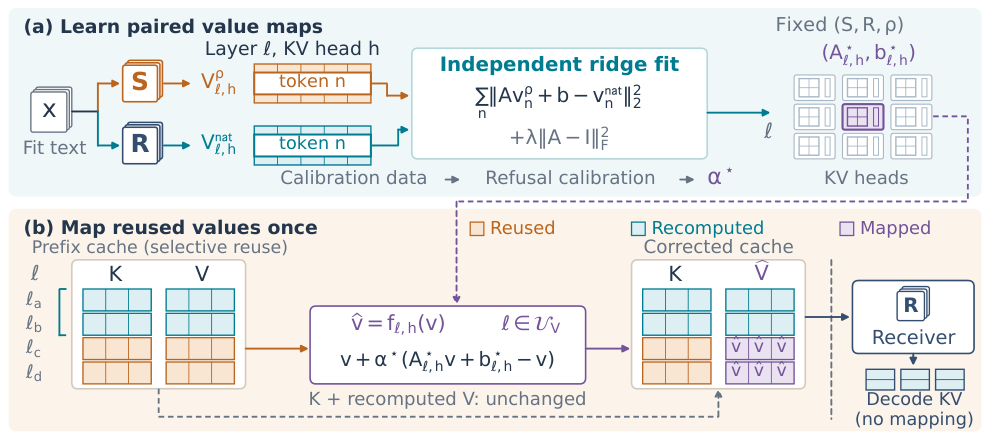
Reading the diagram: the upper half fits maps from corresponding token values and calibrates their strength. The lower half corrects only reused prefix V; K, recomputed V, and subsequently generated state remain unchanged.
Online mapping happens once before decoding. It changes no model weights and requires no new receiver reference cache per request. It supports both full KV reuse and DroidSpeak’s selective layer recomputation: the latter retains recomputed values and maps the other reused layers. Each fit uses 32 HotpotQA and 32 HEx-PHI texts without labels; XSTest refusal rules separately select correction strength.
Safety improvements and deployment savings have distinct conditions
Mitigation experiments cover only LoRI-D Code→Safety and Llama-3-8B Base→Instruct, each under full reuse and DroidSpeak. Aggregating the four settings with five fitting runs, average HarmBench ASR falls from 57.28% to 39.21%, and average StrongREJECT score from 0.4215 to 0.2163. Safety evaluation uses fixed sets of 127 and 313 prompts, respectively. Corrected reuse remains more harmful than native inference, so this is mitigation rather than guaranteed restoration.
On an NVIDIA A40 with 50 HotpotQA timing inputs, time to first token averages 85.62% below native inference. Timing starts with resident sender caches and excludes sender prefill, cache transfer, tokenization, and distributed scheduling. Compared with uncorrected reuse, full reuse adds about 34 ms and DroidSpeak about 97 ms. The latter also includes an additional suffix prefill in the current implementation; the entire increment is not mapping-kernel cost.
The contribution is treating behavioral compatibility as part of the cache interface. The trade-offs are concrete: for LoRI-D full reuse, complete refusal of benign OR-Bench prompts rises from 4.0% to 12.6%, versus 11.0% for native inference. QA quality is not generally restored either. Read the K/V separation evidence first, then the mapping mechanism and the safety, quality, and latency results together. Speedup or average ASR alone misses the practical trade-off.
03 · Hybrid-model memory: compact allocation needs complete state
Native Dual Pools or Shared Paging? Memory Organization for Concurrent Hybrid LLM Serving
Dongwook Kang · First arXiv submission: 2026-10-11; revised: 2026-10-14
Hybrid attention–SSM models hold growing KV alongside recurrent and convolution state. In a modified vLLM runtime, this paper compares coarse shared pages S0, recurrent-checkpoint paging S1, S2 with packed convolution slots, and static dual pools D0. S1 reduces internal waste in attention blocks but increases allocation per recurrent checkpoint; S2 packs small convolution states into shared slabs. D0 provides compact allocations, but a full pool cannot borrow spare capacity from the other.
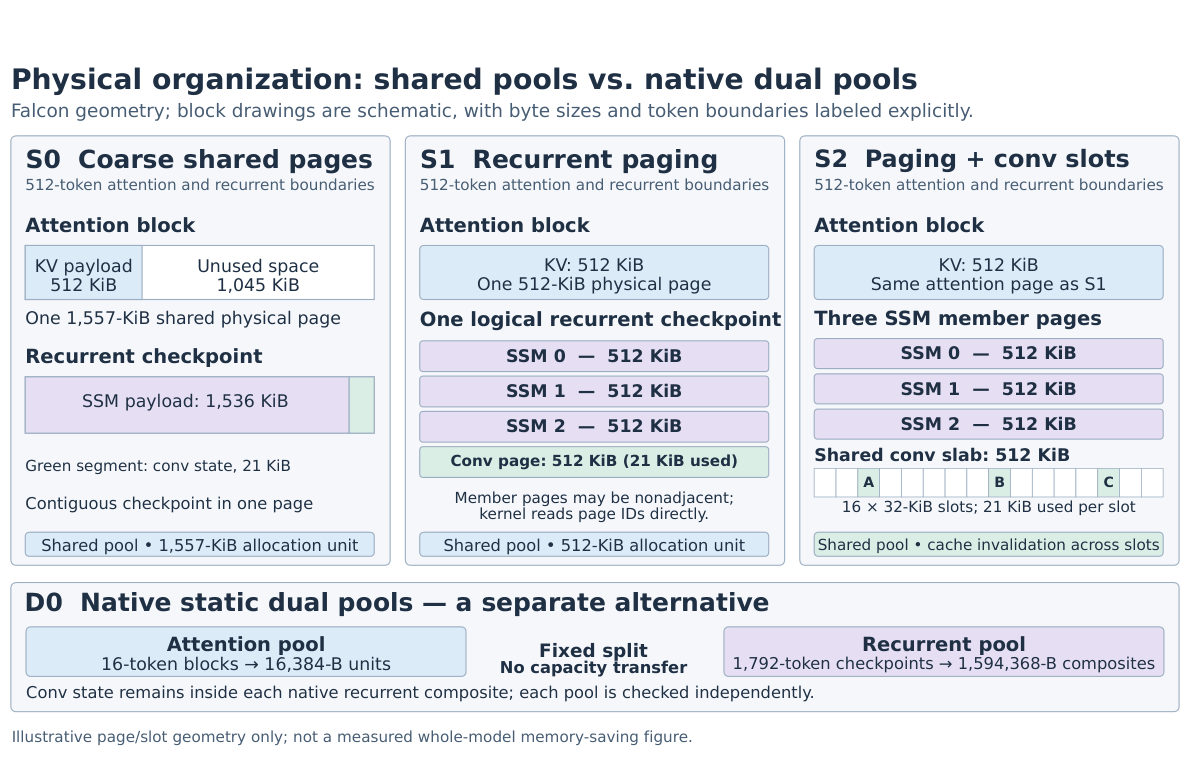
Reading the diagram: the upper row progressively pages recurrent state and packs convolution slots; the lower row separates pools by state type. These are representative allocation geometries, not whole-model memory-saving percentages.
Main experiments use Falcon-H1-7B-Instruct on one A100 40GB with BF16 and TP1. S0→S2 improves throughput and tail latency at the main operating point, but the S2–D0 ranking changes with budget, load, and admission headroom. Crucially, the revision reports output differences between some retained-state continuation paths and independent recomputation, with the cause unresolved. The primary confidence interval for the retention interaction also includes zero. The paper supplies mechanisms and experimental questions for memory organization, but does not yet establish correctness for a drop-in replacement.
04 · Cloud telemetry detection: early alerts and false alarms belong together
Benchmarking Deep Learning Models for Anomaly Detection in Real-World Cloud Telemetry
Sumit Dhyani, Sougata Mukherjea · 2026 11th International Conference on Cloud Computing and Big Data Analytics (ICCCBDA) · Conference publication: 2026-04; arXiv: 2026-10-11
This study compares GRU, Anomaly Transformer, TimesNet, and Autoformer on IBM Cloud Console telemetry, using NAB to account for alert timing and false alarms. Standard NAB is 29.05±0.28 for TimesNet and 21.27±0.36 for the improved GRU. Adding log-scaled error, MAD normalization, and persistence/cooldown rules to GRU reduces window-level false positives from 121 to 66 while detected windows rise from 4 to 5.
The ablation is more revealing: robust normalization alone reaches standard NAB 41.24 but produces 3,318 timestamp-level false positives; enabling all components yields 21.27 and 66, respectively. A higher score need not imply an affordable alert burden. Evidence comes from one cloud platform, with limited specification of training splits and repetition counts; window statistics are not direct production alert rates. The paper has no suitable method or architecture diagram, so this section remains text-only. Read it for scoring and post-processing trade-offs, rather than a universal ranking of model families.