When a coding agent claims to have reduced I/O, what evidence ties the speedup to the change? After a mistaken action, how can an evaluator tell whether both the affected state and the user’s task have recovered? BELOW and SecondChance build measurements for these questions. On the serving side, LoomKV distinguishes two capacity shortages with different remedies, repeated prefill and waiting for GPU pages. Other studies follow these questions into subgraph recovery, trace diagnosis, delegation, placement, network scheduling and GPU power.
In depth
BELOW tests the explanation behind a speedup
Below the Stopwatch: Checking the Performance Claims of Coding Agents in the Kernel
Yuvraj Sehgal, Sneh Patel, Mahsa Panahandeh, Naser Ezzati-Jivan · arXiv v1 · 2026-11-23
A patch promises fewer file reads by caching a result. A shorter runtime establishes only part of that claim. The new version might skip required work. Conversely, reads might disappear while something else dominates latency. BELOW separates three questions a reviewer can answer independently. Did the output stay the same? Did the workload run faster? Did the proposed mechanism leave its expected footprint?
The authors identify 1,343 runtime-performance PRs involving Python code in AIDev. Before measuring, they map each stated mechanism to observable events. Avoiding repeated I/O should change read counts or bytes. Reducing lock contention should affect futex waits. A separate build agent sees the code and diff but cannot read the title, history or performance claim. Its workload may still differ from production, but it has less opportunity to tailor the test to the explanation. Both versions use dependencies fixed to the PR date, with the merge base supplying the old code. The harness checks changed-line coverage, offline execution and output hashes.
Three identical cloud VMs run interleaved trials of the base, the new version and a second copy of the base. Comparing the two base runs measures noise. Timing runs omit tracing. Separate runs collect counters and LTTng events such as system calls, scheduling and page faults. Of the 82 PRs that reached analysis, 32 ran faster, 28 showed no clear change and 22 ran slower. The expected mechanism left a signal in 34 cases, including 20 where it appeared only in kernel traces. Outputs changed in 42 cases. A changed hash warrants investigating whether both versions did equivalent work. It does not by itself identify a functional regression.
The 82 are a subset for which the team could build and exercise both versions and obtain usable measurements. Their success rate cannot be applied to all agent-written PRs. For an individual review, the transferable question is which signal should move if the explanation is right. Specifying that in advance makes both a faster patch with a doubtful explanation and a genuine optimization outside the bottleneck easier to recognize.
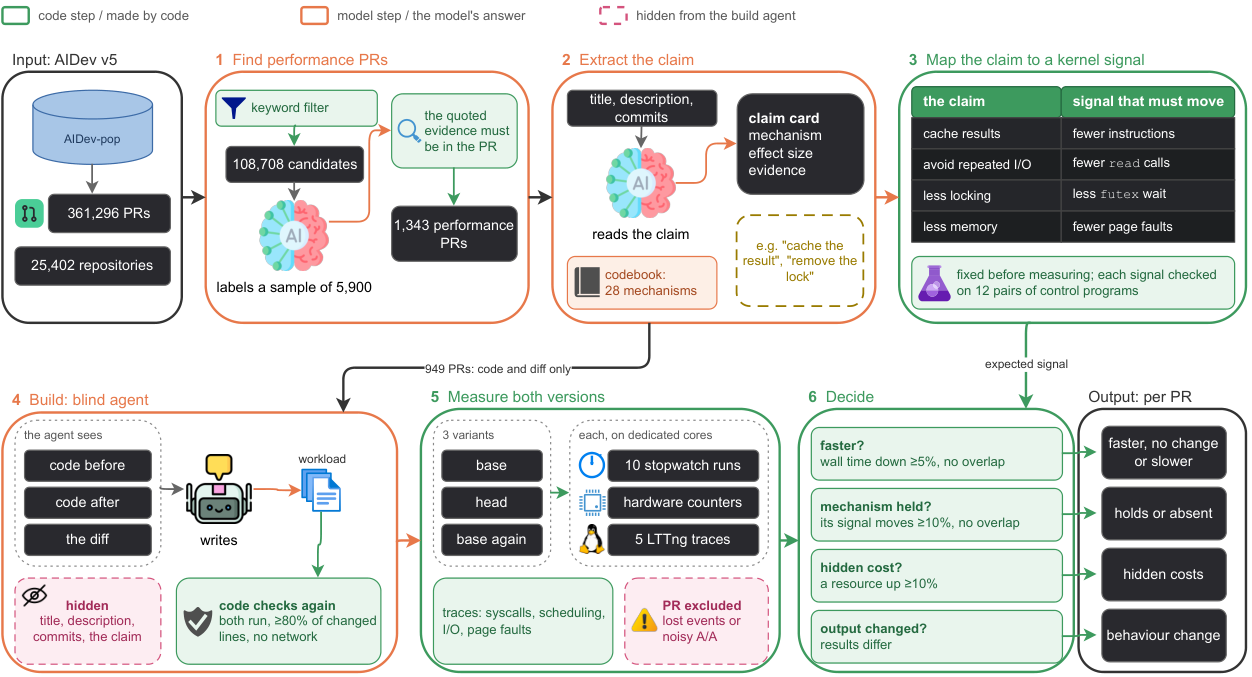
The build agent sees the diff. The predicted signal enters the decision after measurement.
SecondChance separates fixing an error from completing recovery
SecondChance: Benchmarking Reliable Error Recovery in AI Agents
Atahan Dokme, Adar Avsian, Larry Heck · arXiv v1 · 2026-11-23
An agent enables roaming on the wrong phone line. Enabling it on the intended line on the next turn can satisfy the original request while leaving the first change in effect. SecondChance saves states of this kind and gives different models the same history and environment from which to continue. Scoring only the final task misses residual damage. Scoring only the reversal can reward an agent that abandons the user’s task.
The authors select 129 natural errors with observable consequences in τ²-bench, BFCL and AppWorld. Each continuation restores the environment and conversation. The evaluator holds the error annotation separately. Four conditions add information in stages. The agent proceeds unaided, is told that an error occurred, learns which action was wrong, or receives a repair plan. The agent still has to execute the plan. The evaluator separately checks the erroneous effect, the task goal and requirements such as disclosure or permission where applicable. This distinguishes noticing a problem from choosing and carrying out an adequate remedy.
Twelve models made 5,760 continuations. On the 75 τ² and BFCL checkpoints it attempted, GPT-6.1-sol completed 16% of recoveries unaided. With a plan it corrected 43% of errors and completed 27% of recoveries. The two hosted models did not run AppWorld. The full population also mixes 57 checkpoints with a demonstrated fix, 15 known to be impossible and 57 of unknown fixability. Restricting attention to the demonstrated fixes in τ² and BFCL, the best plan-assisted complete recovery rate reaches 54%. That conditional rate shows how often an available route to recovery still goes unfinished.
For an agent handling operational changes or customer transactions, the important artifact is the world state after the mistake. A useful audit can ask separately whether the affected object was restored, whether the original request was fulfilled and whether the repair respected the user’s authority. Those answers point to different improvements in detection, planning and verification.
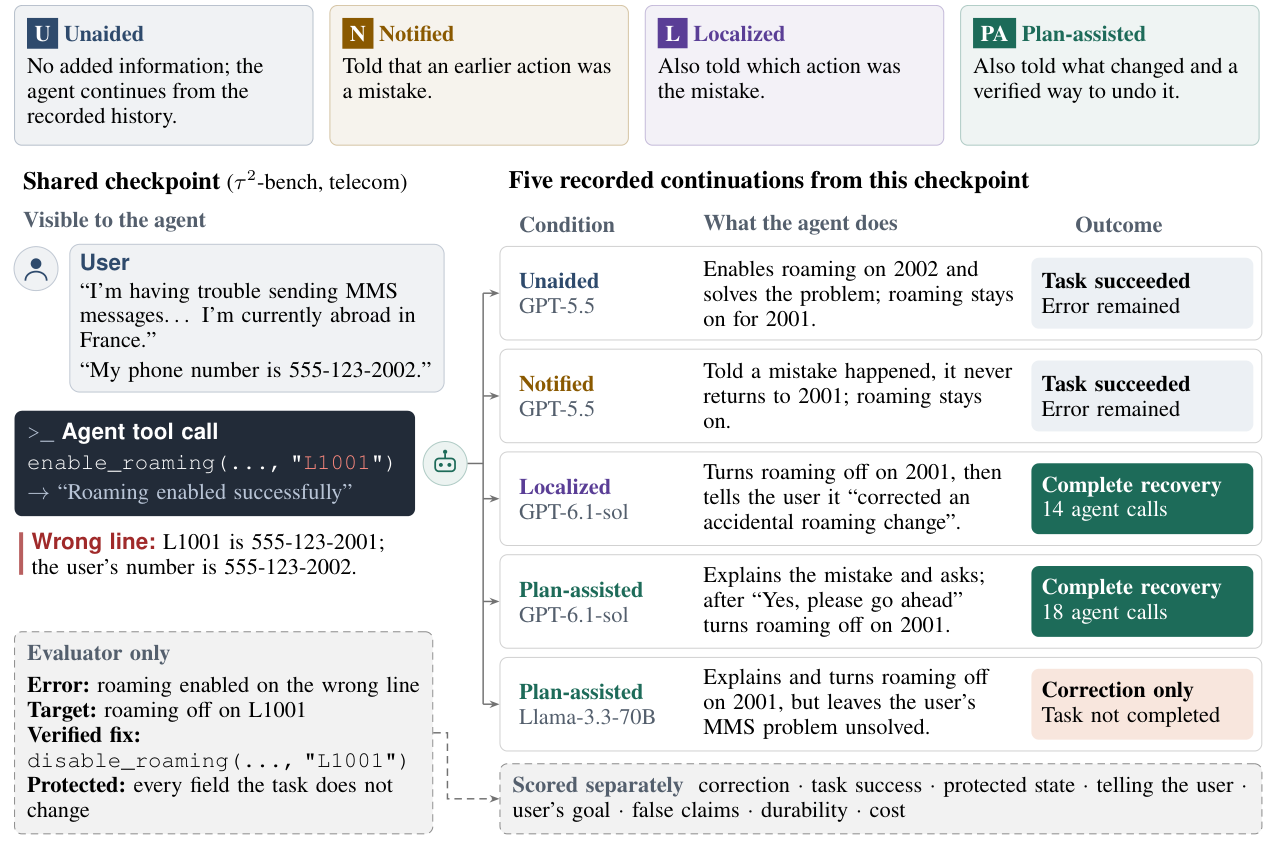
From one incorrect roaming change, continuations can finish the task, fix only the error, or complete recovery.
LoomKV uses one lossless code at two capacity bottlenecks
LoomKV: Lossless KV Cache Compression from GPU Memory to SSD for LLM Serving
Wentao Zhu, Ziao Sheng, Peng Deng, Huiqi Hu, Xuan Zhou, Xing Wei, Zhuang Wang · arXiv v1 · 2026-11-24
A coding session resubmits earlier turns. Keeping the prefix in DRAM or SSD can save prefill on the next request. Yet even a perfect external hit leaves a request waiting if the GPU has no room for its active KV pages. LoomKV treats these as distinct sources of delay. Its two modes share a codec but put decompression in different places, so the storage ratio alone cannot predict the gain in service throughput.
Within an attention head, the sign and upper exponent bits in BF16 high bytes tend to recur. LoomKV calibrates a two-level codebook per head, gives common high bytes short codes, preserves uncommon values with an escape path and copies the low bytes verbatim. Across nine models BF16 KV takes about 0.71 of its original storage. In the external-tier mode, LMCache stores records at their actual lengths. A load decodes directly into scattered vLLM pages. Reserving the original slot size for each record would forfeit much of the capacity that makes future prefix hits possible.
For active GPU state, FragPack packs variable-length records into smaller pages. A fused decode-attention kernel reads them in place. Staging and overflow space come out of the same GPU budget. Tier mode restores bit-identical KV. Pool mode also stores values losslessly, but its attention implementation changes, so the relevant check is numerical agreement with FlashAttention-3. Lossless storage alone would not establish bit-identical final outputs.
The main AgentX replay serves Qwen3-30B-A3B on two 80 GB H800s with 54 GB of KV space on each. Goodput counts requests per minute meeting both the two-second engine first-token limit and the 40-millisecond inter-token limit. The largest external-tier effect appears near the LRU capacity threshold. Raw tiers evict prefixes shortly before sessions return, while compressed tiers retain them, yielding 2.7–3.6 times the goodput. Once the external tiers hold the working set, additional active GPU tokens can relieve admission waits instead. On a separate trace derived from an AI IDE, the two modes deliver 1.24 and 1.59 times baseline goodput respectively. These are alternative configurations. The first diagnostic question is whether requests are recomputing lost prefixes or waiting for GPU pages.
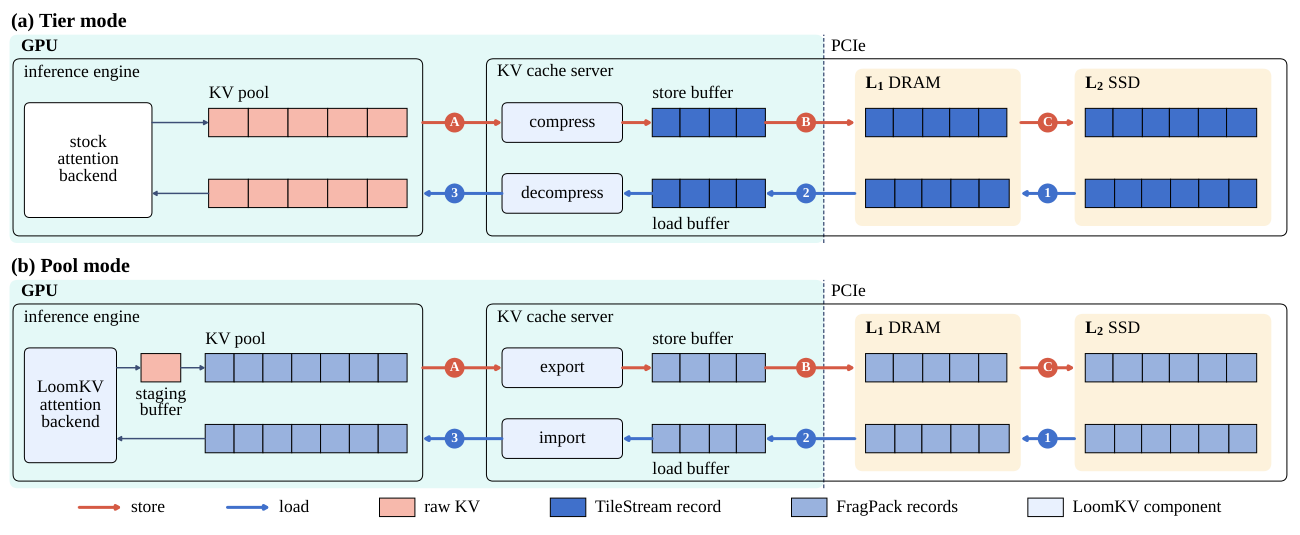
The upper path decodes on an external hit. The lower path lets attention consume packed GPU pages.
Agent execution and diagnosis
Agent-Kernel follows dependencies when retrying
fork() for Agents: Agent Kernel for Non-blocking LLM Orchestration
Ankit Chadha, Pratyay Banerjee · arXiv v1 · 2026-11-24
When one of three subtasks throws an exception, replaying the whole trajectory repeats two successful computations. Agent-Kernel records dependencies and inserts parent outputs into child prompts. An exception resets the failed node and its descendants while preserving completed siblings. In the transient-fault experiment, a budget of three retries per failed node gave full recovery, compared with 55% for three whole-trajectory replays. Those budgets count different operations. Other baselines, including in-place step retries, also recovered fully, making completion time the differentiator. A plausible but wrong answer still needs a detector before recovery can start.
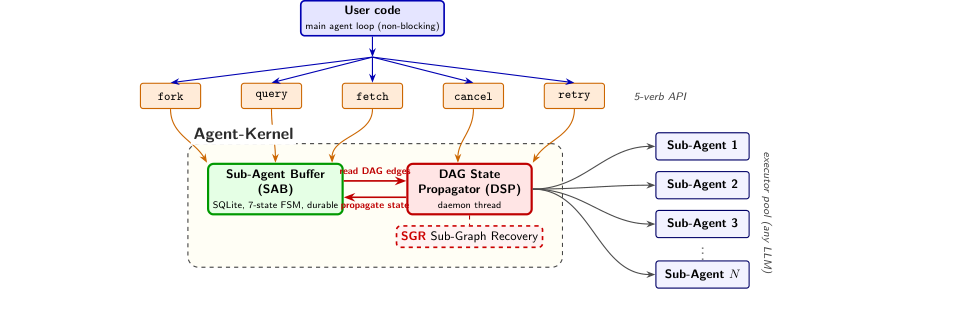
The scheduler reads parent outputs from shared records and resets the affected subgraph.
TimeTravelContainer branches a running tool session
TimeTravelContainer: A Live Forking Sandbox for Stateful Agent Exploration
Zizheng Guo, Yanqing Zhang, Nathaniel Pinckney, Cunxi Yu, Brucek Khailany · arXiv v1 · 2026-11-24
Design exploration often branches after a large design is already in memory. Restarting the tool makes the cost of branching depend on the full loaded state. TimeTravelContainer shares process memory and filesystem contents through copy-on-write, with independent kernel state in each branch. Writes create private pages. This complements Agent-Kernel’s reuse of textual task results. On MAGE’s Ariane133 workload, cloning fell from 86.5 seconds to 1.03 seconds. EvoDRC supplied a second family of repeated tool calls. End-to-end timings replayed fixed EDA workloads without LLM inference, so the maximum clone speedup cannot be applied directly to total interactive latency.
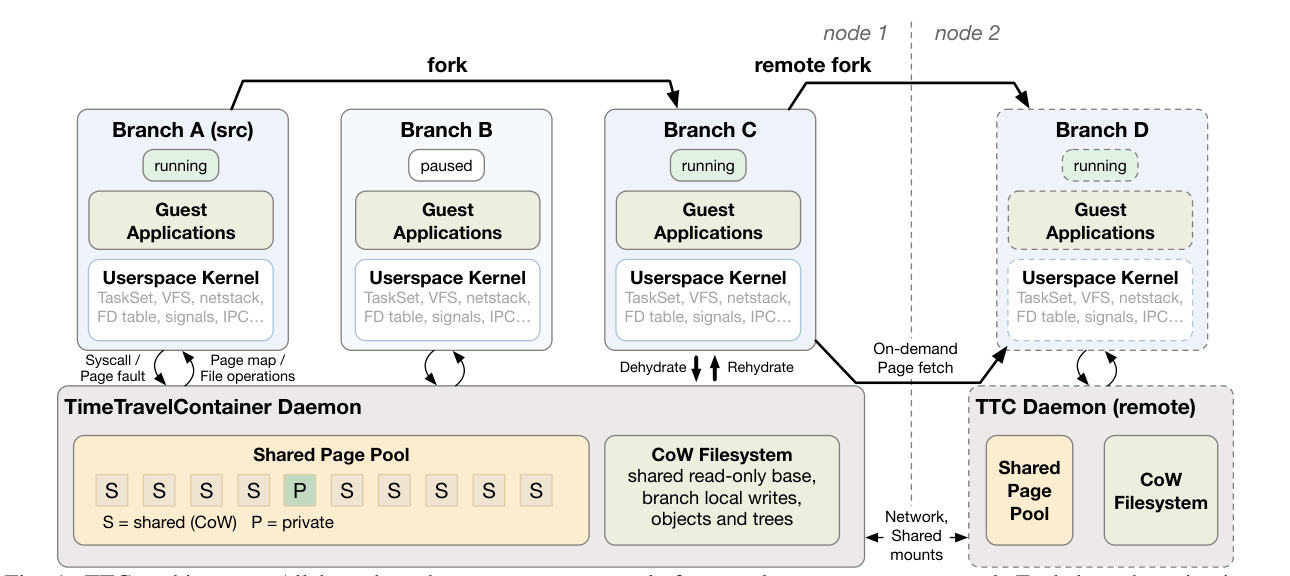
Branches share backing pages and files until a write creates private state.
RecordRoute locates the decisive record before assigning a failure mode
RecordRoute: Auditing Agent Failures with Localization-Guided Diagnosis
Yifan Duan, Lihuan Li, Chao Xue, Siyuan Zheng, Du Yin, Flora D. Salim · arXiv v1 · 2026-11-24
When several agents repeat an erroneous observation, searching for its keywords may return a downstream echo. RecordRoute trains a ranker on pairs of records from the same trajectory, using word and character TF-IDF plus task overlap. The top record identifies an actor and step and supplies local evidence for predicting the failure mode. Across 6,257 Who&When Pro failures, joint accuracy reached 63.67%, versus 52.30% for ASCon. On natural CatchBench failures in the POST setting, the first choice hit 37.46% and the top three covered 77.78%. That difference makes the list more useful for retrospective investigation than the first answer alone.
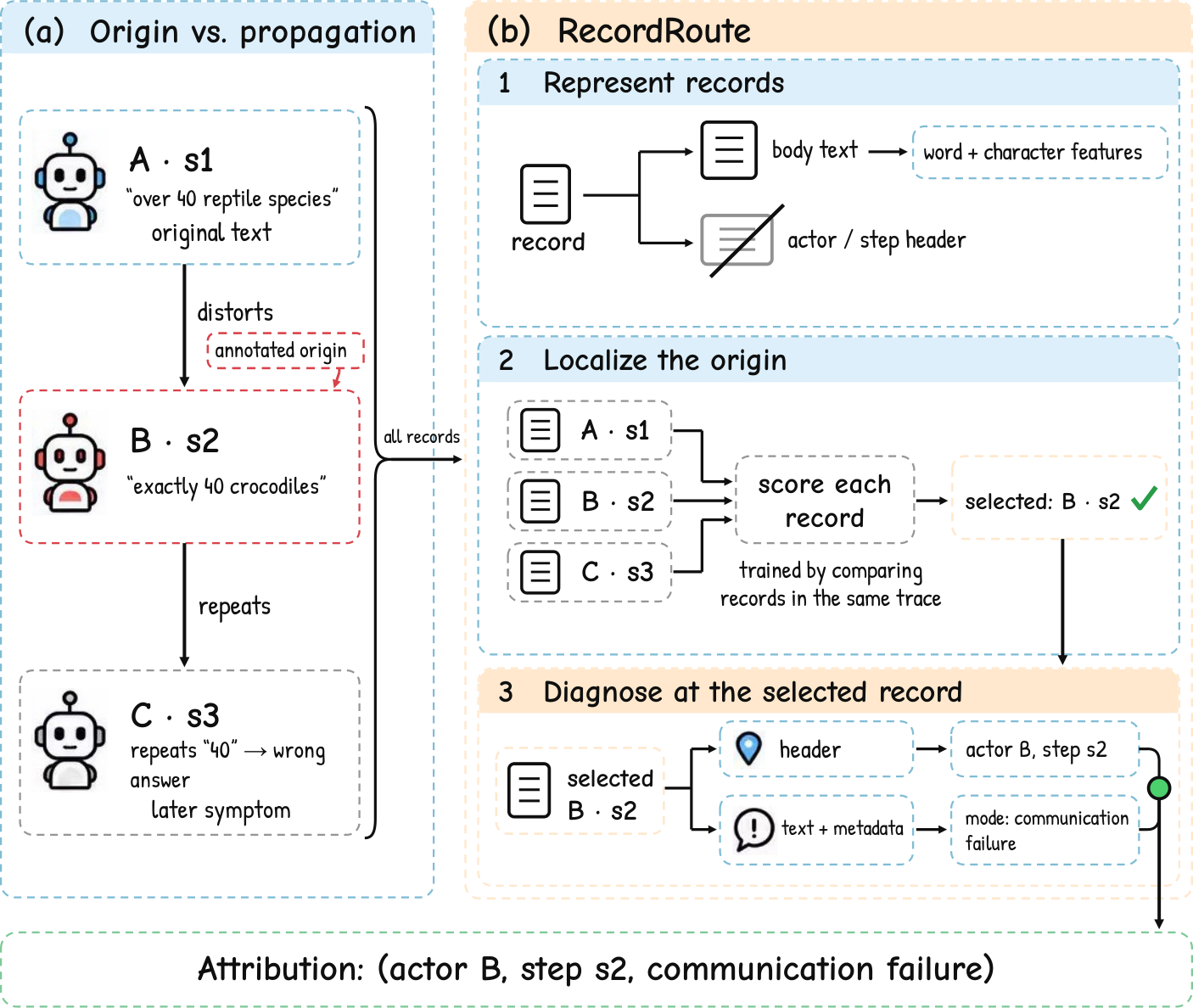
The ranker picks a step in the propagation chain before the classifier reads its evidence.
ShellBench measures how everyday tasks respond to model and harness choices
ShellBench: What Matters More for AI Agents, Models, or Harness for Everyday Tasks
Vincent Koc, Aditya Washikar, Rishab Naveen Venkataraman, Onur Solmaz, Zhentong Fan, Xinyang Han, Toby Vincent John, Hao Li, Achyut Mukund, Biresh Chandra Biswas, Eshan Shukla, Louis Pan, Ivan Kudryavtsev, Patthigulla Sai Surendra, Krish Oberoi, Ayaan Zaidi, Hema Veeradhi, Taylor Agarwal, Erik Erlandson, Agustin Rivera, Jacob Tomlinson, Louka Ewington-Pitsos · arXiv v1 · 2026-11-24
A workspace may contain conflicting files, making the source of an answer part of task success. ShellBench crosses 100 everyday tasks with 12 models and five existing harnesses, varying reasoning effort. Model means ranged from 18.8% to 62.5% and harness means from 42.9% to 45.2%. Averages hide sensitivity to the rubric. Removing source and stale-information criteria moved Codex from fourth to first among harnesses. Ninety tasks used a model judge, with human review on sampled criteria. For assistants expected to leave traceable evidence, that scoring choice can materially change a deployment comparison.
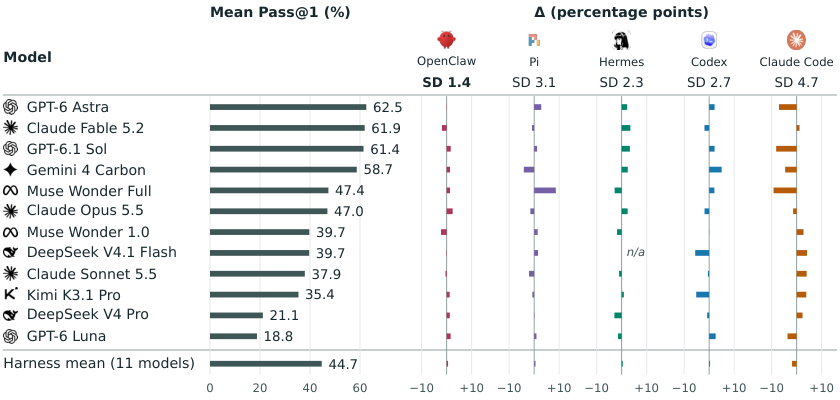
Model means are on the left, deviations for individual harnesses on the right.
Delegent delegates checkable work to a smaller model
Delegent: A Multi-Agent Harness That Reduces Cost without Sacrificing Performance
Lingwei Gu, Jimmy Lin · arXiv v1 · 2026-11-24
Coding agents can spend much of their budget reading and testing. Delegent keeps planning and main edits with a frontier model and assigns searches, file reads and test runs to local subagents. On search tasks the harness also checks returned quotations against their sources. With a 27B FP8 subagent, frontier spend fell to about a third on DeepSWE and to about 41% on agentic search while maintaining task performance in the tested samples. An instruction ablation shows the importance of specifying what the lead should retain. These percentages cover frontier charges. Local hardware, execution and caching affect the deployment’s total cost.
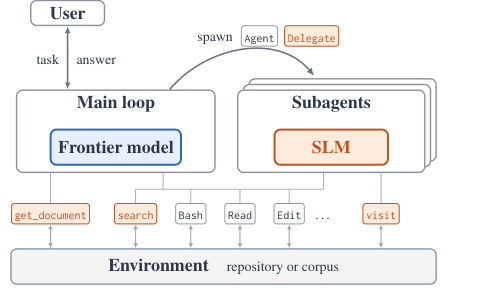
The lead loop keeps key decisions and delegates work whose results it can inspect.
AGL-SKILL lets a coding agent revise another agent's workflow
AGL-SKILL: Coding Harnesses as Agentic Optimizers
Ryan Tsui, Yuge Zhang, Yuqing Yang · arXiv v1 · 2026-11-24
The optimizer’s editing permissions matter in a skill-optimization comparison. AGL-SKILL gives a coding agent training examples, a dollar budget and an editable target. It can change prompts, tools and code and decide when to spend on evaluation. The target is then frozen for held-out scoring. Unguided optimizers surpassed the cited skill-optimization methods on all five benchmarks. Moving from $5 to $25 improved about two thirds of benchmark–harness pairs, by only 0.03 on average. Comparisons with prompt-only optimization should account for this broader editing surface and the cost of running the final target.
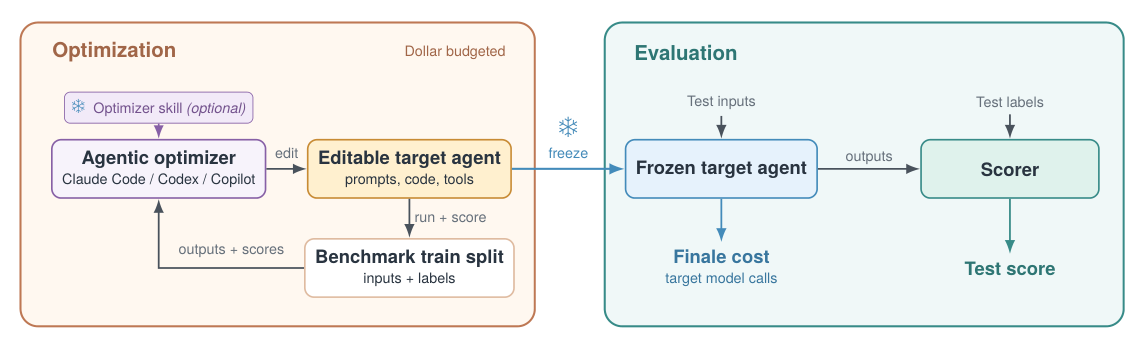
Optimization spends against a budget on the left. The target is frozen before test scoring on the right.
MetaFORGE revises coding instructions using MPI execution feedback
MetaFORGE: A Meta-Learning Framework for Harness Optimization in Automated Code Generation for Parallel Computing
Scott Piersall, Yang Gao, Shenyang Liu, Liqiang Wang · arXiv v1 · 2026-11-24
Improving one parallel program and improving the next generation call require different artifacts. MetaFORGE compiles, checks and executes MPI C candidates, turns runtime and load-balance diagnostics into edits to persistent skill instructions, and retrieves past findings from external storage. The study used four ranks, six tasks, three sizes per task and five trials per size. Dot-product runtime improved 27.00% relative to zero-shot Codex, compared with 14.84% for TextGrad. Across complete runs, token use was lower in only eight of 18 workload comparisons. The evidence supports feedback on specific parallel patterns, with transfer across process counts still open.
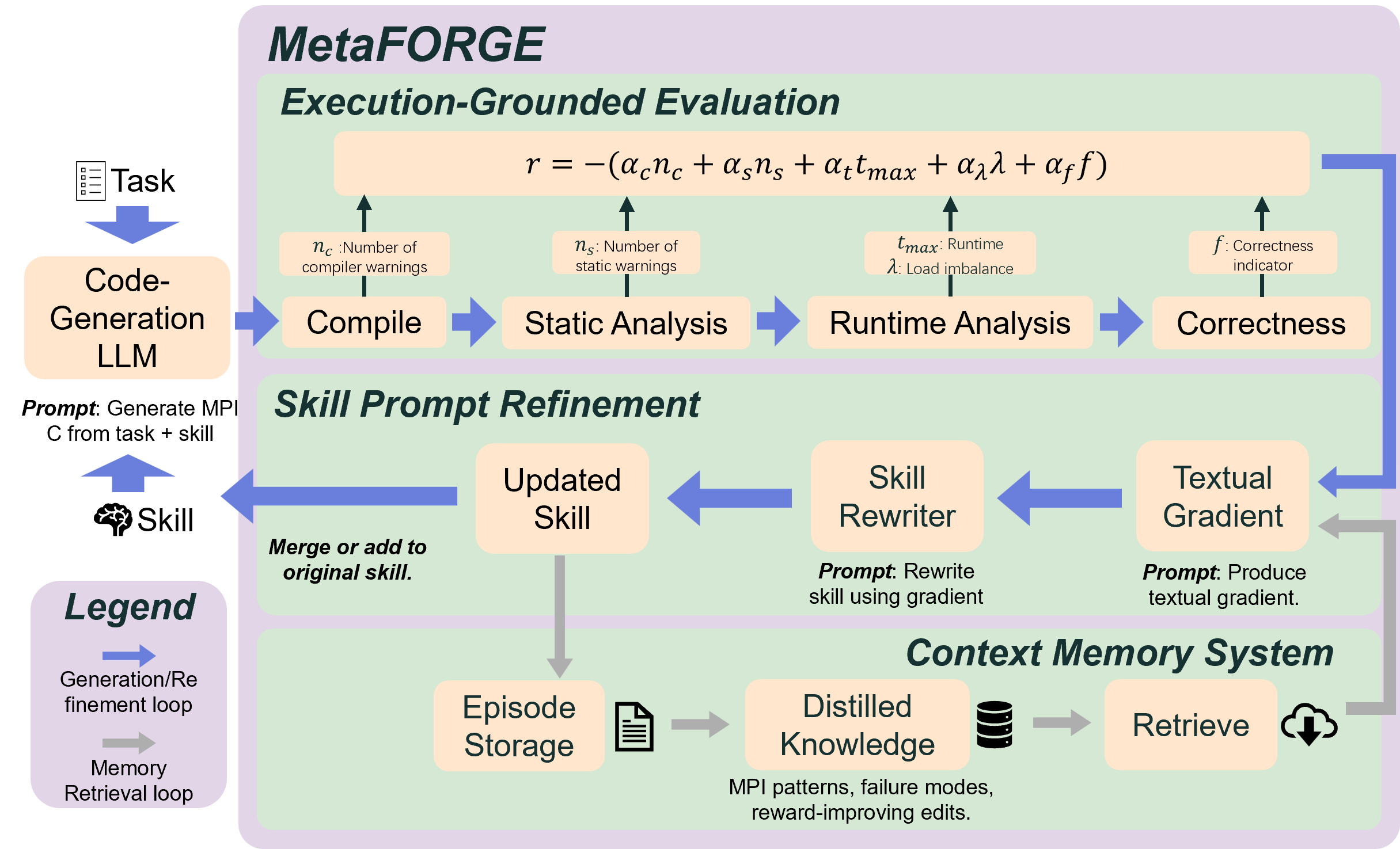
Compilation and execution feed diagnostics into both skill revision and memory for later runs.
How a one-time permission decision can affect future tool policy
When Answering Is Administering: Permission Replies That Rewrite Coding-Agent Policy
Zeming Fei, Hongming Fei, Jingwen Chen, Xiaoyang Wang, Prosanta Gope, Biplab Sikdar, Ying Zhang · arXiv v1 · 2026-11-24
A prompt asking whether an agent may take one action raises two operational questions. Who can approve this call, and who can change the policy for later calls? The authors examine thirteen permission designs, comparing authority to update rules, precedence when rules conflict and whether rule authorship is retained. They formulate preservation of operator restrictions as a checkable property of delegation. Recording authorship allows a system to recognize when a delegate is withdrawing its own restriction. The validation combines implementation analysis and runtime evidence across designs. For AgentOps, the practical distinction is that a persistent policy change deserves its own audit event.
Inference scheduling and execution
ModelLess accounts for the time a shared GPU can lend
ModelLess: A Serverless System for Multi-Tier LLM Inference on Shared GPUs
Ding Shi, Wei Wu, Jiayuan Chen, Chenghu Yang · arXiv v1 · 2026-11-24
An idle GPU can have too little time before the owner returns to do useful work for a borrower. ModelLess reclaims capacity per model instance, distinguishing uninterrupted online requests, flex requests that can return to a durable queue and job requests that can resume by recomputing their generated prefix. GLM-5.2 at TP8 on H20 woke in 2.9–4.4 seconds against 244–277 seconds for a cold start. A weekly trace replay of 1,100 GPUs gave 37.9% net lendable time with a 60-second idle threshold, five seconds each for recovery and borrower load, a three-second yield and a ten-second minimum useful window. That upper bound assumes demand and omits card-group fragmentation. The job tier and follow/seal protocol lack end-to-end evaluation.
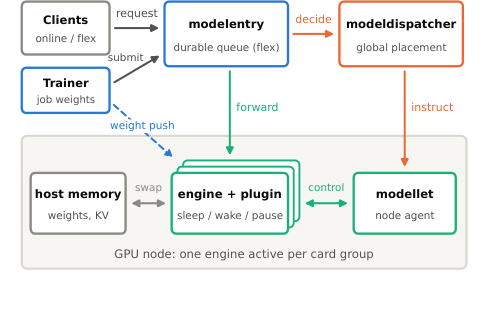
A node manager controls engine residency while the dispatcher places requests.
RePrism schedules a request together with its prompt representation
RePrism: Joint Request and Representation Scheduling for LLM Agent Serving
Xijiang Shen, Aoli Zhu, Yanbo Tan, Xiyuan Hu, Huailiang Tan · arXiv v1 · 2026-11-24
A fixed prompt can be prefilled and retained as KV or distilled ahead of time into a LoRA adapter. Future workflow reuse affects which representation pays off now. RePrism first qualifies adapters on held-out inputs, then scores ready request–representation pairs using workflow dependencies and coordinates admission and eviction. On a 24 GB RTX 3090 serving Llama-2-7B-Chat at 1.8 arriving sessions per second, request throughput was 1.37 times S-LoRA’s and P95 session completion time fell by a factor of 4.10. Adapter qualification measures behavior on a test distribution. Arbitrary prompts cannot be assumed interchangeable with adapters.
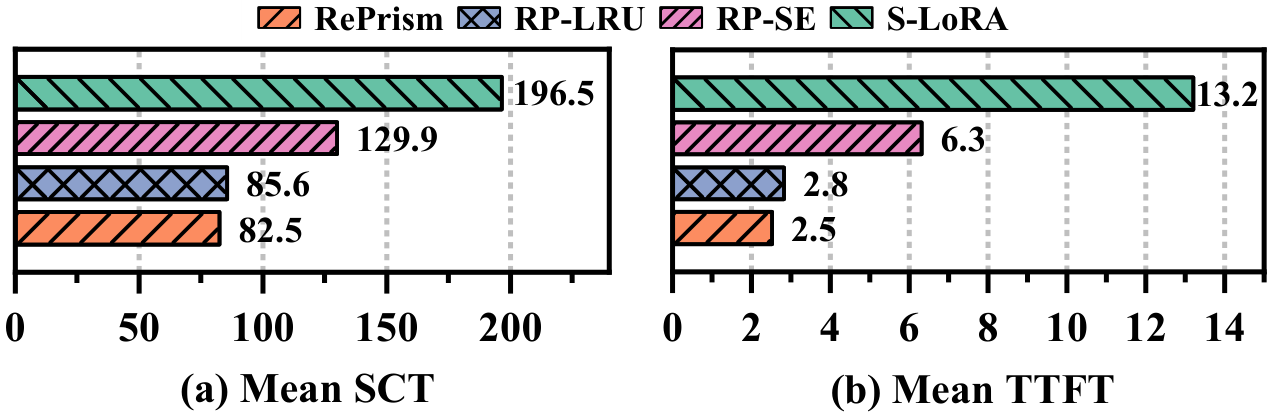
The two panels show how eviction choices affect session completion and time to first token.
RankServe values expert residency by time saved per byte
RankServe: Rank-Aware CPU-GPU Scheduling for Memory-Constrained MoE Serving
Hengyi Zhu, Zhendong Mi, Pu Zhao, Yanzhi Wang, Hao Wang, Shaoyi Huang · arXiv v1 · 2026-11-24
Low-rank compression gives experts unequal memory footprints. Even a popular expert may be cheap to execute on the CPU. RankServe values residency against the faster miss path, either CPU execution or a temporary transfer to the GPU. Recent routing demand and expert size turn that saving into a priority per byte. On three models and five batch sizes from 1 to 32, per-model geometric-mean speedups over the fastest baseline for each setting ranged from 1.69–2.29 for first-token latency and 1.71–2.48 for time per output token. Baselines use different weight representations, so the end-to-end comparison includes compression as well as scheduling.
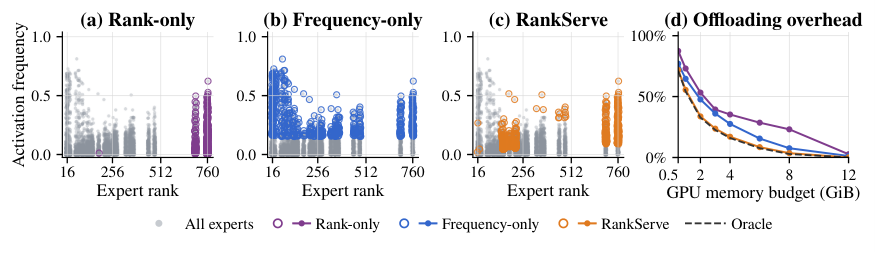
The first three panels show which experts stay resident. The last compares residual offload overhead.
Mayfly distinguishes parked sessions from ready ones
Mayfly: Lifecycle-Aware High-Bandwidth Flash for Recursive Self-Improvement
Chunlin Tian, Mingjia Fan, Feng Yu, Qingyun Zou, Wenju Zhao, Weng-Fai Wong, Bingsheng He · arXiv v1 · 2026-11-24
Parking KV during a tool call needs capacity. Decoding once a session becomes ready also needs sustained bandwidth. Mayfly keeps a valid copy of overflowed KV on high-bandwidth flash, permits bounded in-place attention reads, migrates state back as HBM becomes free and discards obsolete KV at announced session ends. Traces from three self-improvement workflows drive the simulation. With 128 sessions on a modeled H200, completion took 34% less time than simply parking on HBF. The traces ground arrival and reuse patterns, while flash behavior and throughput gains depend on the hardware model.
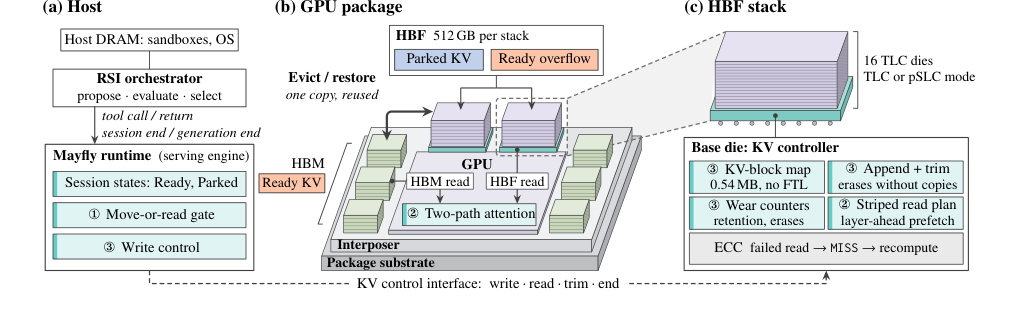
The host, GPU and flash controller use session, attention-access and reclamation information at different stages.
Wavefront refines a draft block in a fixed number of passes
Wavefront: Low-Rank Drafting with Parallel Causal Refinement for Speculative Decoding
Huy Huu Nguyen, Xin Huang · arXiv v1 · 2026-11-23
Parallel drafting saves time but can produce later tokens inconsistent with earlier choices. Observing that DSpark’s correction head often overrides the full-rank seed, Wavefront uses a low-rank seed and lets each slot read the entire preceding draft prefix from the previous pass. A fixed Jacobi pass count permits capture in one CUDA graph. On greedy Qwen3-8B at concurrency one, average throughput exceeded DFlash by 23.6% and the closer xPress baseline by 2.6%. The appendix separately tests concurrency up to 32. Both the comparison system and the serving load matter when interpreting the margin.
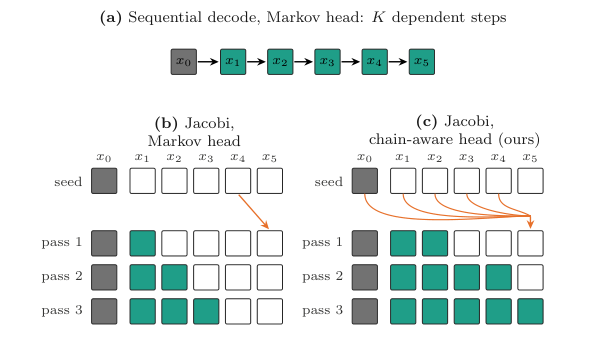
Each row is a pass. Whole-prefix access lets multiple slots settle in the same pass.
LEGOSpec isolates draft components under matched training
LEGOSpec: A Composable and Efficient Framework for Speculative Draft Design and Training
Hanzhen Wang, Jiaming Xu, Guohao Dai · arXiv v1 · 2026-11-24
Different acceptance lengths may reflect different training data or optimizers. LEGOSpec swaps context features, backbone, proposal and objective within a common training pipeline. Those controlled comparisons motivate DFlux’s hybrid attention backbone, convolution, residual correction and hierarchical supervision. Training used 1.4 million samples for six epochs on 16 H800s. Across Qwen and Gemma experiments, acceptance length improved over the strongest comparison by up to 13.7% on regular workloads and 34.7% on long contexts. This complements Wavefront’s throughput results. The extra tokens committed per verification still have to offset the latency of proposing them.
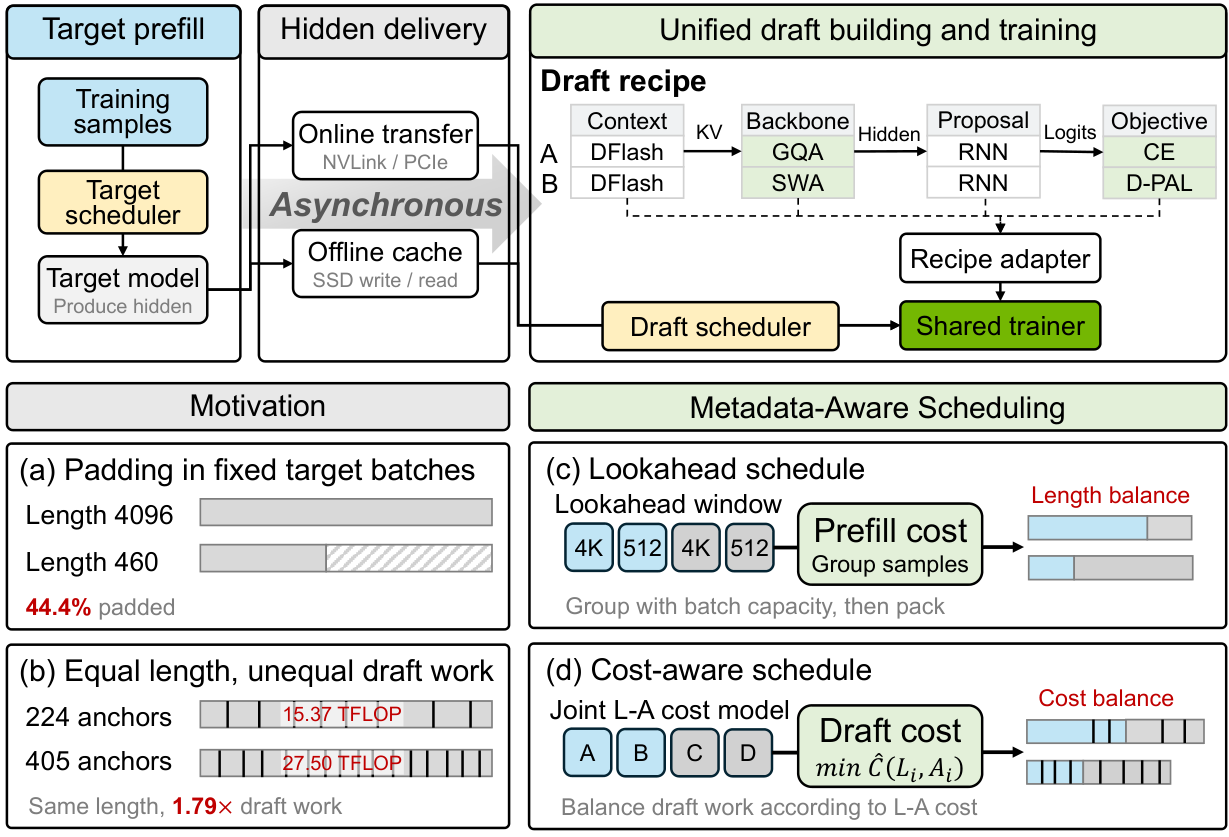
The upper pipeline unifies draft training. The lower panels distribute batches by expected work.
BRAID-MoE moves routing earlier to overlap cross-device transfers
Breaking Routing And Inter-device Dependencies in Mixture-of-Experts
John Zarka, Danyal Ahmed, Eugene Belilovsky, Edouard Oyallon · arXiv v1 · 2026-11-24
Expert parallelism dispatches tokens and combines expert outputs. If the next router waits for that combine, a faster communication library still leaves a serial dependency. BRAID-MoE pairs laddered residual paths with early routing so that adjacent combine and dispatch operations run back to back while experts consume fresh activations. A two-stream implementation overlaps transfers with attention. On converted Qwen3-30B-A3B across two nodes at EP8, peak speedups reached 1.29 times for prefill and 1.37 times for decode across workloads. Changing model dependencies and recovering quality introduce deployment costs beyond a communication-kernel swap.
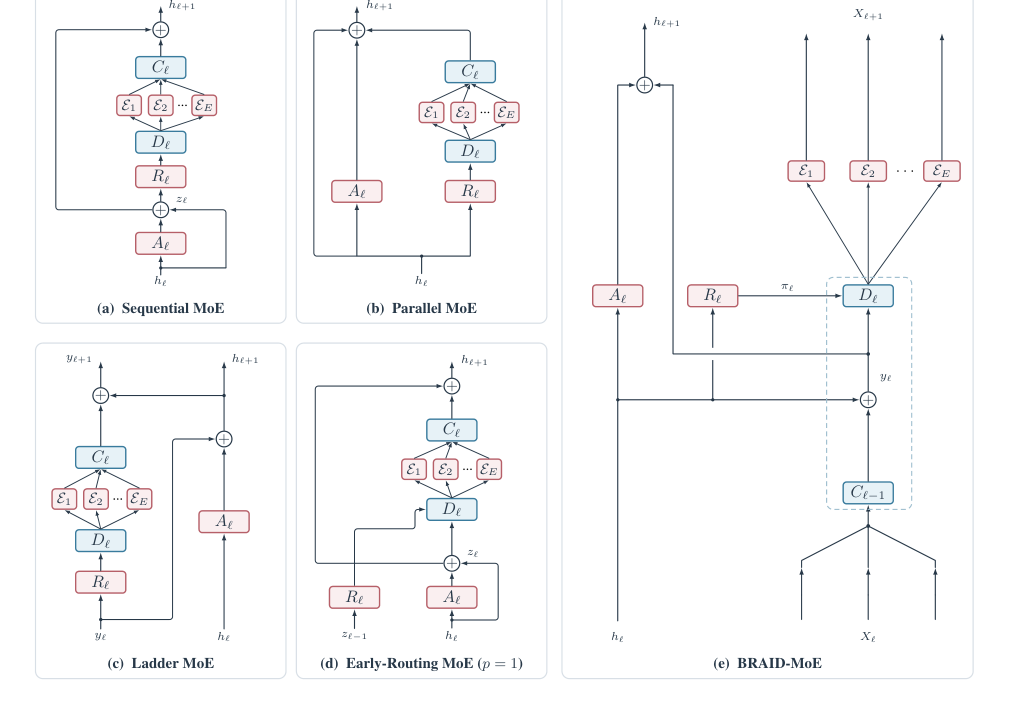
The alternative connections change when routing can start and which work can run independently.
IACC uses collective and consumer progress to allocate bandwidth
Inference-Aware Congestion Control for Distributed MoE Inference
Weiye Chen, Qi Xin, Ahmed M. Abdelmoniem · arXiv v1 · 2026-11-24
A GPU waiting on a collective may stay idle after an individual flow finishes. IACC groups related flows by collective operation, uses the consuming computation’s progress to guide allocation, then divides bandwidth within a group. In SimAI packet-level ns-3 simulations, 12 prefill GPUs and four decode GPUs share four leaf switches, putting expert traffic and KV transfers in contention. Against HPCC on five trace-guided workloads, mean first-token latency fell 6.32%–19.41% and mean time per output token fell 7.02%–27.33%. Within-group weighting was sensitive to skew, and less local waiting did not always translate into better overall latency.
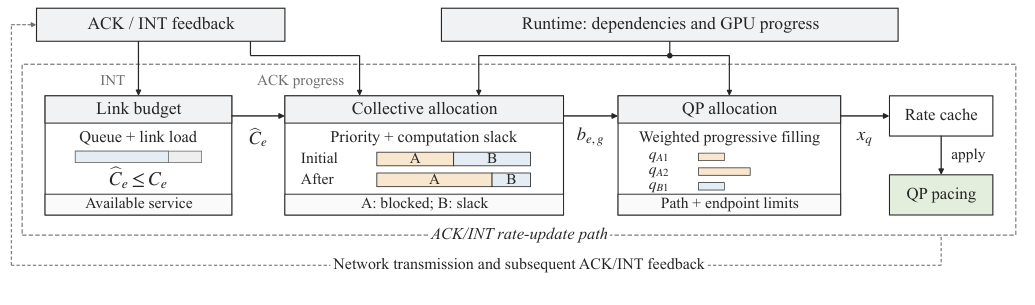
Inference-side progress reaches the network controller and informs collective-level allocations.
Joule prices data movement under a GPU power cap
Joule is FLOP: Optimizing Tensor-Core Kernels Beyond Latency Hiding at the GPU Power Wall
Taowen Liu, Zhiwen Mo, Hongxiang Fan, Aaron Zhao · arXiv v1 · 2026-11-24
Can eliminating a transfer help after its latency has been hidden? Under a power cap, movement competes with arithmetic for energy, so saving transfers can sustain a higher clock. Joule calibrates energy costs along hardware paths and their relationship to frequency, then uses the model to choose tiles and schedules. Across 60 dense shapes from five Qwen3 models, B200 at 1,000 W beat exhaustively selected cuBLAS by a geometric mean of 4.94%. Fused Mega-MoE on eight B200s gained 2.60%–5.17% over the upstream kernel. The mechanism has less room below the cap or near the minimum required movement.
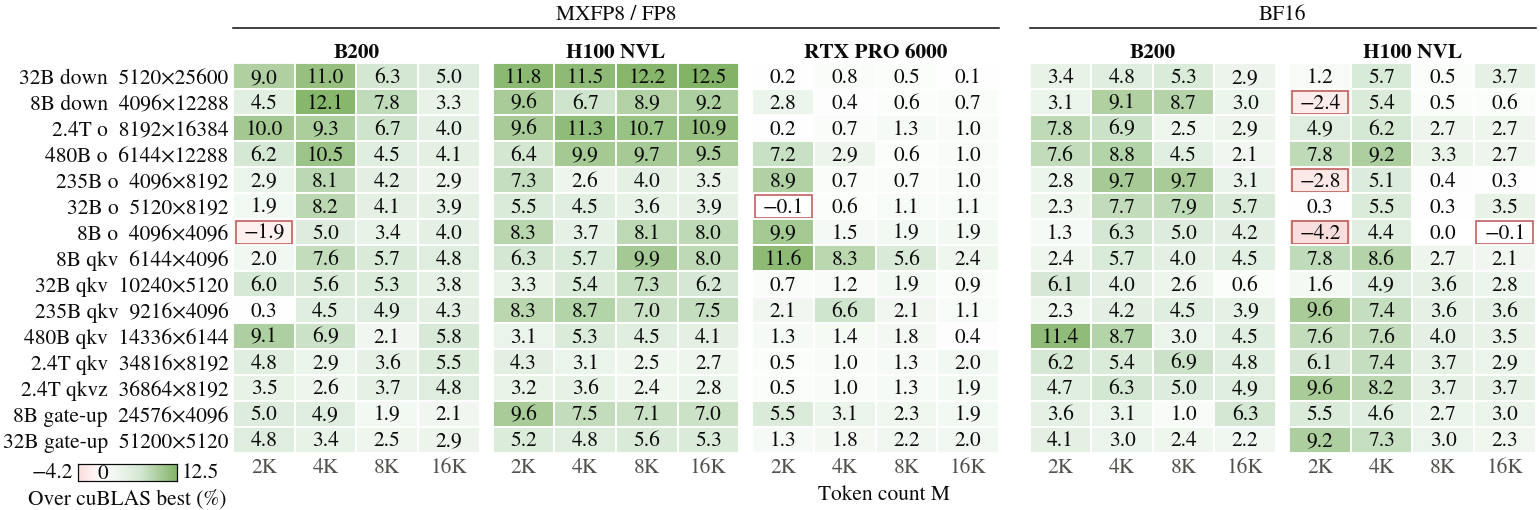
The heatmaps resolve gains by shape against an exhaustive baseline, showing variation within each device.
Shifter Quantization lets integer products span quantization groups
Shifter Quantization: Compact Representations for Native Integer Computation
Yufeng Huang · arXiv v1 · 2026-11-24
Groupwise scaling can interrupt an integer accumulation across the full dot product. SQ reconstructs integer operands in registers by shifting and appending shared bits. SHI adds a four-bit main product and shorter correction products. The paper includes a useful counterexample. At concurrency eight on Qwen3.8-27B, SQ4 raised steady MTP3 throughput from 582.4 to 765.5 tokens/s over groupwise INT, while SHI4 at 809.5 trailed native NVFP4 at 922.4. These windows count complete seconds with every sequence ready for decode and no prefill. The native format available on the deployment and the measured phase determine the benefit.
GreenDynaMix offsets thermal throttling through precision selection
GreenDynaMix: Thermal-Aware Dynamic Mixed-Precision MoE LLM Inference Systems
Han-Yi Lin, Kieran Griperay, Qiang Zhou, Xiangyu Zhou, Nate Bonacci, Zinachidi Achikeh, Li He, Shaofei Qi, Hongqiang Wang, Jeff Zhang, Tianlong Chen, Pi-Cheng Hsiu, Jingtong Hu · arXiv v1 · 2026-11-24
Sustained generation heats a GPU from idle to a plateau. GreenDynaMix controls frequency and expert precision together, lowering clocks to manage heat and assigning lower precision to selected experts to recover throughput. In single-session llama-cli thermal traces, peak temperatures on L40S, RTX 4090 and Orin NX fell from 47, 65 and 75°C to 42, 56 and 67°C. Throughput moved from 251, 287 and 21 to 245, 289 and 20 tokens/s respectively. Applying an Arrhenius model to the temperature traces gave aging-rate reductions of 29%, 25% and 33%. Long-term failure rates and multi-request service quality require separate measurements.
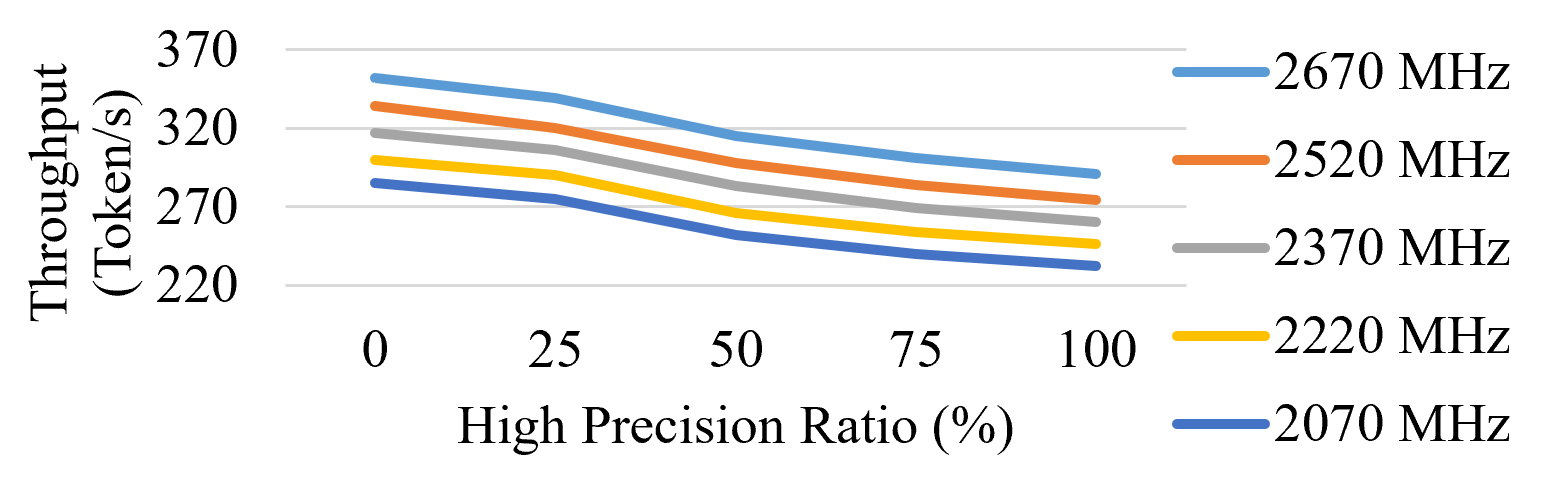
Throughput curves at different clocks show the controller’s options as the high-precision share varies.
SPADE prunes device groups that cannot improve placement
Scalable Placement for Disaggregated LLM Serving on Heterogeneous Edge Fleets
Truong-Thanh Le, Hoang-Loc La, Amir Taherkordi, Frank Eliassen, Phuong Hoai Ha · arXiv v1 · 2026-11-24
An edge planner must group devices into replicas, assign prefill or decode roles and split layers among unequal machines. SPADE detects dominated replica candidates and removes redundant extensions, then combines water-filling layer partitioning with bounded multidimensional knapsack optimization of a congestion objective. Eight physical devices ground the deployment study. In a separate synthetic fleet of 30 devices across five hardware types, the planner found the optimum in 441 milliseconds. A roughly two-hour genetic search still yielded a 19.7% worse objective. The 441 milliseconds measures planning time, distinct from request latency.
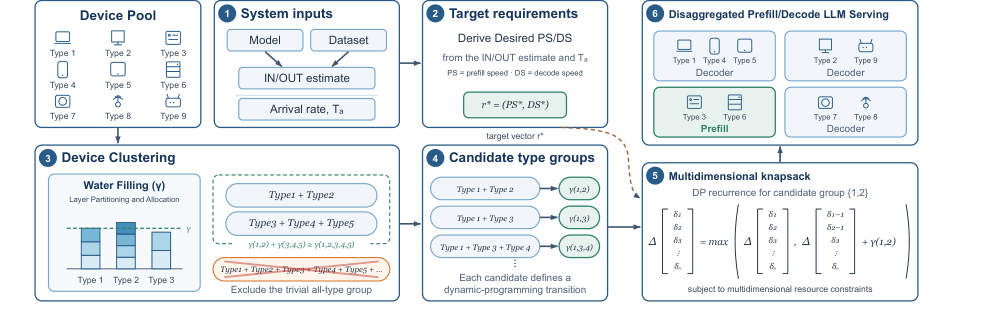
Pruning narrows the candidate space before joint placement selects replicas.