AI-assisted close reading. Experimental results are author-reported; code inspection and analysis are identified separately. No paper benchmark was run.
Sentry detects local failures during a task, supplies targeted recovery guidance, and accumulates lessons from verified recoveries. It is relevant to agent reliability, but does not directly repair runtime code.
Paper: Sentry: Learning to Recover from LLM Agent Failures at Test Time. Changxiu Ji, Amy Lu, Qizheng Zhang, and Kunle Olukotun. Version reviewed: arXiv 2610.02994v1.
Why can useful failure knowledge become harmful?
The authors observe that advice useful during a failure can distract an agent when it remains in the context during normal execution. A different family of monitors intervenes on failure without accumulating recovery knowledge.
Sentry combines these properties: keep the playbook external, then retrieve a small set of lessons after detecting a matching failure.
| Mechanism | When does recovery knowledge appear? |
|---|---|
| Persistent guidance | Throughout execution |
| Fixed monitor | When its intervention rule fires |
| Sentry | After a matching diagnosis; verified recoveries update the playbook |
These rows describe the mechanisms discussed by the authors, not every possible memory system.
The contribution to examine is when recovery knowledge is exposed and how new lessons are admitted, beyond adding another reflection prompt.
Source: author explanation.
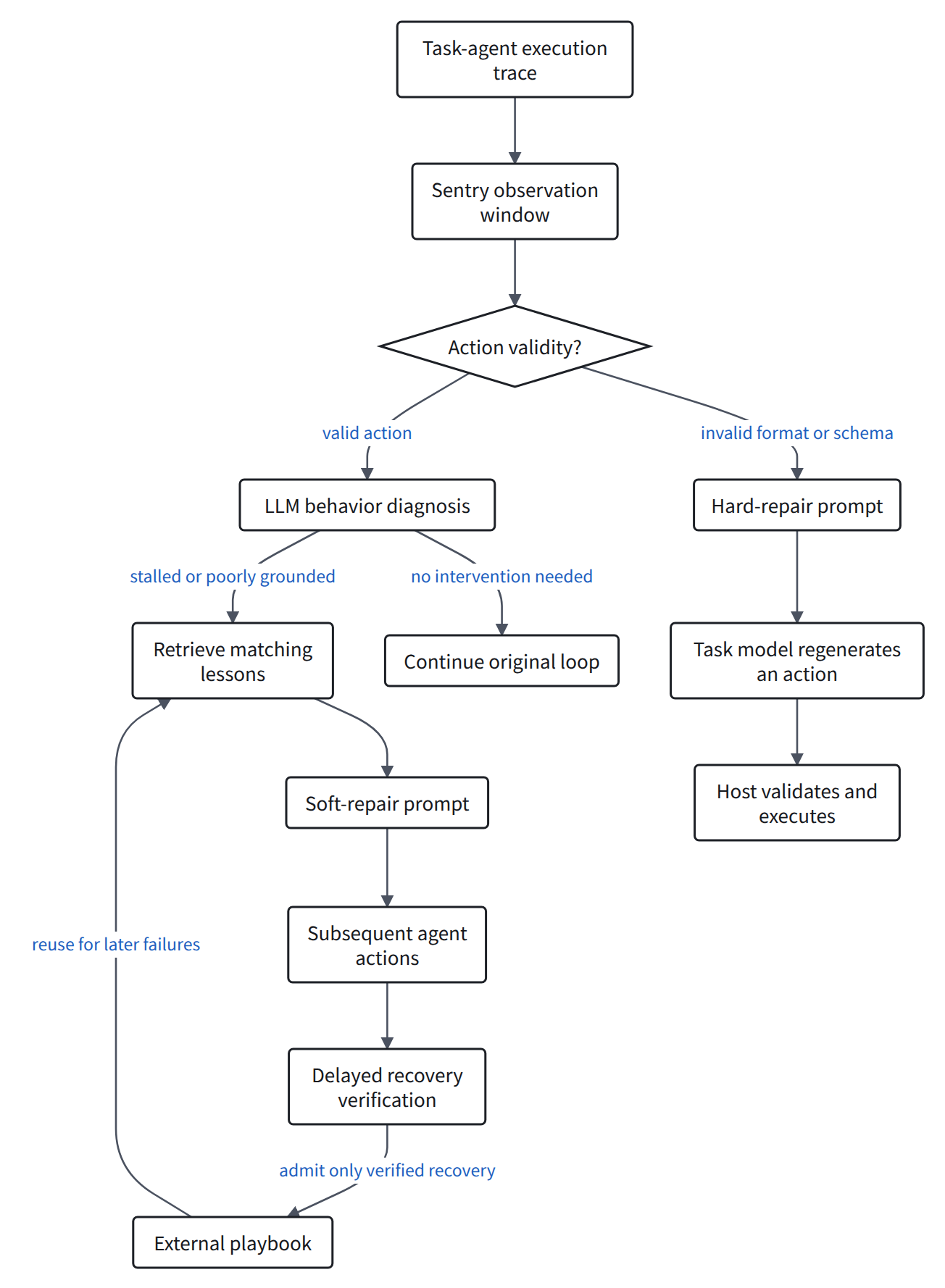
How do the two recovery routes enter the agent loop?
 Enlarge diagram ↗
The default detector reads five recent reasoning–action–observation cycles. Soft repair retrieves at most five lessons and checks recovery after ten subsequent cycles.
Hard repair requests a valid action; it is not a code patch. An environment error alone does not establish a malformed action.
The implementation first checks parsed_ok and schema_valid, supplied by the host. A model then diagnoses behavioral failures such as repetition, stalls, or unsupported reasoning.
Sources: detector, paper configuration.
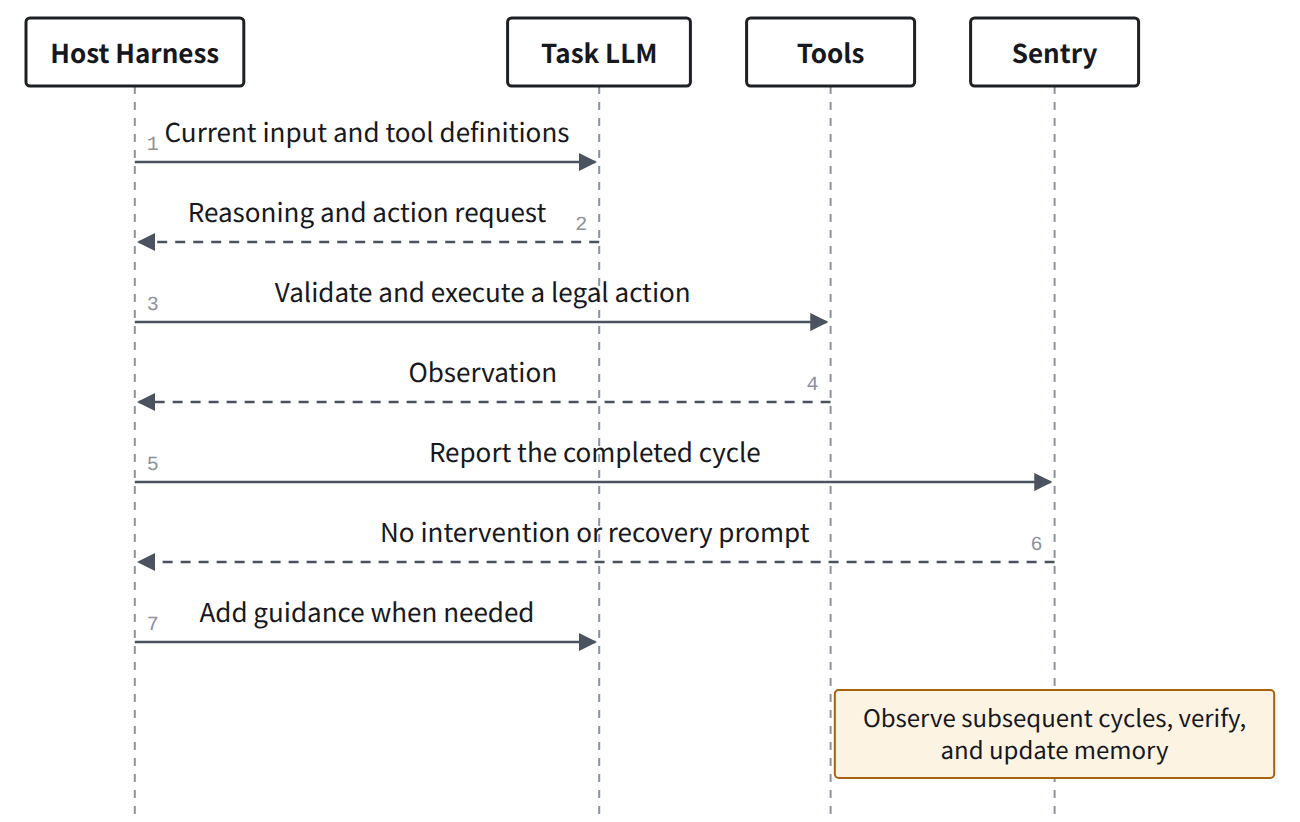
What changes, and what remains the host's responsibility?
 Enlarge diagram ↗
This shows integration for an executable action. The host reports invalid actions for the separate repair route.
| Object | Does the method directly update it? |
|---|---|
| Next model input | Yes: recovery guidance is added |
| Recovery playbook | Yes: verified soft recoveries add entries |
| Task-model weights | No training step is part of the method |
| Harness scheduling and process code | Sentry does not automatically generate patches |
The host receives guidance from runner.step() and decides how to insert it into the conversation. It still generates, validates, and executes actions.
Runtime intervention therefore does not imply modification of the runtime implementation.
Sources: integration interface, official repository.
What counts as a verified recovery?
| Route | Verification criterion | Added to the playbook? |
|---|---|---|
| Hard repair | The replacement conforms to the schema and is explicitly accepted by the environment | No |
| Soft repair | The triggering pattern stops and grounded, task-relevant progress resumes | Only if judged recovered |
The soft verifier cannot access final task rewards. Its judgment is model-based and needs an independent audit.
The public implementation has three important boundaries:
- If the task ends before ten subsequent cycles, the incomplete recovery does not update the playbook.
- While soft verification is pending, another soft intervention is suppressed; action-validity repair remains available.
- Verifier or updater exceptions are logged and re-raised. The host must handle this failure path.
Playbook growth does not establish that the detector improves. Detection and retrieval procedures remain fixed.
Sources: runtime state and admission, verifier.
How far does the experimental evidence go?
The default model is Qwen3.5-9B. These are author-reported results, not experiments reproduced for this review.
| Evidence | Reported result | Interpretation |
|---|---|---|
| SWE-bench Lite | Best runtime-intervention baseline: 0.24; Sentry: 0.30 | A six-percentage-point gain on 50 tasks |
| Paired recovery experiment | 200 checkpoints: 33.5% to 60.5% | A 27-point gain in locally judged recovery from the same initial state |
| Final outcomes of paired branches | 74 better, 101 tied, 25 worse | Interventions help some cases and harm others |
| Aggregate resources | 1.54 times the base agent’s tokens | The gains have an additional resource cost |
The study also evaluates WebShop, AppWorld, and Mind2Web Replay. AppWorld measures average check pass rate, not full-task success. Replay is a controlled adaptation, not the original Mind2Web metric.
The headline 37% average improvement aggregates relative gains across metrics. It is not a uniform 37-percentage-point success-rate increase.
Across 99 soft-repair windows in the human audit, recovery judgments agree with annotations in 81.8% of cases. This supports usefulness without making the verifier an infallible oracle.
Source: paper and appendices.
What does this mean for runtime stability?
The following is analysis of the method and interface, not additional experimental evidence.
| Situation | Relationship to Sentry |
|---|---|
| Invalid action format | Directly addressed by hard repair |
| Repeated actions without progress | Addressed by behavioral diagnosis and guidance |
| Agent ignores available evidence | Local guidance may help; effectiveness needs testing |
| Scheduler hangs and cannot report steps | A prompt-based intervention is not guaranteed to run |
| Tool executes but its result is lost | The host must provide trustworthy state; guidance cannot automatically recover the missing result |
| Restart causes duplicate side effects | Durable recovery and idempotence are not established by this method |
| Sentry’s own model endpoint fails | The host must choose degradation, suspension, or termination |
Sentry depends on working observation and control paths. Behavioral stalling must be distinguished from a runtime that cannot advance.
A useful experiment would first measure recovery on intact traces, then disrupt result delivery or call/result pairing. Does Sentry recover, misdiagnose, or admit misleading lessons?
Overlap with our research and remaining questions
Detection, intervention selection, recovery verification, and experience accumulation are direct prior-work overlap. That chain alone is not a new contribution.
| Research question | What Sentry provides | Additional evidence needed |
|---|---|---|
| When should the system intervene? | Conditional detection and guidance | Actual trigger points and delays across harnesses |
| How does experience enter the LLM? | External memory with failure-triggered retrieval | How guidance persists through compaction and replay |
| Where did the failure originate? | Behavioral categories and local evidence | Controlled interventions separating model, information-transfer, and runtime faults |
| When is a runtime change needed? | Recovery mainly through guidance | Comparison of extension control limits and core repairs |
| Does improvement remain stable? | Cross-task lesson accumulation | Misverification, conflicting entries, and failures of the recovery mechanism itself |
Compared with HarnessFix, Sentry mainly updates recovery guidance and memory; HarnessFix generates implementation patches. Both require separating local improvement, final task outcomes, and elimination of the original defect.
Sentry is direct related work and a candidate baseline for behavioral recovery. Its effectiveness under runtime faults should be measured, not assumed absent.
Code reviewed at 1d91bca14fa6a4e17908856cc787eb8e8354395f. The review covers methods, experiments, relevant appendices, and core integration, detection, verification, and admission code. No benchmark was installed or executed.