New hardware requires version and ownership constraints
NVIDIA’s Vera Rubin NVL72 report captures drivers, runtime, IMEX, networking and scheduling in AICR recipes. The tested host supplies R615.23; GPU Operator leaves driver installation disabled while managing the toolkit. Whole-GPU allocation remains on the device plugin, while DRA ComputeDomains manage cross-node IMEX. These are different responsibilities.
The recipe also records Ubuntu 26.04, an arm64 64K-page kernel and RKE2 requirements, and raises the NFD topology updater memory budget for multi-terabyte workers. Host-static IMEX and DRA-managed IMEX cannot own the node simultaneously. Explicit ownership explains failures better than a component version list alone.
Three validation phases establish different facts
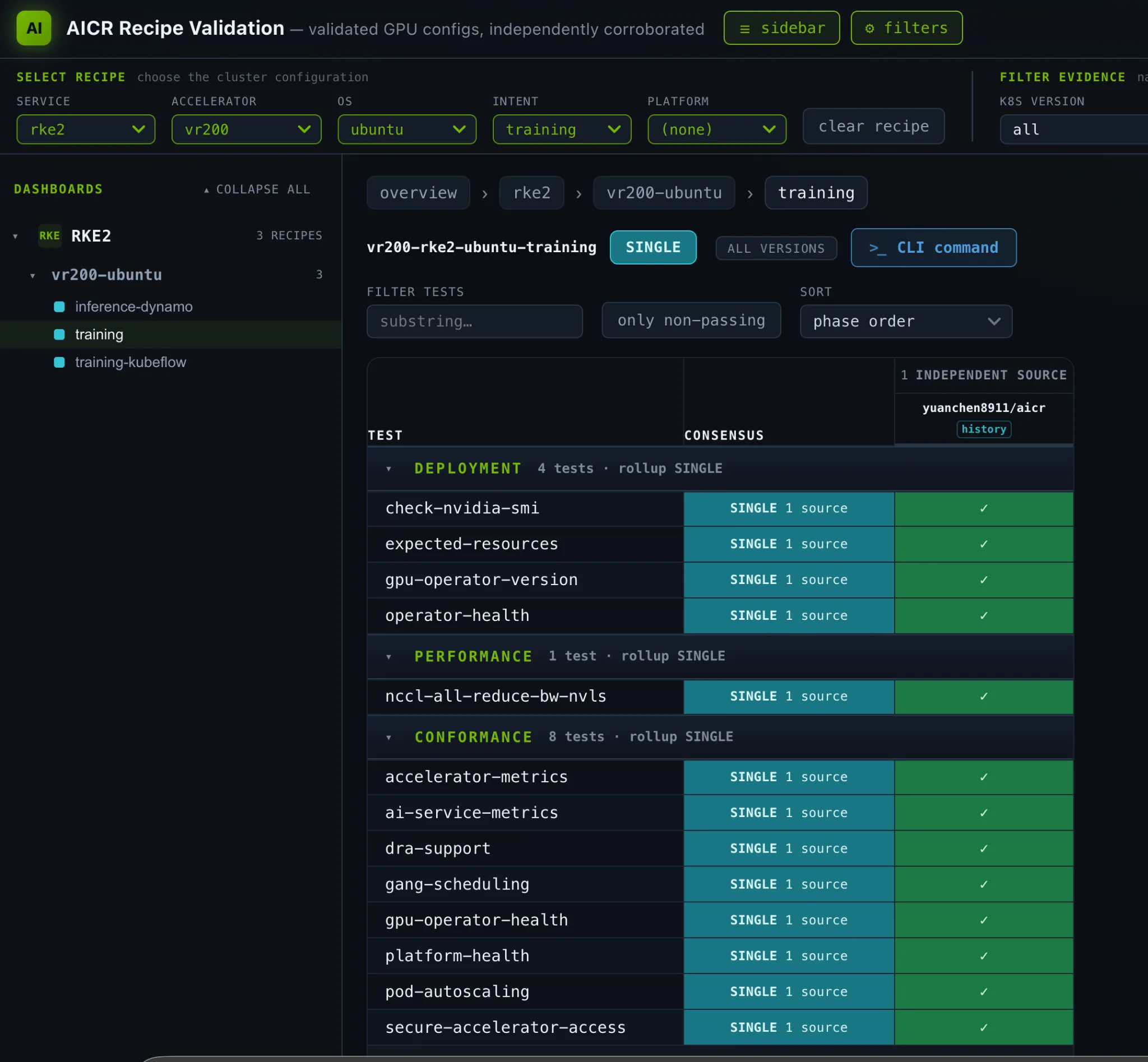
The Rubin training recipe records deployment, performance and conformance checks separately; passing checks apply to the displayed tests.
Deployment checks components, resources and nvidia-smi. Conformance checks access, scheduling and metrics contracts. The training performance gate runs cross-node NCCL all-reduce through an IMEX ComputeDomain over NVLink. Its 744.71 GB/s bus bandwidth at 16 GiB is a specific test result, not model training speed.
Inference deployment and conformance pass while inference performance remains deferred: Rubin dispatch code does not establish that a released image contains kernels built with the required CUDA. MIG and ConnectX-9 RDMA datapath performance are outside scope. Signed evidence belongs to its captured recipe coordinate; it does not automatically attest to later changes in a Preview recipe.
Separate hardware faults from software defects
One initial fabric failure was resolved by reseating hardware and was unrelated to DRA. A separate unmapped Rubin architecture value in go-nvlib did crash-loop the DRA kubelet plugin; the article describes the fix propagating through bindings and shipping in DRA v0.5.0. A changed nvidia-smi banner also broke initial validator parsing, a distinct compatibility issue.
My interpretation is that visible healthy resources, functioning communication and workload performance are different milestones. Pinning a recipe and retaining phase-specific evidence transfers well to platform bring-up; passing Preview checks is not production-support certification. Host/Operator/DRA ownership and actual image build conditions are more informative than version recency alone.
Source: Original engineering article