LMCache Maintainers · 2026-10-15 (Asia/Shanghai) · Official release
LMCache v0.5.6 merits a separate note because a cache’s optimization path also crosses trust boundaries. The release removes pickle from device IPC descriptors, tightens admin HTTP defaults, and changes session and lookup-lock handling. These concern input interpretation, management exposure, and resource lifetime respectively; they should not be treated as one generic security switch.
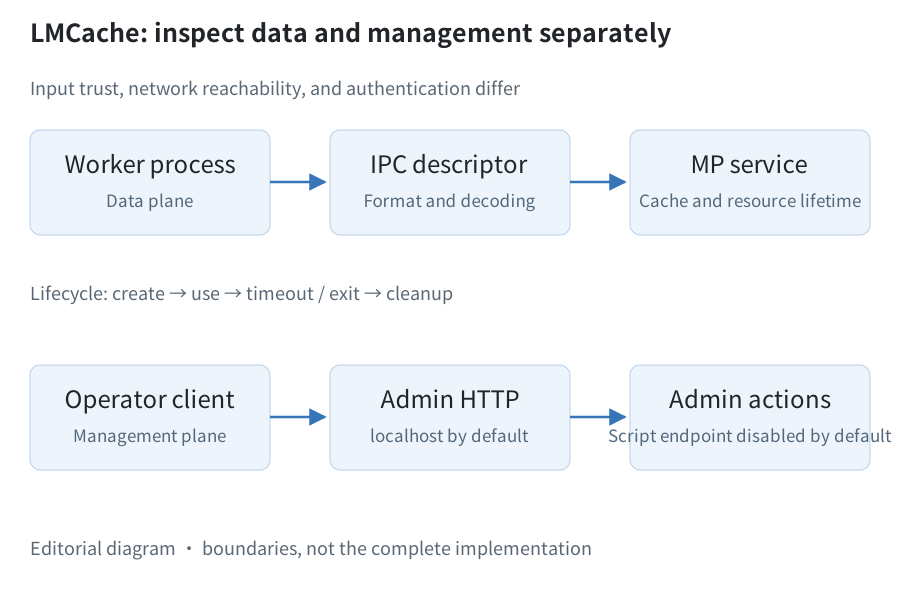
Editorial diagram: separate data, management, and lifecycle checks; this is not the full implementation architecture.
Identify the affected operating mode
The official advisory lists >=0.3.9, <0.5.6 as affected and 0.5.6 as patched. It concerns unsafe deserialization on the multiprocess ZMQ transport. In-process use inside vLLM does not open that port. The transport binds to localhost by default; explicitly configuring a routable address changes reachability.
An inventory of versions is therefore only the starting point. Check the actual process mode, listener addresses, network isolation, and reachable clients. Identical package names do not imply identical exposure, and localhost binding is not authentication.
Inspect data and management paths separately
Device descriptors resemble internal metadata, but crossing process or machine boundaries raises questions about who can submit them, how receivers interpret them, and what happens on failure. A safe serialization format addresses only part of that contract; access control and resource limits remain separate concerns.
Management interfaces introduce another boundary. Diagnostics, script execution, and dynamic configuration may carry greater privilege than ordinary cache requests. A safer default does not establish that an existing deployment template or startup argument has not re-enabled a capability.
A useful acceptance test has two independent paths: legitimate workers complete required cache operations, and untrusted or unauthorized calls are rejected. The first tests availability, the second the boundary. Passing only one leaves the upgrade incompletely assessed.
Test whether resource lifetimes actually close
Sessions, locks, and storage objects have lifecycles. A practical test plan should cover normal completion, client interruption, timeout, reconnection, and repeated cleanup requests. Observe whether resources are released correctly without disrupting other sessions.
Distinguish an error response from restored state consistency. A failed request can leave a lock that later appears as a latency or availability problem. Premature release can damage in-flight operations. Record session identifiers, resource ownership, and cleanup outcomes rather than only HTTP or RPC status codes.
Verify more than a version string
In an isolated environment, fix the client, connector, and service configuration actually used in production. Validate normal reads and writes, abnormal exits, management access, and network policy. Before mixing versions during a rolling transition, establish the project’s supported compatibility range instead of assuming old and new processes interoperate safely.
Afterward, observe session counts, lock waits, failed requests, cache hit rate, and tail latency together. Security changes should not silently break serving paths, while good performance should not obscure a missing boundary.
The broader Ops4LLM lesson is that KV caching is both a performance resource and shared state maintained by multiple processes. Its evaluation must connect data formats, reachability, management privileges, and lifecycle behavior, rather than stopping at hit rate and transfer throughput.