Prepared with AI assistance from the Hao AI Lab technical report (November 10, 2026) and pinned source inspection of
hao-ai-lab/vstack@16a4c03andhao-ai-lab/veriserve@8345c9c. An earlier 2026-11-12 daily Tech Note brief summarized the blog post; this standalone close reading audits the underlying state machines, TLAPS proof premises, trace decoupling, and the 42-bug ledger directly from source. Local TLC, TLAPS, and GB200 benchmarks were not executed.
Once coding agents can write LLM inference schedulers, KV allocators, and custom kernels, the bottleneck moves from raw generation capability to verification. Hao AI Lab tackles this “second half” problem with two tightly coupled artifacts: vstack, an anti-reward-hacking verification workflow for coding agents, and VeriServe, a Prefill-Decode (PD) disaggregated serving prototype built around a formally checked KV-page capability ledger.
A surface reading of the blog highlights two headline numbers—516,973 TLAPS obligations passed and +0.18% mean p50 TPOT overhead on NVIDIA GB200. Cross-checking gates.md, proofs/README.md, trace/README.md, case-studies/README.md, verified-bugs.csv, and the 1,774-line ledger.py reveals a sharper engineering picture: what the proofs actually establish, where hardware assumptions and four-instance topology caps sit, and how carefully the authors fence off model-checking hits from experimental findings.
Problem root: why disaggregated PD serving suffers silent HTTP 200 KV corruption
Modern serving engines have evolved from single-node executors into asynchronous distributed systems that layer paged KV memory, shared prefix caching, and one-sided GPUDirect RDMA over the exact same pool of physical GPU KV pages.
When a request aborts or hits a local deadline, cleanup races simultaneously across NIC DMA queues, CPU prefix trees, and GPU attention kernels. Because one-sided GPUDirect RDMA writes straight into target GPU memory without target-CPU involvement, lifecycle races frequently leave the HTTP path intact: the server returns HTTP 200 OK while silently blending one user’s KV cache into another user’s output. Citing recent LMSYS and Cloudflare production disclosures (including a rejected-request KV handoff defect impacting 155 user responses), the report emphasizes why multi-GPU RDMA timing races routinely slip past single-machine CI.
To bound this subsystem, the authors specify four targets:
| Formal target | Original specification | Close-reading observation: how production engines break it |
|---|---|---|
Isolation |
In-flight RDMA or late control messages from an old request never read/overwrite a new request’s memory or state | Bare integer page_id handles plus local-deadline reclamation allow late DMA writes to hit freshly reassigned pages |
Integrity |
Every KV page read by Decode attention or published to the prefix cache holds complete data from the right generation | Publishing KV pages into shared prefix caches without checking mid-flight generation invalidation poisons later prefix hits |
Finality |
Every active request and draining page reaches a terminal state in finite steps rather than hanging forever | Crucial distinction: VeriServe fails timed-out requests promptly, yet permanent QUARANTINED still does not satisfy page-level reclamation to FREE |
Conservation |
Every physical page stays strictly accounted for: returns to FREE only with stop evidence, otherwise isolated in QUARANTINED |
Unrenewed transfer leases or dropped abort notifications leave Decode waiting indefinitely while leaking KV capacity |
Analysis: The root vulnerability is not merely a forgotten lock in one file—it happens because transport workers, prefix caches, and schedulers maintain separate local counters over bare integers without sharing a single atomic, versioned ownership token.
Source: Hao AI Lab blog post, VeriServe README.
vstack anti-reward-hacking architecture: from 5 conceptual stages to S0–S8 and the 4-part Exposure Gate
Asking a capable coding agent to “model this engine in TLA+ and make TLC/TLAPS pass” invites classic verifier reward-hacking: when the checker flags an interleaving race, naive agents weaken the invariant, delete the timeout path, or insert an unjustified ASSUME to reach zero errors—closely paralleling the failure modes analyzed in Verified but Vacuous.
 Enlarge diagram ↗
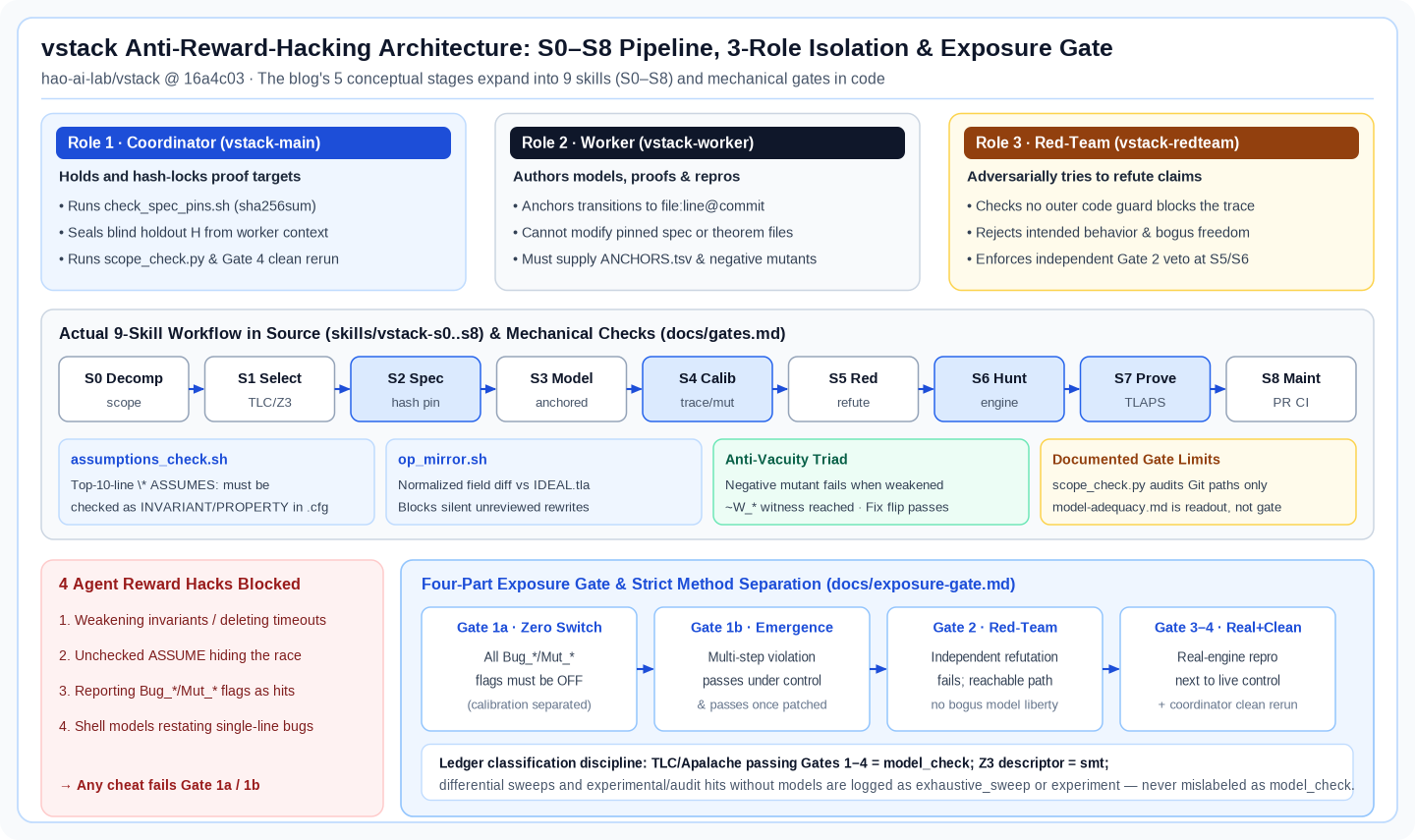
vstack source-level workflow (commit 16a4c03): 3-role separation, the 9 skills (S0–S8), mechanical checks, and the 4-part Exposure Gate. Explanatory diagram from pinned repository docs and scripts.First divergence between blog and repository: While the post outlines five conceptual stages (Specification → Abstraction → Validation → Verification → Continuous Checking), hao-ai-lab/vstack@16a4c03 actually implements 9 skill stages (s0-decompose through s8-package-maintain) across 3 role-isolated agents (vstack-main coordinator, vstack-worker, vstack-redteam).
Inspecting scripts/ and docs/gates.md surfaces four concrete enforcement mechanisms—along with their documented limits:
| Mechanism | Repository implementation | What it stops / documented limit |
|---|---|---|
| Spec hash pinning | check_spec_pins.sh runs sha256sum --check --strict against SPEC_PINS |
Blocks workers from silently rewriting coordinator-locked goals or theorems; cannot detect missing specification coverage on its own |
| Mandatory assumption promotion | assumptions_check.sh enforces \* ASSUMES: headers and verifies every name in .cfg |
Forces every stated model assumption to be checked as an INVARIANT or PROPERTY; lexical format check, not a full semantic TLA+ parser |
| Operator mirror & anti-vacuity | op_mirror.sh normalizes diffs vs. IDEAL.tla; anti-vacuity requires Negative mutants, ~W_* witnesses, and Fix flips |
Rejects unapproved rule rewrites and vacuously satisfied invariants (W_* never reached); op_mirror assumes constrained CASE/record syntax |
| 4-part Exposure Gate | exposure-gate.md: zero Bug_*/Mut_* flags (1a), multi-step emergence with passing control (1b), Red-Team survival (2), real-engine control repro (3), clean coordinator rerun (4) |
Strong epistemic hygiene: only findings clearing Gates 1–4 count as model_check or smt; differential sweeps (exhaustive_sweep) and code audits/repros (experiment) stay strictly separated |
Three candid disclosures inside docs/ rarely appear in high-level summaries:
scope_check.pyis not an OS sandbox:docs/gates.mdstates plainly that auditing Git changed paths against role globs cannot identify which process wrote a file and does not replace OS isolation.- The Model Adequacy Readout sets no pass thresholds:
docs/model-adequacy.mdcomputes Trace Acceptance Rate (TAR), historical fix emergence (Cov_emergent), and blind detection recall (BDR) with 95% Clopper–Pearson intervals, explicitly noting that small sample sizes (N = 10) leave good and poor models overlapping—so it reports diagnostics rather than acting as a pass/fail gate. - Five mathematical gates for TLAPS: Calling a module “machine proved” requires bytecode-pinned closure integrity, zero new module-level
AXIOM/ASSUME, full 3,456-cell dependency closure, zeroOMITTEDlines or truncated logs, and either strict whole-module passes or source-location multiset reconciliation against nativetlapm -Nobligation inventories.
Empirical audit of SGLang and vLLM: 27 PD cases, the 42-bug ledger, and upstream PR reality
Separating the repository’s two bug datasets sharpens what vstack actually caught and what upstream communities have merged so far.
First, veriserve/verification/pd-disagg/case-studies/README.md documents a frozen PD-disaggregation study of SGLang (92a6910ef2, Mooncake) and vLLM (871147447b, NIXL) totaling 27 frozen cases across five root causes (note: counts include model-only and scenario variants rather than 27 distinct root bugs, and exclude 3 out-of-scope SGLang HiCache host-cache cases):
| Root cause | Engine | Cases | Observed evidence & classification |
|---|---|---|---|
| Treating timeout or error as stopped access | SGLang (Mooncake) | 4 | GB200 deadline release & failed write outliving deadline; architectural tradeoff |
| Prefill room reuse losing lifetime identity | SGLang (Mooncake) | 10 | Queued chunk generation mismatch, stale TransferInfo, lost abort poison; mostly locally repairable |
| Decode room reuse losing lifetime identity | SGLang (Mooncake) | 3 | CommonKVReceiver._clear() idempotency on early alloc & ack overwrite; partial GB200 repro |
| Treating lease expiry or error as quiescence | vLLM (NIXL) | 7 | GB200 repro: reading after source lease expiry and publishing corrupt KV to global prefix cache |
| Push-side decode wait lacking completion path | vLLM (NIXL) | 3 (+1 trigger) | Mismatched heartbeat key skipping lease renewal + missing receive timeout causing KV leak/hang |
Overall, the frozen classification marks 15 locally repairable, 10 architectural (reclamation vs. hardware quiescence), and 2 undecided.
Second, vstack/bugs/verified-bugs.csv (16a4c03, VS-001–VS-042) tracks 42 verified bugs (24 SGLang, 18 vLLM; 34 net-new Unknown, 8 Partly Known):
- Strict Exposure-Gate method split:
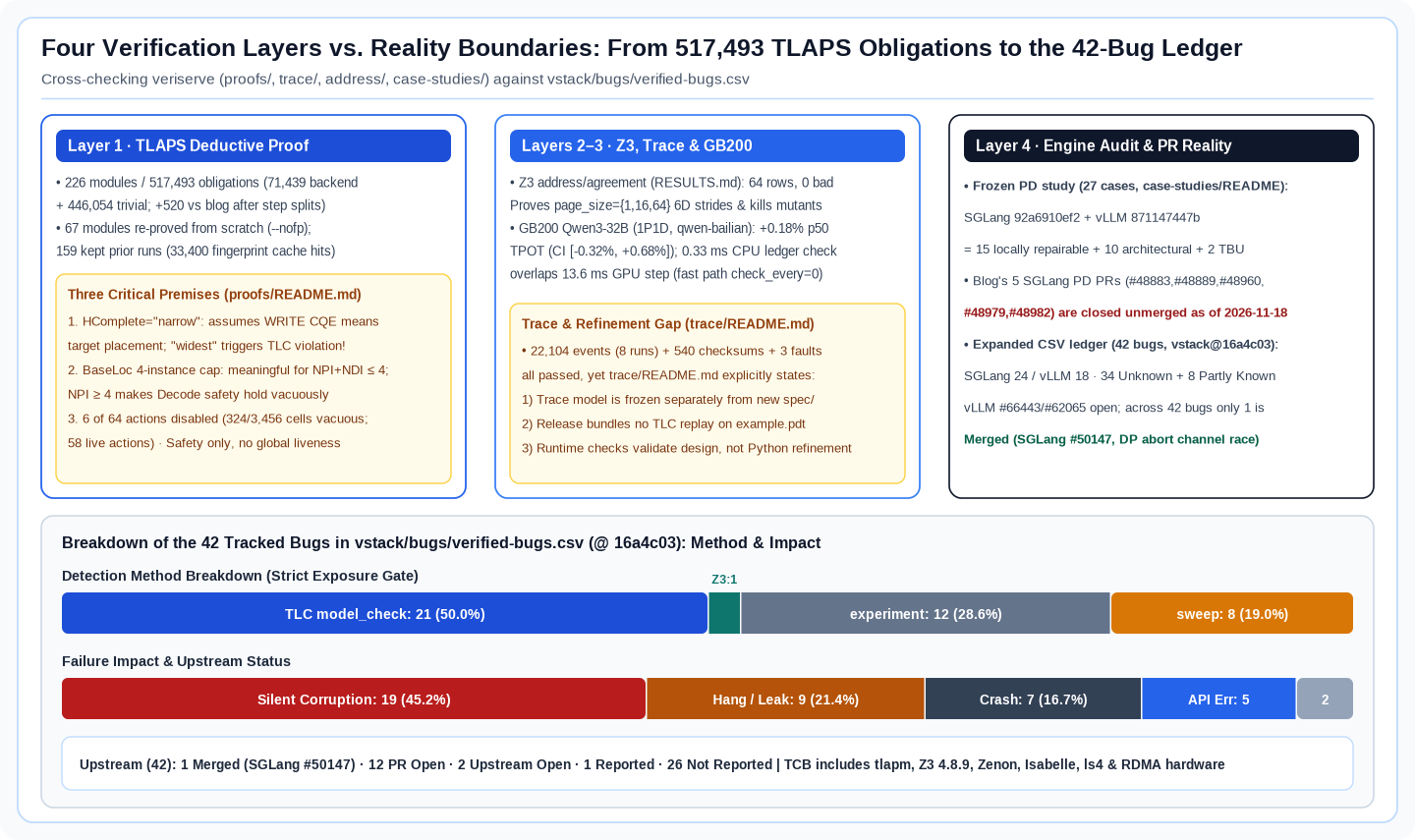
21model_check(TLC) +1smt(Z3) =22formal hits (52.4%), alongside12experiment(28.6%) and8exhaustive_sweep(19.0%). Notably,exposure-gate.mdexplicitly stipulates that shell models (such as a CUDA-graph padding-row constant restating a defect) remain code-reading leads rather thanmodel_check, and classifies model-free audits or engine repros (likeVS-014, whereEngine.shutdown()SIGKILLs unrelated host child processes) strictly asexperiment. - Failure impact:
19(45.2%) cause Silent Corruption, vs.9Hang/Leak,7Crash,5API Error,1Non-Determinism, and1Request Error—underscoring how frequently concurrency defects return corrupt results with no error signal (e.g., DP-attention unordered abort channel losing33/204aborts on 4× GB200 inVS-002, overlap weight updates overwriting activeforward_streamweights inVS-003, or shared-batch logprob scaling under deterministic inference inVS-010). - Upstream PR check as of November 18, 2026: All five initial SGLang PD PRs cited in the blog (
#48883,#48889,#48960,#48979,#48982) are currently closed unmerged (#48883, for instance, failed CI PR-title lint), whilevLLM #66443and#62065remain open. Across all42tracked bugs,1PR is merged (SGLang #50147forVS-002), with12open PRs,2upstream issues,1reported, and26not yet reported. Formal discovery still runs well ahead of upstream merge velocity.
The local-timeout impossibility theorem and PdLedger's six-state (page, gen) capability machine
Why can’t tighter CPU timeouts or callback retries fix the architectural PD races? In verification/pd-disagg/case-studies/impossibility/, TLAPS (53/53 and 27/27 obligations) and Z3 prove a crisp conditional trade-off.
 Enlarge diagram ↗
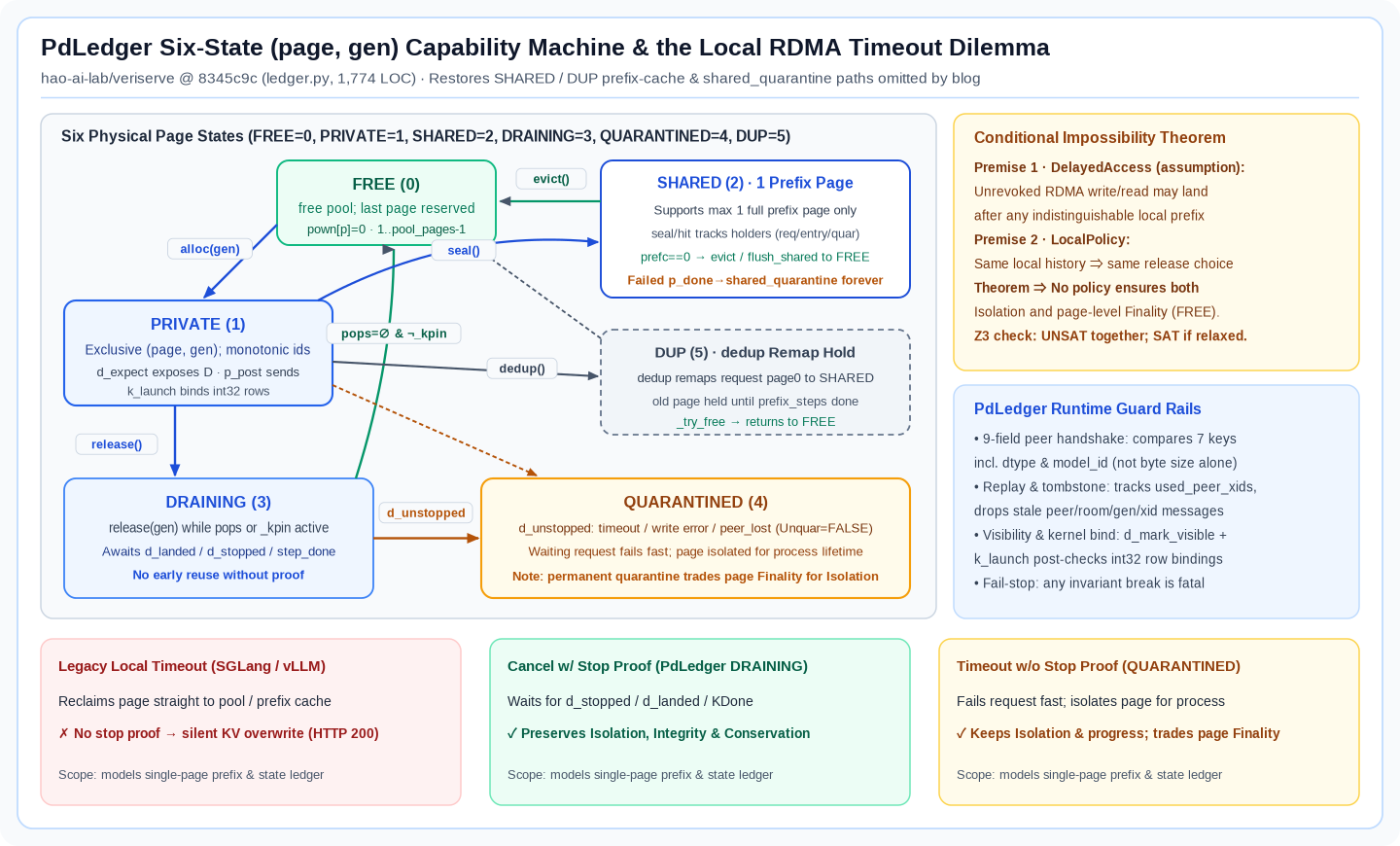
PdLedger (ledger.py, 1,774 lines) and the conditional impossibility trade-off: restoring the SHARED and DUP prefix-cache paths plus shared_quarantine omitted from the blog's simplified 4-state figure.Examine the theorem’s two premises carefully:
DelayedAccess: Assumes a stale physical DMA write—or unrevoked remote READ—can arrive after any finite locally indistinguishable history prefix. The repository notes explicitly that unbounded delay is a worst-case modeling assumption, not an empirical measurement (and residual access after a failed READ plus handle release stays an unverified premise).LocalPolicy: Identical local observation histories must yield identical page-release decisions.
Under DelayedAccess ∧ LocalPolicy, no causal local policy satisfies both Isolation and page-level Finality (eventual return to FREE). Z3 confirms the legacy premises are UNSAT, flip to SAT when either DelayedAccess or LocalPolicy is dropped, yet remain UNSAT even if end-to-end generation checks (NoGenerationValidation) are added—because software version checks cannot block an already-posted NIC DMA write to raw memory.
Vital nuance: Contrary to a casual reading of the blog, VeriServe does not escape this impossibility by proving page-level Finality. As impossibility/README.md states directly, “permanent quarantine still does not satisfy eventual Free.” Instead, PdLedger decouples request termination from page reclamation: on a d_unstopped timeout without stop evidence, the waiting request fails cleanly (preserving request liveness), while the exposed physical page stays in QUARANTINED for the process lifetime (or retains a permanent (eid, page) lock in shared_quarantine when an outgoing transfer on a SHARED prefix page fails), spending bounded capacity to enforce strict Isolation and Integrity.
Reading python/minisgl/disagg/ledger.py line by line surfaces critical implementation guard rails beyond the blog summary:
- Six explicit states and one-page prefix boundary:
FREE=0, PRIVATE=1, SHARED=2, DRAINING=3, QUARANTINED=4, DUP=5. Docstring lines 23–25 specify that prefix sharing supports only a single complete Prefill prefix page (declared upfront viaprefix_tokens; multi-page prefix trees are outsideveriserve). Whendedup()remaps a request’s duplicate page to an existingSHAREDentry, the replaced page moves toDUPuntil its last in-flight kernel snapshot (prefix_steps) finishes and_try_free()returns it toFREE. - 9-field peer layout handshake: Peer validation (
LAYOUT_COMPARED) matches(num_layers, page_size, kv_heads, head_dim, itemsize, dtype, model_id)across peers while keepingpool_pagesandbase_ptrper-instance—explicitly catchingbf16vs.fp16orfp8_e4m3fnvs.fp8_e5m2mismatches that share equal byte size (itemsize). - Dummy padding reservation & post-checked kernel args: Monotonic
gen/xid/eidnever wrap or reuse; the final pool page stays permanently outside ledger allocation (1..pool_pages - 1) for CUDA-graph padding;k_launch()builds FlashInfer int32 indices (K_LIM = 0x7FFF_FFFF), checks row bindings (bind_row), and verifies generated arrays against raw internal state via_kargs_post()before committing the step—raising a fatalLedgerViolationon any invariant break.
What is proved vs. unproved? Auditing four hidden boundaries behind 517,493 TLAPS obligations
VeriServe packages its full TLAPS closure, Z3 results, and trace scripts openly in the repository. Inspecting proofs/README.md, address/RESULTS.md, and trace/README.md reveals four essential boundaries governing what the proof guarantees—and what remains unproved:
 Enlarge diagram ↗
TLAPS, Z3 address arithmetic, PdTrace, and the 42-bug SGLang/vLLM ledger) against explicit premises and upstream merge status.| Audit dimension | Blog headline impression | Exact reality in pinned repository READMEs |
|---|---|---|
| Obligation counts & cache origin | 226 modules · 516,973 obligations |
proofs/README.md records 517,493 obligations (71,439 backend-proved, 446,054 trivial; +520 after splitting 40 slow proof steps). Only 67 modules (153,417 obligations) were re-proved from scratch (--strict --nofp) for release, while 159 modules (364,076 obligations, incl. 33,400 --safefp cache hits) retain prior runs; solver outputs were not re-checked by an independent checker. |
Hardware completion premise (HComplete) |
Proved RDMA safety unconditionally | PdPinnedBridge.tla assumes HComplete = "narrow", meaning an initiator RDMA WRITE CQE implies data placement in target GPU memory (paired with cudaDeviceFlushGPUDirectRDMAWrites). Crucially, the README confirms: under HComplete = "widest", TLC finds a Safety violation. |
| Four-instance cap & disabled actions | Universal proof over all 64 actions | ① BaseLoc maps only 4 locations, so the theorem is non-vacuous only for NPI + NDI ≤ 4; for NPI ≥ 4, Decode owns zero pages and Decode properties hold vacuously. ② Six of 64 actions (RecvHello, Teardown, Unquarantine, DInband, KLaunchWG, DrainDone) cannot fire under Design (Unquar = FALSE), leaving 324 / 3,456 induction cells vacuous (58 live actions). ③ Safety only (Spec => []Safety), with no liveness theorem. |
| Trace decoupling & refinement gap | 22,104 events bridge Python to PdCore |
trace/README.md notes that PdTrace/PdReject is frozen separately from the newer spec/ proof target, packaging includes no TLC trace run on example.pdt (memmove CPU fixture returns INCONCLUSIVE under --require-engine), and neither runtime checks nor Z3 (64 rows, 0 bad in address/RESULTS.md) constitute a full refinement proof from Python bytecode to TLA+. |
Analysis: Making every trusted premise explicit—from tlapm efe4f2d-dirty and Z3 4.8.9 to HComplete = "narrow" and Unquar = FALSE—does not diminish VeriServe; it turns formal assurance into an actionable engineering contract. Future maintainers know immediately which assumptions break if they enable software unquarantine, scale beyond four PD instances, or relax hardware completion ordering.
GB200 overhead breakdown and takeaways for verifiable AI infrastructure
End-to-end GPUDirect RDMA benchmarks on a 4-GPU NVIDIA GB200 node (1P1D over Mooncake with Qwen3-0.6B and Qwen3-32B on Alibaba qwen-bailian traces) report:
- Median Decode-side
PdLedgerCPU check time is0.33 msper step, overlapping cleanly with13.6 msmedian HTTP TPOT; across six paired runs against an unchecked bypass baseline, overhead averages+0.18%mean p50 TPOT (95% CI [-0.32%, +0.68%]). - Code inspection of
ledger.py:268-280explains the fast path:check_every=0disables full $O(\text{pool})$ global-invariant scans on every mutation while always enforcing local preconditions,QuarNoReg, touched-SHAREDchecks, andk_launchpost-checks (check()still exposes full scans for tests/sampling). - Eight single-page prefix-sharing and eviction tests verify
540KV checksums with zero mismatches and catch all three injected glue faults.
Cross-comparison with durable agent runtimes
Placed beside our earlier Pi Durable close reading, a unified engineering blueprint emerges for building high-reliability LLM infrastructure—whether written by humans or coding agents:
- Replace bare resource integers with versioned capabilities: Whenever asynchronous hardware DMA or external tool effects outlive local deadlines,
FREE / PRIVATE / SHARED / DRAINING / QUARANTINED / DUPkeyed by monotonic(resource, gen)outperforms timeout heuristics that invite silentHTTP 200corruption. - Use mechanical gates against agent shortcuts: Pinning
SPEC_PINS, forcing\* ASSUMES:names into checked invariants, requiring negative mutants +~W_*witnesses, and strictly isolatingmodel_checkfromexperiment(Exposure Gate) gives multi-agent verification loops real teeth without relying on rubber-stamp “agent code review.” - Publish TCB boundaries alongside proof counts: Explicitly documenting
HComplete = "narrow", theNPI + NDI ≤ 4ceiling, the 1-page prefix cap, trace-model decoupling, and upstream PR merge status turns a flashy proof metric into durable systems engineering.
Source: VeriServe README, PdLedger implementation, vstack mechanical gates.
2026-11-12 Daily Brief · Pi Durable Close Reading · Verified but Vacuous