What matters in this issue
Two threads stand out. On the agent side, improvement is becoming a more differentiated systems problem: ActiveSaddler chooses which failures should teach the next harness update, RETIRE coordinates old and new executions when instructions change, and two empirical studies examine orchestration, tools, and semantic boundaries between components. Attention is moving beyond individual answers toward how systems evolve and stop obsolete work.
On the infrastructure side, Leto preserves usable training state after a failure. MegaFlux and RapidMoE address expert-load skew and memory-constrained heterogeneous execution, respectively. FastCI and ePACT extend optimization to development feedback and electricity commitments. Together, these papers illustrate why a faster kernel does not automatically produce a more efficient system.
Start with ActiveSaddler and Leto. The former offers a mechanism that can be compared directly with a fixed curriculum; the latter revisits the boundary between failure and surviving state. The other eight papers are grouped around agent reliability, MoE execution, and operational efficiency.
In depth
01 · ActiveSaddler: choosing which failures should teach an agent next
ActiveSaddler: Automated Curriculum Learning for Agent Harness Optimization · Project
Sungho Park et al. · 2026-10-01 · Watchlist: Qingwei Lin is a coauthor
As patches change, the value of practice changes
An agent harness comprises prompts, tool interfaces, and execution-control logic around a model. Automatic optimizers can already diagnose execution traces and modify these components, but often run training scenarios in an order decided beforehand. Once a weakness is repaired, further examples of it may offer little value. A failed first repair may also be abandoned simply because the curriculum moves on.
ActiveSaddler treats this as a separate optimization problem: keep the harness-update mechanism fixed, but adapt the scenarios that supply its evidence. This is offline curriculum learning. It does not update foundation-model weights or automatically patch production code during every request. That distinction matters when locating the method in a development workflow and accounting for its cost.
Select failure patterns, not just difficult tasks
The system groups reusable weaknesses inferred from failed traces into failure patterns. Broad task categories may merge unrelated problems; individual scenarios may split one recurring weakness across many targets. A pattern lets several examples support the same improvement.
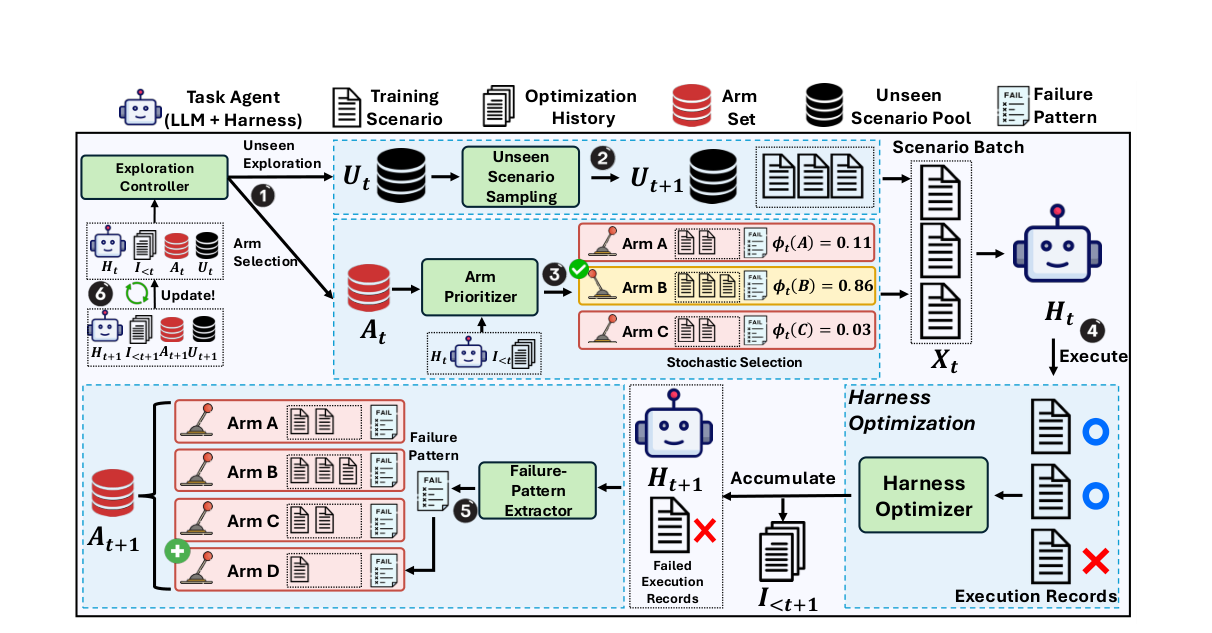
Reading the diagram: the upper-left controller chooses exploration or revisiting; the middle selects a known pattern and its scenarios; execution and harness optimization happen below; the lower-left extractor updates the patterns used by the next iteration.
Each iteration chooses between exploring unseen scenarios and revisiting a known weakness. For revisiting, a prioritizer uses the current harness and previous optimization attempts to estimate remaining improvement potential, then samples a target. AutoSaddler still performs diagnosis, modification, and validation. Execution outcomes update the pattern set and its priorities. Development performance selects the final harness; the test set is reserved for final evaluation.
This is more selective than retrying every failure. The curriculum must distinguish weaknesses worth repairing, weaknesses that may already be resolved, and weaknesses not yet discovered. Those judgments can themselves be wrong. The contribution is adaptive evidence allocation, rather than a claim that model-generated failure diagnoses are inherently correct.
What the results establish
With the same optimizer, the paper compares against a fixed randomly shuffled scenario order:
| Test set | Fixed-curriculum AutoSaddler | ActiveSaddler |
|---|---|---|
| GAIA2, 300 test tasks | 55.4% | 59.8% |
| Terminal-Bench 2.0, 40 test tasks | 72.5% | 80.0% |
These are mean Pass@1 results over three test-time executions: gains of 4.4 and 7.5 percentage points. The comparison shares a task-rollout budget, but curriculum decisions add optimizer-side LLM calls; equal rollout budgets do not mean identical total costs. Removing pattern-based grouping, adaptive prioritization, or exploration control reduces performance, supporting the role of the combined feedback-allocation mechanism.
Assessment: an agent-optimization method worth reading closely. It improves the choice of feedback and complements better patch generators. Results remain tied to particular models, optimizers, and splits. The Terminal-Bench test subset contains only 40 tasks, so its 80% result is not an 80% score on the full public leaderboard. Useful follow-up evidence would show whether patterns remain stable under model or workload changes, and whether saved executions offset the controller’s additional cost.
02 · Leto: preserving usable state when a training process fails
Leto: Fast In-Place Recovery for LLM Training on Surviving Hardware
Geon-Woo Kim, Joon Ha Kim, Daehyeok Kim · 2026-09-30
Why recovery still takes time
A training-process crash does not always require resetting or replacing a GPU. Leto targets hardware-operable failures, or HOFs: failures after which the same hardware can resume training. Conventional recovery may still reload a checkpoint, recompute subsequent progress, and rebuild CUDA and communication state. Some of that work is avoidable.
The central question is whether useful state can outlive the failed process when its hardware survives. Leto separates process lifetime from state lifetime and prepares a replacement trainer in advance. Preparing on the original hardware and rank can complete more identity- and device-dependent initialization than warming a spare elsewhere.
Three components make takeover possible
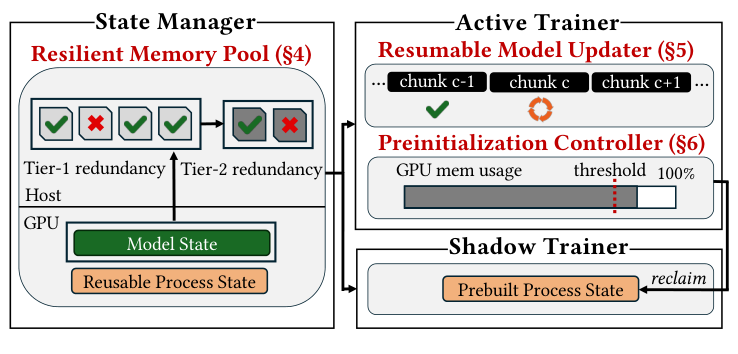
Reading the diagram: the State Manager owns model and reusable state; the Active Trainer trains; the Shadow Trainer prepares replacement-process state. The controller below reclaims shadow GPU state when active training needs the memory.
First, a state manager owns allocations for model parameters, optimizer state, and reusable buffers. They therefore do not depend on the active trainer’s survival. Two-tier erasure protection, with persistent redundancy in host memory, addresses inaccessible pages rather than assuming that all out-of-process memory remains intact.
Second, surviving memory is not necessarily consistent memory. If a failure interrupts a parameter update, some chunks may have advanced while others have not. Chunk-level transactions coordinate model and parity updates. Recovery resumes from committed boundaries instead of treating a partially updated model as valid.
Third, a shadow trainer prepares CUDA, NCCL, and other process-owned state. It shares the GPU with active training, so it cannot reserve unlimited memory. When the allocator needs space, Leto can reclaim the shadow’s GPU state. Recovery may then need to finish deferred initialization. The design explicitly trades recovery readiness against normal training’s memory requirements.
How execution resumes
For an HOF, shadow trainers take over together, reattach to retained state, repair protected pages, and either restart the interrupted iteration or finish its update, depending on progress. This avoids recomputing completed iterations; it does not mean every failure entails zero recomputation. Failures that require replacement hardware or destroy reusable state still use checkpoint recovery.
On 6- and 72-GPU A100 clusters, the authors report 3.6–6.5× faster recovery than the strongest checkpointing baselines and up to 13.7 percentage points more productive training time. The result above 95% productive time at 131,072 GPUs comes from simulation, not a deployment at that scale.
Assessment: a significant training-recovery design to follow. Its contribution combines state lifetime, update consistency, and memory contention from preinitialization. Before adopting the idea, establish how many local failures are HOFs and how dependable the failure classifier, state manager, and checkpoint fallback are. Recovery speedups alone do not determine practical benefit.
Agent reliability and execution semantics
03 · Multi-agent issue study: orchestration, tools, and memory deserve attention
Understanding Issues, Causes and Solutions in Open-Source LLM-based Multi-Agent Systems
Asad Ur Rehman et al. · 2026-10-01
The authors filter 22,848 closed issues from 21 open-source projects into 944 relevant records, then analyze problems, causes, and remedies separately. Orchestration and execution is the most frequent issue category; workflow, tool integration, and memory are frequent causes, while workflow optimization is a prominent remedy.
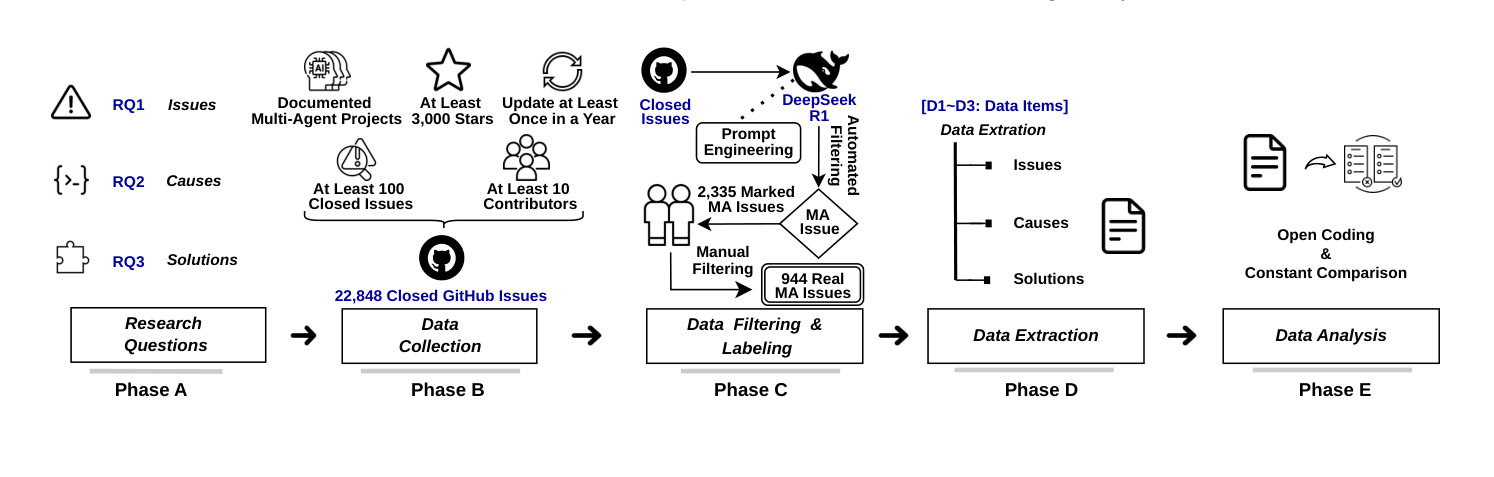
Reading the diagram: select projects, collect and filter issues, then code problems, causes, and solutions separately. This is an empirical-study pipeline, not an automated diagnostic system.
The evidence source matters. It shifts attention from model capability to development and usage problems in real frameworks, informing test categories and debugging checklists. Closed issues have reporting and resolution biases, however. The 944 records are not a denominator of executions and cannot establish a production failure rate.
04 · RETIRE: withdrawing old execution’s authority when instructions change
Serving a Revisable World: Versioned Execution for Interruptible Agents
Yanxin Zhang et al. · 2026-10-01
Aborting a request and submitting its replacement does not automatically coordinate queued output, outstanding GPU work, and reusable KV state. RETIRE separates resource ownership from authority to publish effects: revoke the old version, close writers, certify a reusable prefix, resume the successor, and reclaim isolated resources asynchronously.
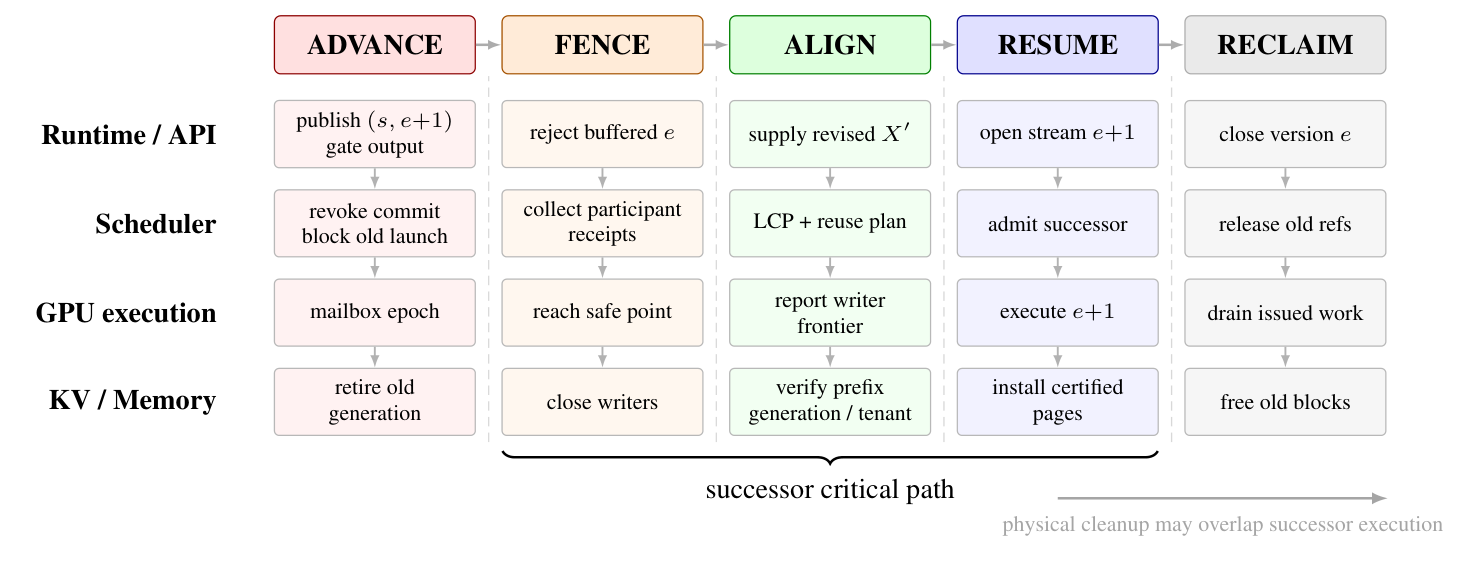
Reading the diagram: follow ADVANCE → FENCE → ALIGN → RESUME → RECLAIM across the columns. One transition reaches the runtime, scheduler, GPU, KV, and memory layers.
The vLLM implementation reduces successor time-to-first-token by a median 17.1% in controlled paired experiments. The correctness contract is the more fundamental result: obsolete output must not publish, and only certified state may cross versions. This does not undo external tool effects that have already occurred and is not general transaction rollback.
05 · Compound AI: reliability at component boundaries
Compound AI System Reliability: A Failure Taxonomy and Resilience Pattern Catalog from 150 Production Incidents
Rudrendu Kumar Paul, Sourav Nandy · 2026-10-01
From 150 incidents, the paper derives 23 failure modes across retrieval, generation, tools, orchestration, and integration, then evaluates patterns by fault injection in a six-component testbed. Its important failure case is a system whose individual components return successfully while their semantic or format contracts are broken.
The reported 71% MTTR reduction for combinations of at least three resilience patterns comes from controlled experiments against an unstructured-monitoring baseline. It is not an average improvement observed after deployment across the 150 production systems. Read it as a taxonomy and design checklist. Transfer requires examining quality-gate false positives, circuit-breaker thresholds, and recovery costs. The original paper has no suitable architecture figure, so this entry remains textual.
MoE and infrastructure efficiency
06 · MegaFlux: pipelining expert replication to handle routing skew
MegaFlux: Skew-Resilient MoE Megakernels via Pipelined Expert Replication
Jianzhu Yao et al. · 2026-09-30
Even fused communication and computation cannot prevent a hot expert from creating a GPU straggler. MegaFlux keeps router outputs unchanged but dynamically places replicas and assigns token blocks. Computation starts as the required weights arrive; backward execution also overlaps replica-gradient reduction with other computation.
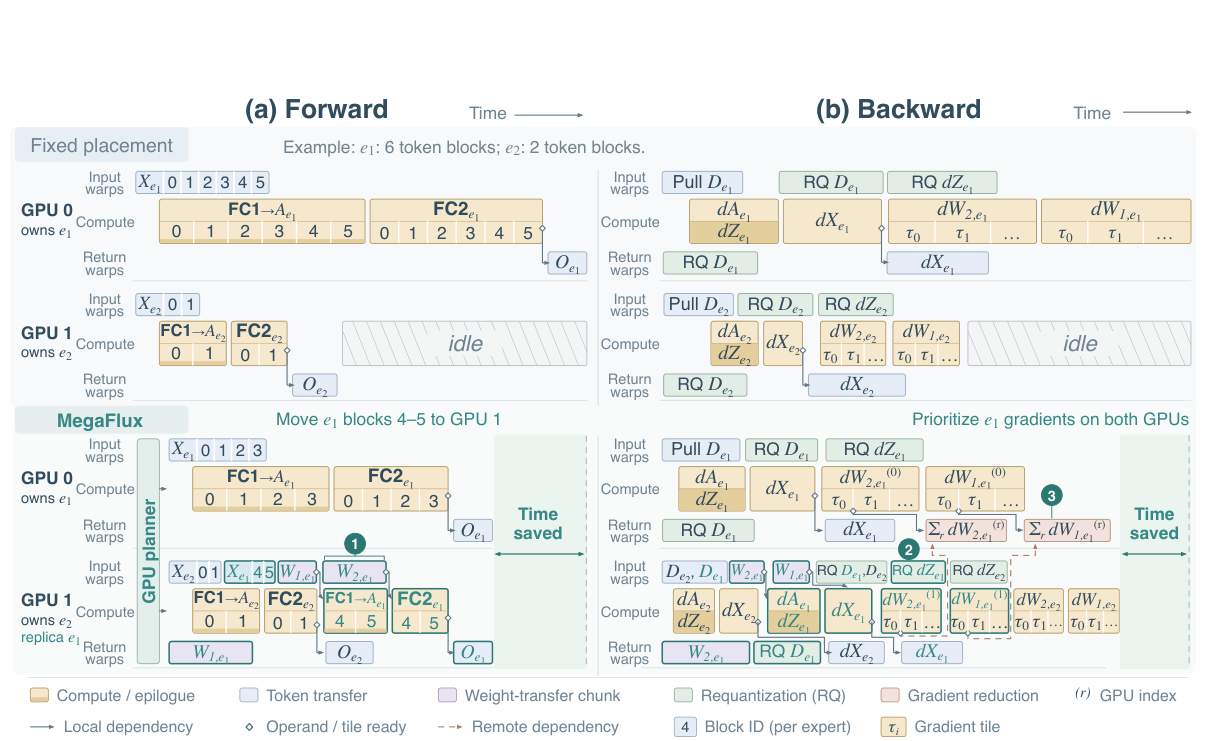
Reading the diagram: compare fixed placement above with replication below. The left shows weight transfer overlapping forward computation; the right shows backward work overlapping replica-gradient reduction.
Across eight B200 GPUs, geometric-mean layer speedups are 1.45× forward and 1.28× backward; vLLM integration yields 1.13–1.26× median end-to-end prefill speedups. Layer acceleration is not whole-system acceleration. Planning and replication have costs, small backward workloads can regress, and cross-node topology remains outside the evaluation.
07 · RapidMoE: GPU-resident low-precision weights with selective CPU residuals
RapidMoE: Exploiting Cross-Asymmetry via Adaptive Residual Offloading for Large-Scale MoE Inference
Wenxun Wang et al. · Tsinghua University · 2026-10-01
When full MoE weights do not fit in GPU memory, moving whole experts can saturate PCIe, while extensive CPU execution is slow. RapidMoE separates quantized weights from residuals: the GPU runs the resident low-precision path, the CPU corrects dynamically selected critical experts, and UMIA adjusts that set to balance accuracy and latency.
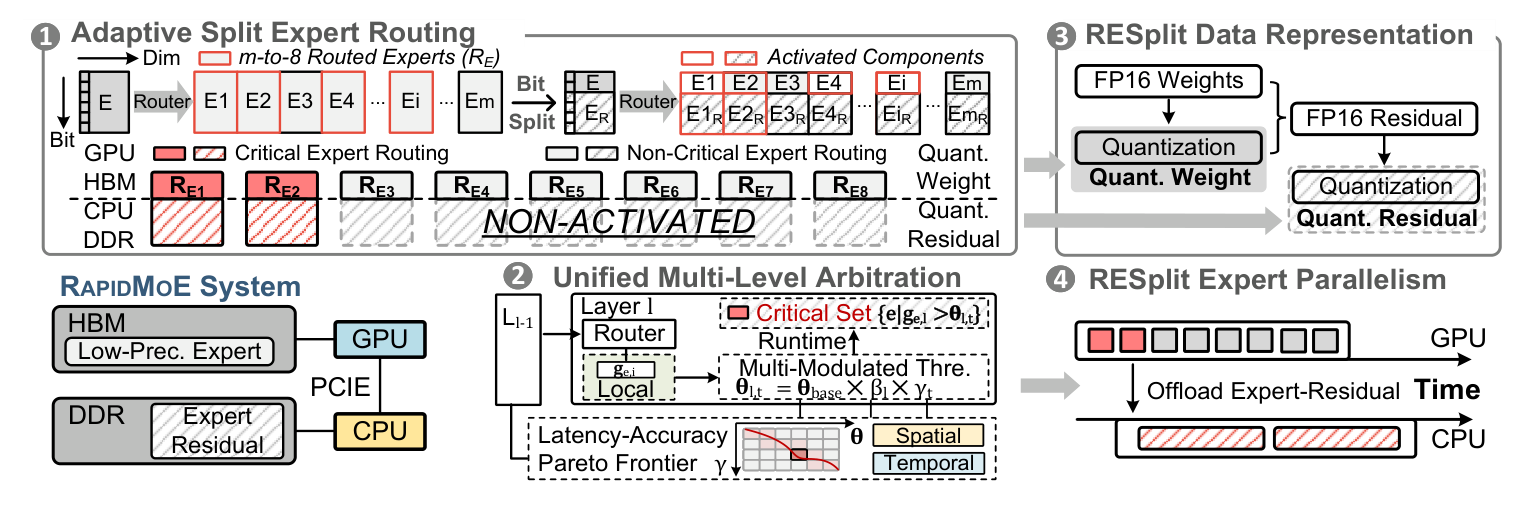
Reading the diagram: expert selection is at upper left, split representations at upper right, UMIA at lower left, and CPU–GPU execution overlap at lower right.
The authors report up to 3.5× decoding and 2.1× prefill speedups over compared offloading systems. This addresses a different deployment regime from MegaFlux: memory-constrained, lower-concurrency CPU–GPU execution with an accuracy trade-off. It is not a direct replacement for fully GPU-resident, high-concurrency serving.
08 · ePACT: serving against electricity commitments
ePACT: Energy-Performance-Aware Commitment Tracking for LLM Serving
You Peng et al. · 2026-10-01
If both overuse and underuse relative to an electricity commitment incur charges, minimizing physical energy need not minimize cost. ePACT’s global planner updates interval targets from measured consumption and the remaining hourly commitment. A local controller predicts energy and completion time, then selects serving capacity and GPU clocks subject to service checks.
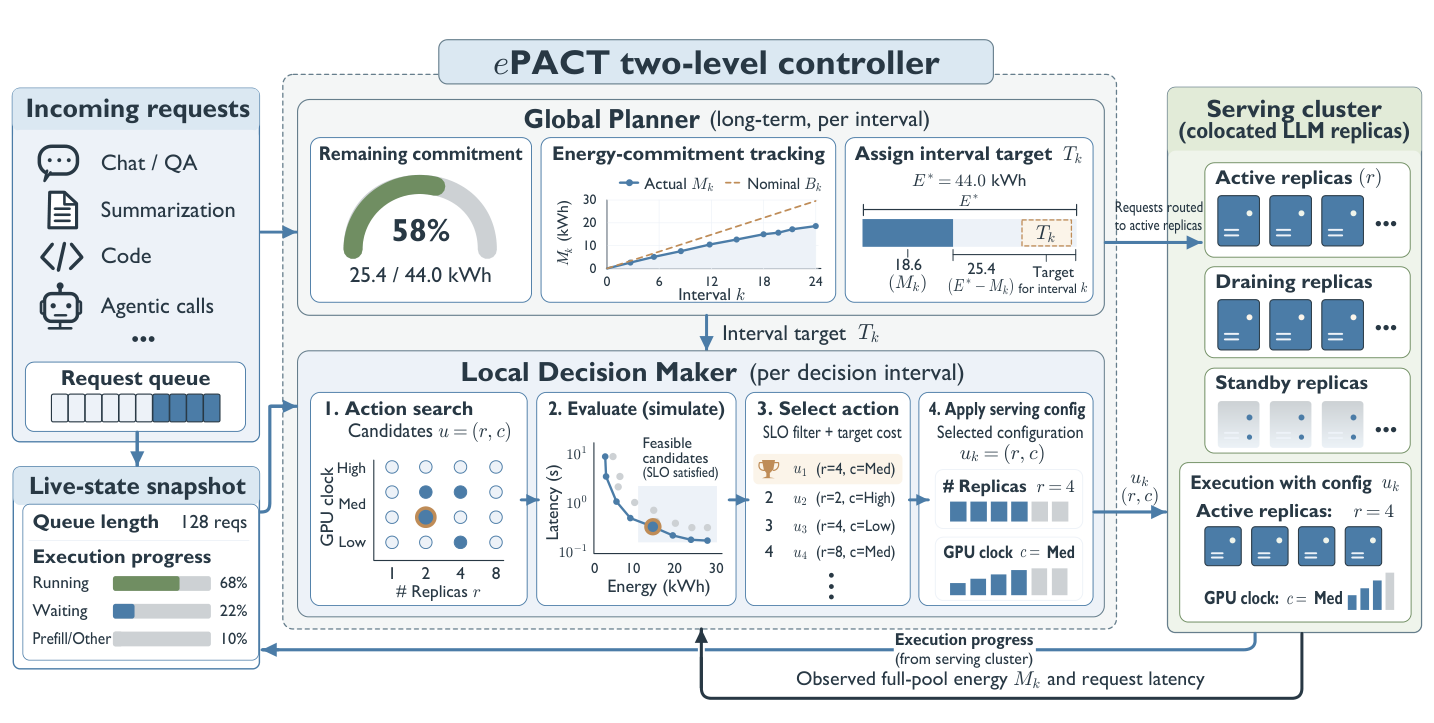
Reading the diagram: the upper planner updates the target; the lower controller searches configurations and checks predicted SLOs; the serving pool applies the choice and returns measured energy.
In 24-hour trace simulations, asymmetric deviation cost falls 73.8% and 75.7% for H20 and H200 pools with near-vLLM SLO attainment. Those are deviation charges under a specific two-sided cost model, not equivalent reductions in total bills or energy. Predicted SLO checks also do not guarantee actual deadlines.
09 · FastCI: reducing GPU CI waste with runtime evidence
FastCI: Efficient GPU-Intensive CI for LLM Training Frameworks
Tianshuo Qiao et al. · 2026-10-01
Training-framework CI often runs expensive training or evaluation jobs. FastCI uses runtime traces to select tests affected by a change, prunes redundant coverage in equivalent execution contexts, prioritizes risky tests, and reduces workload dimensions outside a test’s intended validation scope.
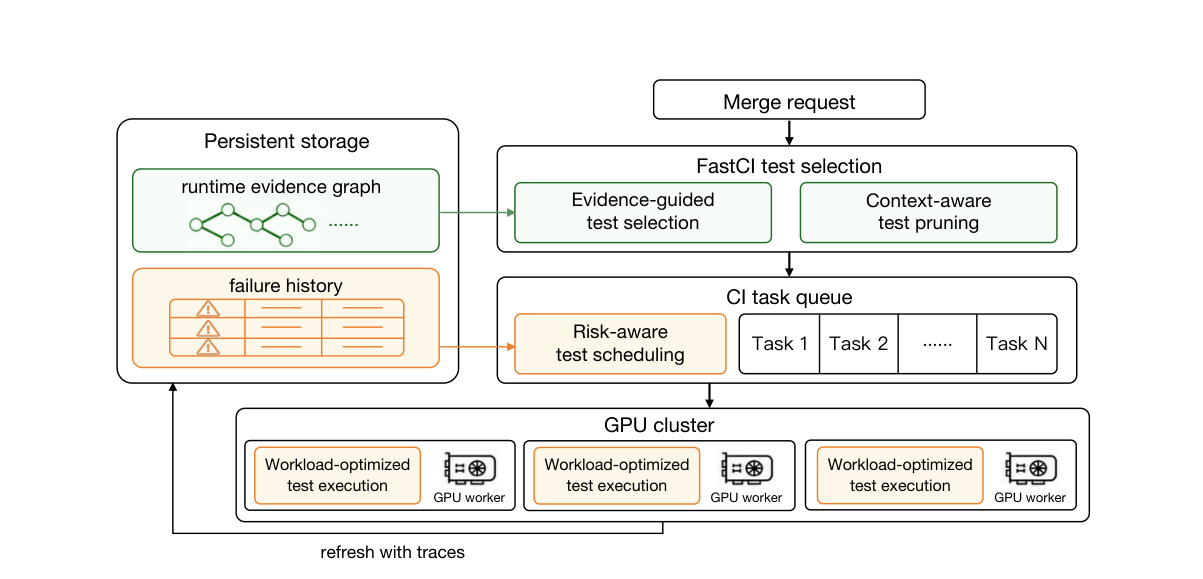
Reading the diagram: changes drive test selection and pruning, followed by prioritization and workload adjustment. Historical executions continually update the evidence store underneath.
On the authors’ ByteDance training-framework workload, CI latency falls 77.5% and GPU usage 63.9% relative to the deployed pipeline. The useful idea is reducing work while preserving a test’s purpose. Changed-code coverage retention is not proof of preserving every bug detection; missing historical evidence and regressions hidden by smaller workloads remain important adoption questions.
10 · LOGOS: compressing raw logs into an investigable failure chain
From Alert Floods to Precedence Forests: Zero-Prior-Knowledge Incident Triage with LOGOS
Radhika Niranjan Mysore · 2026-10-01
Without complete traces or topology, LOGOS uses entity–event co-occurrence and temporal precedence to produce a compact forest from logs for subsequent human or LLM diagnosis. Across 25 enterprise outages and 12 open-source issues, the authors report a median processing time of 4.5 minutes and mean recall of 0.76.
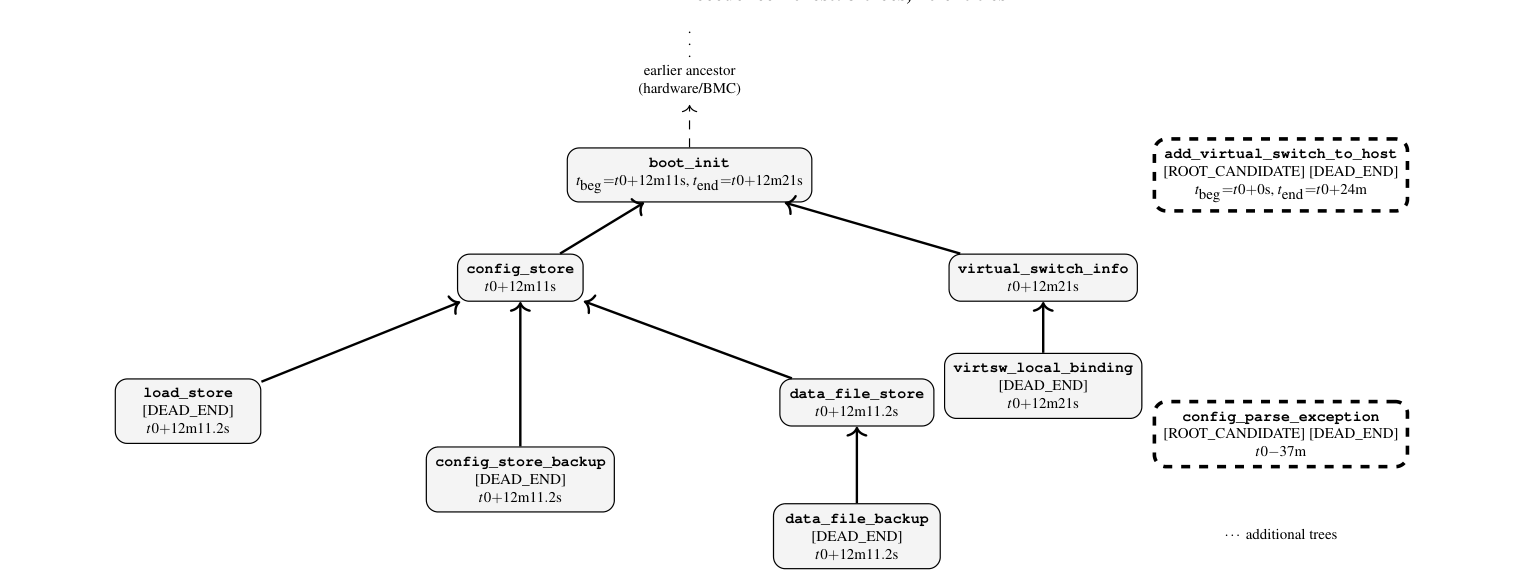
Reading the diagram: entities form trees through earlier co-occurring relations. Leaves and root candidates narrow investigation; the arrows represent constructed precedence, not proof of causality.
Its contribution is diagnostic context preparation. “Zero prior knowledge” still involves vendor-specific parsing work. Selecting the largest connected component can miss causes in secondary subgraphs. This is batch triage over a log bundle, not a complete continuous or interactive diagnostic platform.
Technical reading: two independent Tech Notes
- TLX Jagged Flash Attention: keeping Blackwell busy on variable-length sequences—how a high-level language exposes scheduling control, and why jagged recommendation workloads do not establish universal dense-LLM wins.
- KV Cache and LMCache: from one generation to reusable multi-turn state—what is stored, why it grows, when reuse pays, and the problems an external storage layer must solve.
Community and dataset update
GitHub Copilot coding-agent traces are available. The official Azure dataset description confirms 301K sessions, 9.3M LLM calls, and 8.7M tool calls, sampled from non-enterprise user sessions on June 1–7, 2026.
The release supports research into latency, caching, scheduling, and call structure. It contains no prompts, responses, tool-output text, or source code, and model identities are anonymized. It is therefore not a complete conversation dataset ready for supervised training. The user supplied October 2, 01:05 Shanghai time for the @haoran_qiu98 announcement; it appears here as a next-morning supplement. That precise posting minute was not independently verified; substantive claims follow the official repository.
What to follow next
A common theme is managing the lifetime of state and evidence: whether a failure pattern remains relevant, an old execution retains authority, training state survives its process, or cached state survives a request. These affect different layers of reliability and cost. Follow-up evaluation should examine degradation and recovery over longer periods and changing distributions, alongside headline speedups.