What to read first
Two studies of coordination lead this issue. vLLM-Omni separates text, speech, and diffusion generation into stages, then uses a shared control plane for progress, cancellation, and delivery. The dynamic-concurrency study asks whether coding agents that delegate work during execution produce more complete software. The former offers an inspectable runtime design; the latter uses matched experiments to expose both benefits and delivery risks. Together, they help explain how bottlenecks move across components.
Three further papers address measurement stability, diagnostic evidence, and review validity. Inference performance must be repeatable; external outcomes must be bound to the instance that actually ran; and another model’s critique needs complete input and a checked process outcome. These works bring reliability down to concrete execution records, beyond final scores alone.
01 · vLLM-Omni: Coordinating Multimodal Generation in One Runtime
vLLM-Omni Technical Report: A Unified Serving Runtime for Omni-Modality Generation
vLLM-Omni Team · arXiv · 2026-10-07
Stage boundaries accommodate different generation processes
A speech assistant may reason, generate codec tokens, and finally synthesize a waveform. An image model instead performs iterative denoising. Their scheduling assumptions differ: one decoding loop is a difficult fit, while separate servers tend to duplicate routing, streaming, and cancellation logic. vLLM-Omni adds a shared request lifecycle above specialized engines, preserving their internal execution models.
A stage binds a model component, an engine, and a resource budget. Requests enter through AsyncOmni. The orchestrator selects the next stage and replica, and decides whether an output goes to the client or downstream. Engines retain token scheduling, KV management, and denoising. OmniConnector moves large tensors while control queues carry lightweight metadata, keeping the scheduler out of the bulk-data path.
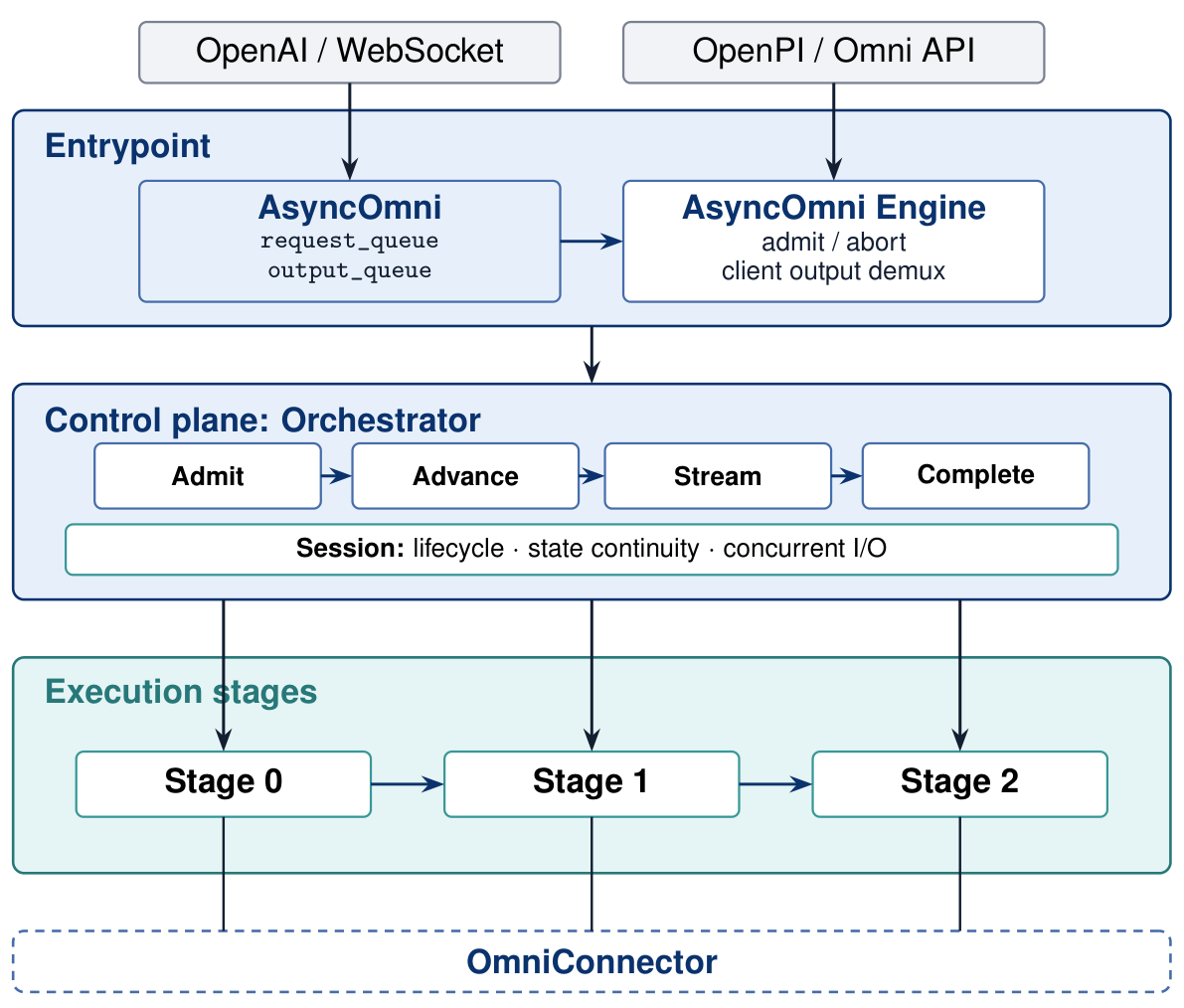
Read downward from admission to execution. Stages exchange generation state through the connector, while the control plane retains lifecycle ownership.
Start downstream work early while preserving state ownership
Consider Qwen3-Omni’s thinker→talker→code2wav pipeline. With async_chunk, downstream stages receive placeholder requests in advance and begin decoding as codec chunks arrive, overlapping upstream generation. Each edge can use chunks or a complete payload; one granularity is not suitable for every model. Stage pools can add replicas independently, while existing requests retain replica affinity so later streaming updates and local caches stay together.
The connector carries hidden states, codec codes, latents, and KV blocks, with their semantics managed by layers above it. Long-lived sessions add state continuity and concurrent input/output on the same control plane. Separating request progression from model execution is useful, but also makes consistent cancellation, state cleanup, and stage handoffs essential.
Cross-stage KV must also be distinguished from hidden states. KV is exported from paged block tables and needs dedicated extraction, key management, and installation at the destination; hidden states condition downstream generation. A shared transport interface unifies movement, not cache validity. Runtime designers therefore need to establish when each piece of state becomes available, which request owns it, and when it can be released, alongside network-path optimization.
Benefits depend on load and the bottleneck
On two H100 GPUs with Fixed-Len-2500/900 and text-plus-audio output, chunking reduces mean end-to-end latency at concurrency 32 from 136.62 to 72.63 seconds. Mean audio real-time factor falls from 0.927 to 0.630; this metric divides synthesis time by the duration of generated audio. At concurrency one, end-to-end latency changes from 25.07 to 18.51 seconds. The benefit is not a fixed multiplier.
Adding downstream replicas does not guarantee continued improvement. With three H100s and two replicas each for talker and code2wav, real-time factor at concurrency 32 is 0.732, worse than the two-GPU chunked configuration. The authors suggest upstream admission and handoff may have become bottlenecks; these numbers do not isolate a unique cause. A separate H200 MRv2 experiment also requires a one-line guard on an attribute access during startup, so its results cannot be treated as measurements of the unmodified configuration.
Read this for architecture and workload diagnosis. The control plane, chunk transport, and concurrency sweeps matter more than interpreting model coverage as a universal speedup. The report largely uses frozen nightly recipes and provides no cross-framework performance ranking in this revision. Broader session workloads, closed-loop robot evaluation, and cross-hardware measurements remain open.
02 · Dynamic Concurrency: More Sub-Agents Need Better Coordination
When Sub-Agents Work in Parallel: The Promises and Pitfalls of Dynamic Concurrency in Long-Horizon Coding Tasks
Han Li, HanHaoNing Li, Ziqian Jiang, Yiling Lou · arXiv · 2026-10-07
Comparing execution policies rather than fixed multi-agent workflows
Dynamic concurrency lets a main agent decide when to delegate, what to assign, and how to collect results during execution. Unlike predefined roles and task graphs, it can produce either useful independent implementations or redundant investigation, missing interfaces, and shared-file conflicts. The central question is whether autonomous delegation improves the final artifact under the same time budget.
The authors run 2,124 executions over 354 tasks, comparing native concurrency enabled and disabled for Codex/GPT-5.4, Claude Code/Claude Opus 5, and Kimi Code/Kimi K3. Matched runs share the model, prompt, environment, and time budget. Tasks span RepoZero, NL2Repo, ProgramBench, LoopsBench, and the shorter-task comparison SWE-bench Verified. These are stratified samples, not the complete benchmark populations.
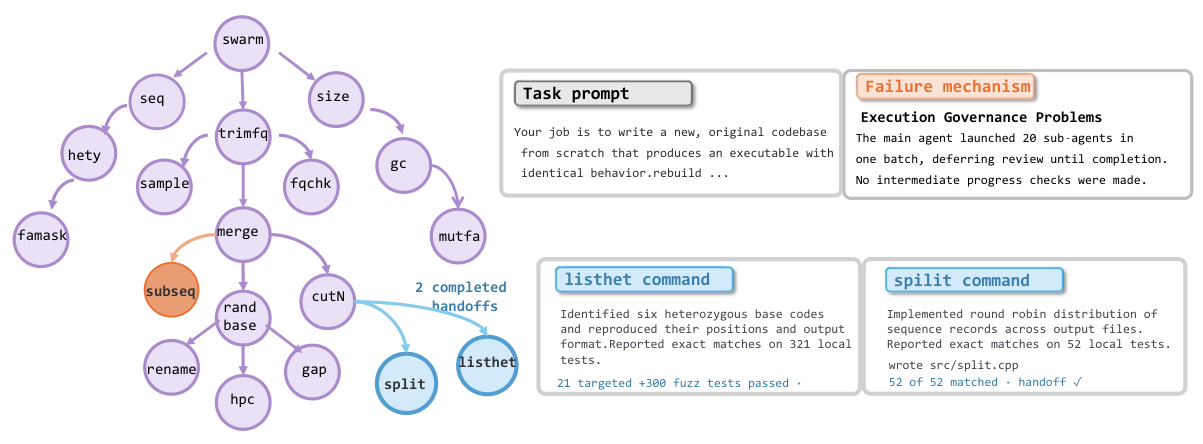
The left side fans out command implementations; the right shows local completion evidence. Few handoffs finish, and the main agent’s batch wait consumes the time needed for integration checks.
Complex tasks create opportunities, but concurrency need not save time
On LoopsBench, Claude Code’s task pass rate rises from 7.1% to 21.4%, a gain of 14.3 percentage points. Mean time also rises from 74.8 to 91.5 minutes. On the SWE-bench Verified sample, the same agent drops from 83.0% to 59.0%. Codex improves from 34.6% to 57.7% on NL2Repo while token use grows from 2.87M to 8.00M. Benefits depend strongly on the task and tool; one improvement cannot justify a universal default.
Across long-horizon benchmarks ordered by average implementation size, the test-pass advantage generally grows. This is an association, not evidence that making a task longer causes a benefit. Every configuration still has zero fully solved tasks on ProgramBench. Passing more individual tests must be distinguished from completing an entire program.
Failures often occur after delegation
The seqtk example makes the problem concrete. Within a 40-minute budget, the main agent launches 20 sub-agents at minute 17.5, then waits for the whole batch while assuming a two-hour timeout. Two tasks return local test evidence, but the planned integration checks never happen. The final program passes only 92 of 440 tests. Local completion reports do not establish completeness of the final program.
Manual analysis of all 1,062 concurrent trajectories produces four main categories, 13 subcategories, and 28 failure patterns. Shared-state and merge problems account for 33.2% of 804 pattern instances. That denominator is pattern instances, not production requests. Successful cases show three routes to benefit: complementary implementation, parallel attempts followed by selection, and independent validation. The main agent still has to integrate and accept the results.
The taxonomy uses independent annotation by two annotators per case, following a 50-trajectory codebook pilot and discussion of disagreements. Reported agreement is κ=0.77. This supports case interpretation but does not independently establish a causal effect of each failure pattern on success rates. Under the task budget, additional delegated work can create both verification opportunities and resource competition; both effects matter.
The scheduling behavior and failure taxonomy are the most useful reading. Explicit file ownership, shared interfaces, failure takeover, and time reserved for final checks are closer to the evidence than simply raising the concurrency limit. Native tool versions, sampled tasks, and limited repeated runs constrain the conclusions. The study does not establish that any new scheduler eliminates the observed failures.
03 · Sequential Isolation: Stabilizing Inference Regression Tests
Reproducible LLM Inference Benchmarking: A Sequential Isolation Protocol for Regression Testing
Arnold Olympio, Juan Manuel Servera Bondroit, Wael Abdelmalek, Guang Lu, João Carvalho · arXiv · 2026-10-07
When an inference update changes latency by milliseconds, measurement noise can hide a regression. The authors execute the benchmark matrix sequentially, restarting the server only when context length changes. Each run has a 30-second warm-up and runs are separated by 10 seconds. Users remain concurrent within each run: the protocol controls the measurement lifecycle rather than serializing online requests.
On one A100 80GB with vLLM 0.9.1, three models in the 7–8B class cover six context lengths and eight concurrency levels, with five repetitions per configuration: 720 runs in total, targeting 512 output tokens. Final average CV is about 2.2%, versus 15.2% in the least controlled stage; 113 of 144 configurations fall below 3%. CV is computed across five run-level P50 time-to-first-token values, not individual-request tail latency.
The protocol provides a regression-testing reference, but cumulative controls do not isolate each measure’s causal contribution. The latency jump between concurrency 200 and 500 locates an interval, not a universal capacity limit of 200. There is no standalone method diagram; the protocol and limitations sections are the useful entry points.
04 · OOM-RL II: An Outcome Does Not Identify Its Cause
OOM-RL II: Reality Is an Oracle, Not a Debugger Provenance-Constrained Diagnosis in Continually Evolving Agent-Engineered Systems
Kun Liu, Liqun Chen · arXiv · 2026-10-07
Realized returns establish an outcome, but may not identify which model version or change produced it. The authors retrospectively examine an evolving trading system: the account returns +11.1391% over the year versus −6.0997% for CSI300, yet annual alpha under the main specification has a HAC(3) p-value of 0.27526 and is not statistically significant. Retrospectively chosen weak periods do not automatically establish failure of a frozen model.
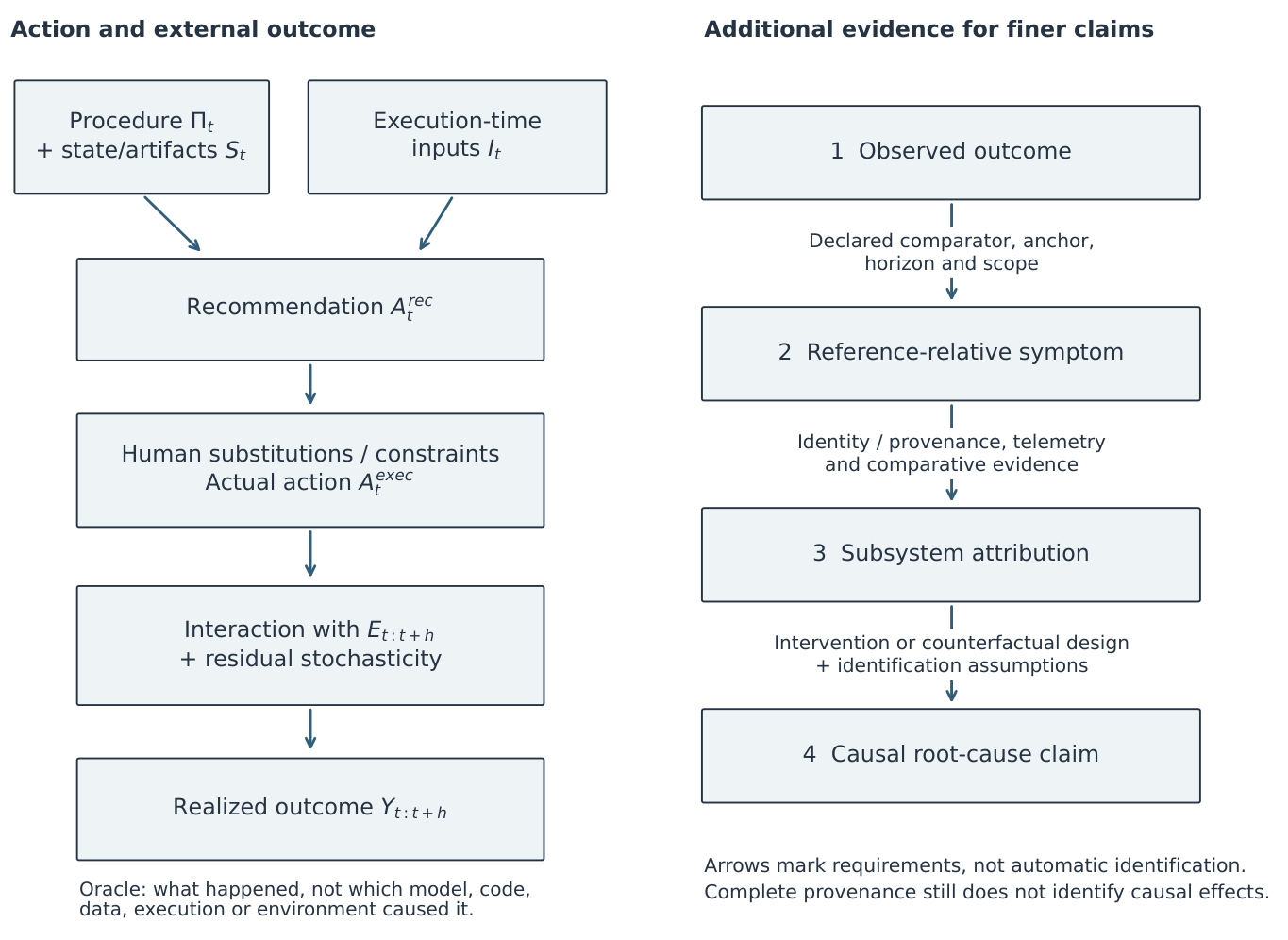
The left separates recommendations from executed actions. More specific diagnoses on the right require additional identification structure; complete provenance alone still does not identify a causal effect.
The paper distinguishes frozen instances, pre-specified adaptive procedures, and ad-hoc development. It proposes per-action binding of code, configuration, models, inputs, recommendations, and executed actions so outcomes can be associated with actual runtime state. Historical bindings are incomplete and the new protocol has not been prospectively validated. This is a framework for diagnostic evidence, not a validated automatic root-cause method.
05 · Cross-Provider Review: Establishing That a Review Is Valid
Cross-Provider Review as a Runtime Contract for Coding Agents: A Controlled Pilot and Fault-Injection Study
Bowen Xu, Boyu Chen · arXiv · 2026-10-07
A plausible critique from a second model does not establish a valid review. This paper specifies a runtime contract for read-only cross-provider review: separate resource pools, bounded execution, complete input, usable output, and durable evidence including exit status for every attempt. Reviews are advisory and arrive after the primary answer; they do not automatically repair delivered code.
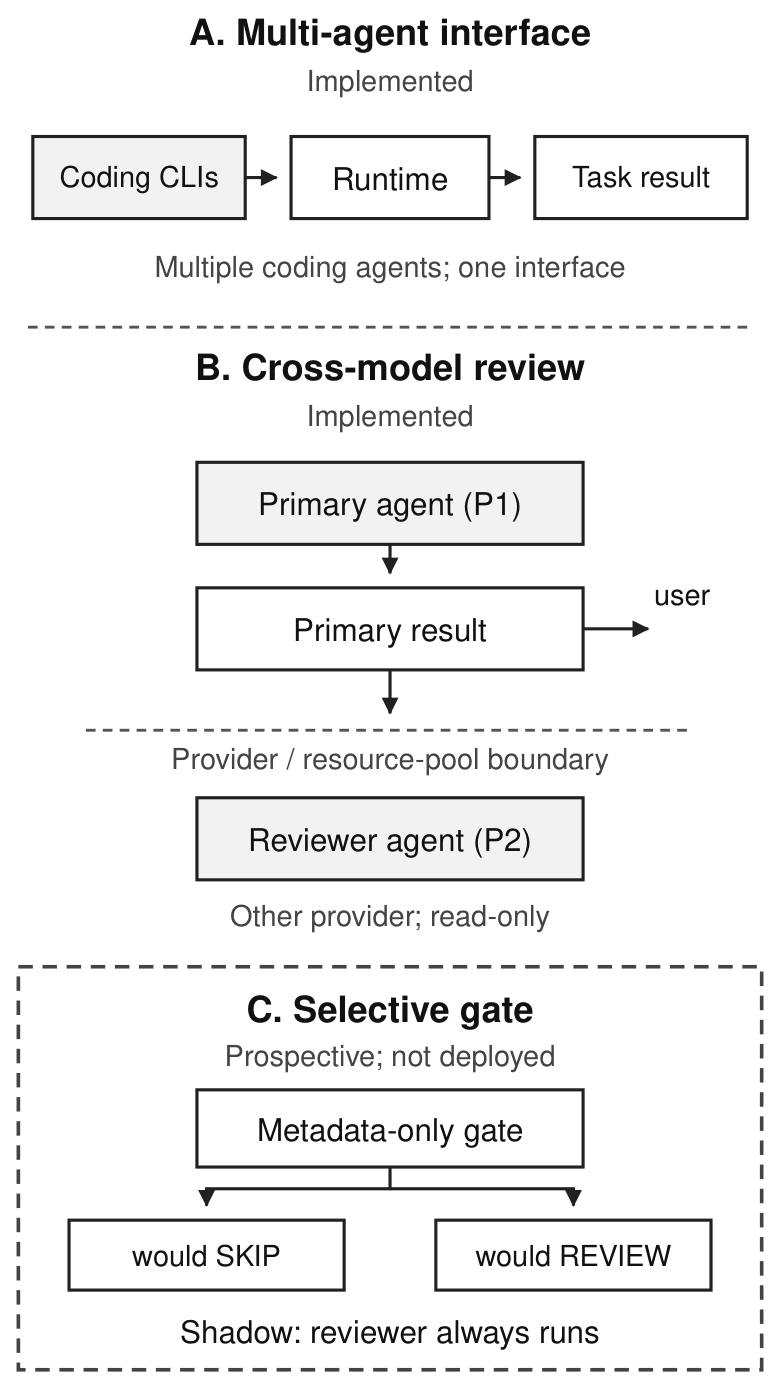
The primary answer reaches the user before another provider reviews it. The lower gate remains prospective; every review still runs during shadow evaluation.
8 of 20 paired development turns receive a material finding, with an exact 95% interval of 19.1–63.9%. Tasks were agent-authored and labels came from one model adjudicator, so this is not an estimated finding rate for ordinary users. Fault injection exposes false success after truncated input, cancellation during process reaping, and nonzero exit with a complete verdict. Missing exit-status records also prevent retrospective scoping of contamination in 25 subsequent formal observations, forcing the measurement-valid cohort to restart. The useful advance is treating “no issue found” and “review failed” as distinct, auditable runtime events.
Another evidence gap in incident response
Original post by ky nichol · @kynichol · 2026-10-07
ky nichol argues that system logs often lack a complete record of what people and agents did during an incident, in what order, and with what effect. He distinguishes scripted remediation of known failures from major incidents spanning teams and vendors, advocating control, execution graphs, verification, and portable operational memory. This is an industry perspective from Cutover’s cofounder, not an effectiveness evaluation. Read alongside OOM-RL II, its useful connection is how action records can support retrospective diagnosis.