What to watch
Agent reliability research is sharpening two stages: interpreting a failure and turning it into an effective revision. SSCBench shows why an available lookup does not establish that an agent saw counterevidence before acting. SkillMorph connects execution traces, suspicious actions, and specific skill edit sites, reducing the arbitrariness of rewriting guidance after an isolated failure. These are the priority readings: one clarifies evaluation claims, the other the mechanism of improvement.
On the systems side, IAPRepair coordinates repair before failure, Zepp revisits the objective of MoE balancing, and ByteExpress reports production RDMA experience. Their shared concern is how an optimization shifts pressure onto other resources. An LMCache security update adds another boundary: once a cache extends beyond a single process, its network interface becomes part of the reliability problem.
In depth
01 · SSCBench: Establish when counterevidence arrived before interpreting failure
SSCBench: Evaluating the Evidential Validity of Fault-Injection Tests for Tool-Using LLM Agents
Xincheng He, Wanli Dong, Zhaoqiang Guo, Yan Liu, Lei Xu · First published: 2026-10-08
Fault adoption can occur under different evidence conditions
Suppose a flight-change tool reports success without updating the reservation. An agent that tells the user the change succeeded has propagated an error. But if it reads the reservation only afterward, the run does not establish that it persisted despite already seeing a contradiction. Existing fault-injection studies often measure propagation or task outcomes. SSCBench adds the observation conditions needed to support a particular interpretation of those outcomes.
Counterevidence requires more than a correct value somewhere in a database. It must concern the same entity and state or logical request, come from sufficiently authoritative information not changed by the injection to agree with the fault, and refute the assertion using semantics visible to the agent. A product record that appears inconsistent with an order option is insufficient until the execution establishes which variant belongs to that order item.
From a checkable case to evidence actually observed
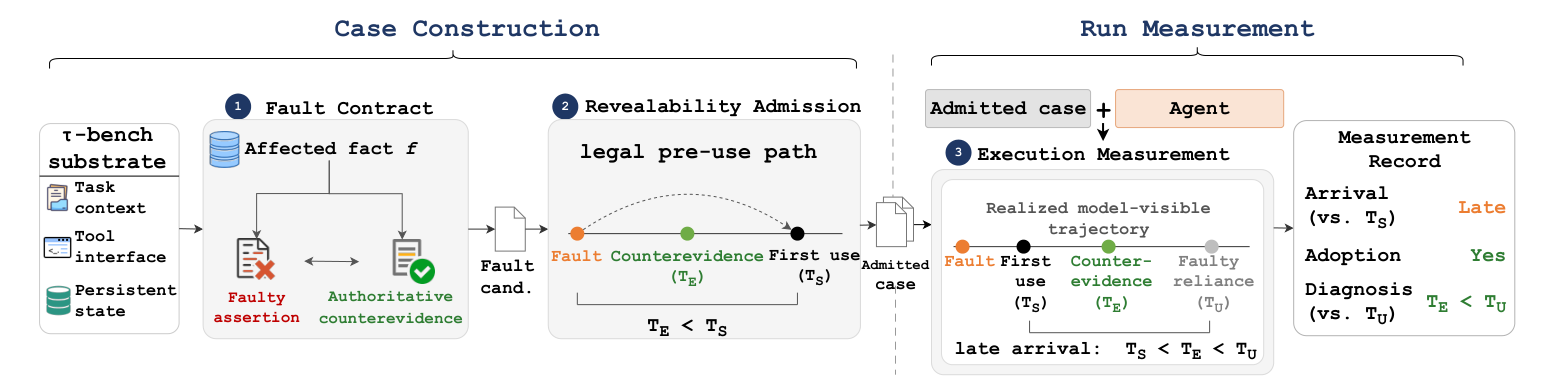
Reading the diagram: define the faulty assertion and authoritative refutation on the left; establish a legal pre-use checking path in the middle; reconstruct evidence arrival, first use, and first faulty reliance from the actual trajectory on the right.
The protocol first defines a fault contract. It then admits a case only if a legal continuation through the normal interface, under the original permissions, can expose counterevidence before the affected fact is first used. Admission establishes an opportunity to discover the fault, not what happened in each run. Measurement reconstructs events from model-visible history; hidden state known to the evaluator cannot count as evidence the agent received.
The authors distinguish first dependent use, first faulty reliance, and counterevidence arrival. First use includes correct and qualified uses, so it does not depend on whether a run ultimately adopts the fault. Executions are classified by evidence arriving before use, after use, or never within the observed run. Undecidable cases remain separate from absent evidence. The output records adoption alongside its evidential condition and decidability.
The denominator changes with the claim
Experiments cover the retail and airline environments of τ-bench, four fault operators, five agent configurations, and 1,191 faulted executions. A configuration receives a faulted task only after solving its clean counterpart. The primary analysis uses the first repetition for each configuration–seed pair. Of 141 evaluable WriteEffect executions, 101 adopted the fault. Among these, 44 eventually received counterevidence: only 17 before first use and 27 afterward; the remaining 57 never received it in the observed execution. Describing all 101 as ignoring existing evidence would change the phenomenon actually measured.
Later revision of a statement is also different from repair. Ceasing to endorse an error, preventing the first erroneous action, and undoing an external state change require different evidence. Automated trajectory analysis likewise needs separate validation of adoption verdicts and event locations: detecting an anomalous step does not necessarily locate first faulty reliance.
Read the measurement protocol and evidence-stratified results first. This is a framework for interpreting evaluations, rather than a general error-prevention mechanism. Its empirical conclusions depend on two environments, four injection semantics, and human judgment rules. Arrival-conditioned comparisons are descriptive, not causal estimates of the effect of receiving counterevidence. For AgentOps, the contribution is to report both failure and the information conditions under which it happened.
02 · SkillMorph: Trace suspicious actions to skill edit sites
Trajectory-Guided Fault Localization for Agent Skill Evolution
Yu Ge, Linna Xie, Zhong Li, Yu Pei, Tian Zhang · First published: 2026-10-08
Locate the revision before generating it
Skill files preserve experience for coding agents, but can repeatedly introduce missing conditions or unsuitable workflows. Asking a model to rewrite guidance directly from a failed trajectory can alter apparently relevant passages while leaving the actual omission intact. SkillMorph borrows from program fault localization: identify suspicious actions, then trace them to edit sites in the skills. The model and execution harness stay fixed; instructions and associated resources evolve.
The method does not assume natural-language instructions have the observable coverage semantics of code. Reading a whole file does not prove the agent followed every instruction. Observable actions instead form an intermediate representation: they can be compared across successful and failed runs, while recorded skill reads narrow the search for related guidance.
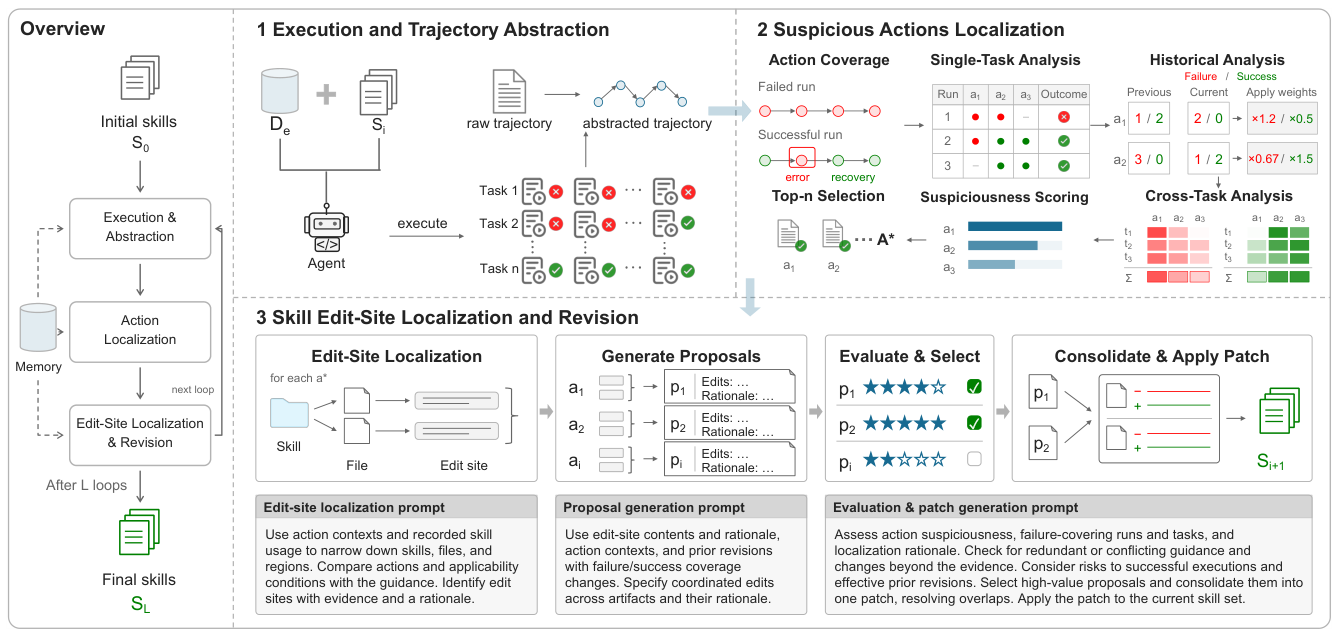
Reading the diagram: repeated executions become comparable action evidence, ranked using history and cross-task statistics above; below, localization narrows from skills to files and edit sites, then proposals are selected and consolidated into a patch.
Each loop repeats the evolution tasks and abstracts raw trajectories into before-state, action, and after-state transitions. Successful traces are retained too. If an action introduced an error later repaired within a successful run, it still supplies failure evidence; otherwise final success would hide both the defect and recovery cost. SkillMorph compares failure and success coverage across runs of the same task, adjusts weights using changes between loops, and aggregates across tasks to prioritize actions more consistently associated with failure.
A localization agent uses action context and recorded skill access to narrow from skill packages to files and line ranges, explaining missing, conflicting, or inapplicable guidance. Proposals can coordinate edits across multiple files. Selection checks duplication, risks to successful behavior, and revision history before producing a consolidated patch. Models still interpret these relationships; suspiciousness scores do not prove that a skill caused a failure.
Gains extend to consistency across repeated executions
The authors use Claude Code with DeepSeek-V4-Flash-0731, using the same model for execution and evolution. SWE-Skills-Bench contains 49 skills with ten tasks each. Two five-task folds exchange evolution and evaluation roles, producing results across 490 held-out tasks. Each evaluation task runs three times: pass@3 means at least one success, while pass³ requires all three to succeed.
| SWE-Skills-Bench metric | Original skills | CAP-Evolve | SkillMorph |
|---|---|---|---|
| pass@3 | 82.45% | 92.24% | 95.51% |
| Trial-level accuracy | 75.44% | 89.39% | 92.24% |
| pass³ | 67.96% | 84.90% | 88.37% |
CannBot has only 15 held-out tasks. SkillMorph solves 14 in all three trials; CAP-Evolve also solves 14 at least once, but only 11 consistently. The resulting 93.33% is not a broad estimate of kernel-generation success. Evolution has a cost: a loop averages approximately 49 minutes per SWE skill and 127 minutes for CannBot, with three and five loops respectively by default.
Removing edit-site localization lowers SWE pass³ from 88.37% to 82.24%, supporting the locate-before-revise design. Nevertheless, the full method still introduces regressions on some tasks. Six accepted skill-revision pull requests from a collaborating team provide practical evidence, not proof that all generated kernels are faster. Prioritize the localization workflow, ablations, and regression analysis. This method makes improvement evidence inspectable; its gains still need testing across other models, task distributions, and verifiers.
Systems developments
03 · IAPRepair: Schedule migration, reconstruction, and switch aggregation together
IAPRepair: In-Network Aggregation Enhanced Proactive Repair for Erasure-Coded Storage System
Lei Liu, Yong Wang, Junqi Chen, Yangfan Liang, Qian He, Baokang Zhao · First published: 2026-10-08
When an erasure-coded storage node is predicted to fail, data can be migrated directly or reconstructed from healthy nodes. Running both concurrently can overload the same receivers. IAPRepair normalizes load by available bandwidth, jointly assigns reconstruction providers, replacement nodes, and migration tasks, then spends limited switch aggregation state on reconstruction blocks that most need receiver-side relief.
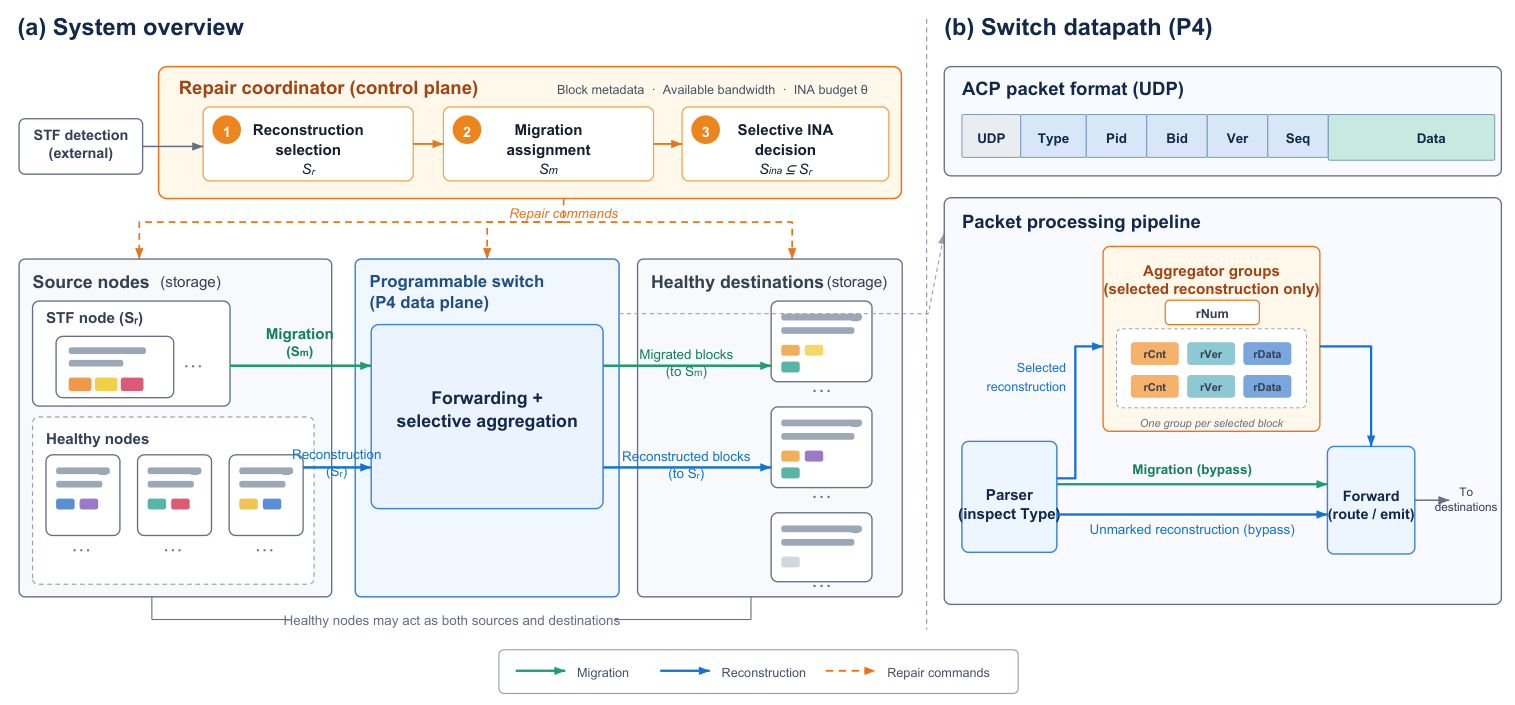
Reading the diagram: the top selects reconstruction, migration, and aggregation; below, only selected reconstruction flows enter switch aggregators, while the remaining traffic is forwarded directly.
The prototype uses a Tofino switch and 16 storage nodes, with default RS(9,6), 8 MB blocks, 512 stripes, one soon-to-fail node, and emulated heterogeneous available bandwidth. Across the coding-parameter experiment, the authors report 47.83%–68.04% shorter repair time than SelectiveEC. These are repair results for the specified hardware and loads; larger scheduling scales are assessed separately through simulation. The interesting contribution is joint scheduling, beyond aggregation alone. Benefits still depend on sufficient warning from failure prediction and available switch state.
04 · Zepp: Constrain balance and optimize communication
Zepp: Accelerating Distributed MoE Serving under Relaxed Balance Constraints
Chang Chen, Andrew Yang, Tiancheng Chen, Jiangfei Duan, Xinwei Qiang, Zhongkai Yu, Xiang Fang, Yufei Ding · First published: 2026-10-08
Making MoE expert loads more uniform can increase communication. Zepp treats GPU and NIC balance as constraints and prioritizes reducing bottleneck inter-node transfers. Replicas keep tokens local where possible; split redistributes NIC traffic, merge removes duplicate transfers, and scheduling overlaps communication with expert computation and intra-node weight swaps.
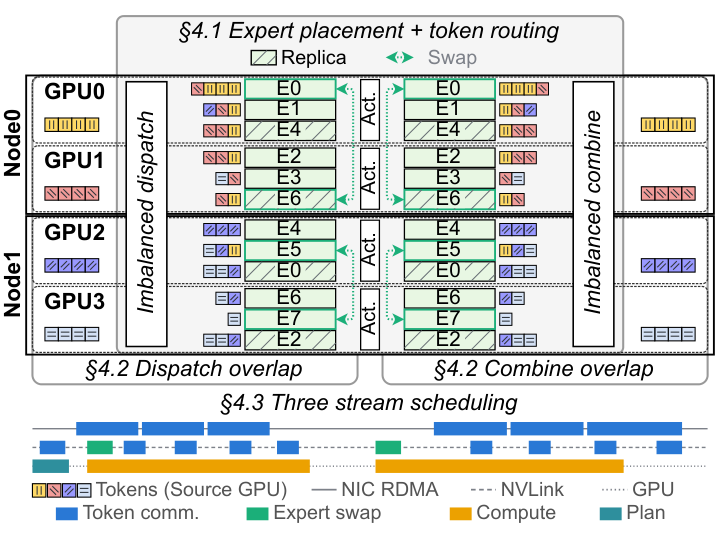
Reading the diagram: replicas, routing, and expert swaps are coordinated above; below, token transfers, expert-weight movement, and computation overlap on the timeline.
Using Kimi-K2-Thinking and Qwen3-235B-A22B routing traces, BF16, and two extra expert slots per GPU, the main multi-node layer experiments report a 1.86× geometric mean speedup over the fastest competing baseline in each configuration. The maximum 6.68× instead compares against A2AV+GEMM: the baselines cannot be interchanged, nor can these layer results be treated as whole-system gains. Read how communication is removed before examining how it is hidden. Historical placement and the intra-node scope of swaps also bound adaptation to abrupt demand shifts.
05 · ByteExpress: RDMA gains depend on software coordination
Deploying RDMA for Distributed Inference and Training At Scale
Yibo Huang, Yi Cui, Yukai Huang, Huaping Zhou, Jiancong Tong, Zhaoyu Wu, Gen Miao, Haoran Wei, Boyan Ding, Zhuo Jiang, Jianxi Ye, Yibo Zhu, Chuanxiong Guo, Yang Xu, Jie Wu · First published: 2026-10-08; revised: 2026-10-12
ByteExpress describes ByteDance’s parameter-server deployment: bemalloc coordinates registered-memory lifetimes, logical connections share QPs, receive credits protect receive queues, and a software send window limits outstanding bytes. The RPC layer retains timeouts, retries, replica selection, and TCP fallback.
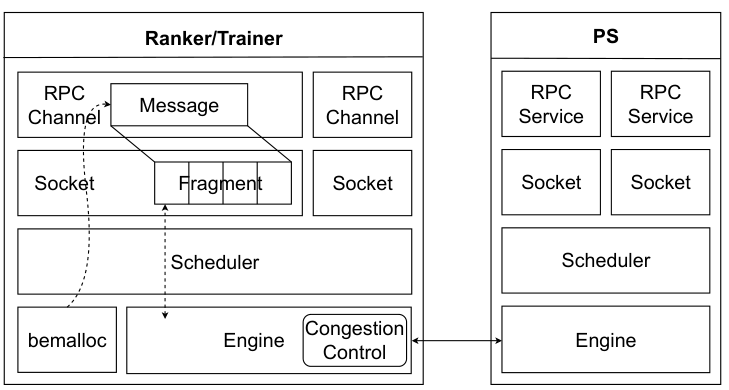
Reading the diagram: RPC requests pass through logical sockets and schedulers into engines; bemalloc supplies registered buffers, while transport control and application recovery cooperate at different layers.
On 300 parameter servers and 124 rankers with 25 Gbps ConnectX-5 NICs, the authors report 35.7% and 43.7% reductions in mean and P99 parameter-fetch latency relative to kernel TCP. These are not end-to-end recommendation latencies. In training, RDMA with hardware congestion control alone was slower; adding the software window brought P99 push latency to 268 ms, 74.0% below TCP’s 1.03 s. The allocation of resource-control and recovery responsibilities is the key reading. No observed PFC pauses during the measurement interval does not justify disabling PFC, and the findings do not directly establish gains for LLM collectives.
The security boundary of cache services
LMCache: Unsafe deserialization in multiprocess transport
Original post: @DailyDarkWeb · 2026-10-08
Original JFrog disclosure · 2026-10-07; LMCache project announcement · 2026-10-13
CVE-2026-105192 concerns the multiprocess ZeroMQ transport: device IPC descriptors reach pickle during message decoding, allowing an unauthenticated peer with network access to trigger code execution. The CVSS 9.8 assessment assumes a routable bind; default localhost operation and in-process mode without that port are different exposure conditions. The project announcement identifies versions 0.3.9–0.5.5, 0.5.6 release candidates, and pre-fix development branches as affected. It states that a fix using versioned, type-validated MessagePack descriptors merged into the development branch on October 12 and was planned for 0.5.6. Thus, “unpatched” describes the original post’s point in time. The changed wire format requires workers and servers to be upgraded together; eliminating this deserialization path does not complete transport authentication. Neither primary write-up offers a suitable architecture diagram, so this item remains a textual explanation.