What matters in this issue
These papers examine the evidence driving automated improvement. An agent platform may keep receiving correctly formatted scores without noticing that its judge ignores a critical criterion. A training program may return nearly zero loss while floating-point rounding removes a gradient that should still exist. Both turn apparently healthy behavior into mechanisms that can be tested.
Start with the admission conditions for self-improvement. The study measures verifier trustworthiness separately from recovery after a bad change, directly informing release control in AgentOps. It does not establish a universal safety threshold. The softmax paper supplies concrete algebraic repairs and traces how rounding becomes training spikes and distillation drift in small learning tasks. The first is relevant to automatic repair pipelines; the second to diagnosing high-confidence predictions and distillation from nearly matching teachers.
01 · Self-improvement admission: measure the verifier and retain the old version
Recoverability and Verifier Strength: Two Measured Preconditions for Unattended Agent Self-Improvement
De Wang, Peng Qi · First published: 2026-10-20 · NeurIPS 2026 Workshop: AgenticOS
Who checks an automatic repair?
An agent that derives prompt patches from failed traces, calls a judge, and deploys automatically already forms a self-improvement pipeline. This paper examines admission after patch generation: can the judge distinguish good changes from bad ones, and can the system recover its earlier behavior after a mistaken decision? It makes release control itself a research subject, beyond optimizing prompt scores.
Verifier strength, σ, is the Matthews correlation between a verifier and a trusted reference check. A judge that always approves can achieve respectable accuracy under class imbalance, but receives zero strength here. Recoverability has three components: whether rollback needs another approval, whether task outcomes after restoration match the original, and how many outcomes changed while the revision was deployed. The last component captures why restoring configuration cannot retract an answer or refund already delivered.
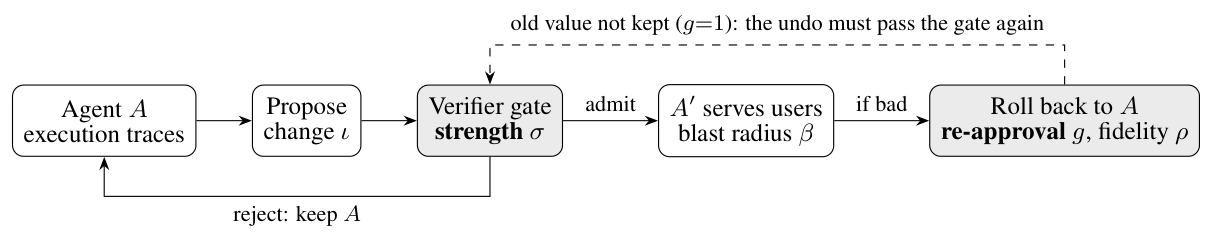
Reading the diagram: follow a change from left to right into deployment. The lower path retains the old version after rejection; the upper dashed path makes rollback depend on the judge again when the old version is missing.
The platform retains previous values and registers verifiers with their measured strength. Unattended deployment requires rollback without fresh approval and strength above a domain-specific threshold. Missing measurements or versions produce an explicit refusal to decide automatically. What matters is the version actually retained: a weight update with its previous adapter preserved can also be rolled back. The authors still require human approval for those updates because their verifier is inadequate.
Returning a score does not establish understanding
Testing a production training-data diversity judge, the authors found that 9 of 37 configurations returned an identical score across different imbalance levels. Apparent consistency could conceal failure to penalize a few tasks dominating the data. They propose two acceptance tests: remove the signal being judged and check whether request settings actually take effect. These checks need repeating when the model, prompt, or request format changes.
The controlled airline experiments use τ²-bench: 50 tasks split into 30 training and 20 test tasks, with two and four runs per task, respectively. The reference combines database-state and communication checks. The LLM judge reaches σ=0.70, but errors cluster on a few tasks, so repeated runs cannot be counted as independent samples. Restoring a saved prompt yields behavioral agreement of 0.95, matching the stochastic baseline from making no change.
Three regenerated undo patches, produced after hiding the original prompt, average 0.16 below their own baseline. These use training tasks, and all three were rejected by the gate, so they are not a fully symmetric deployed comparison with saved-copy restoration. Separately, three admitted changes evaluated on 50 tasks change outcomes 17 percentage points more often than the noise baseline, with a 95% interval of 8–27 percentage points. Both pass-to-fail and fail-to-pass changes occur; this is not a claim that 17% of tasks suffered harm.
What the evidence establishes
The measurement framework and failure cases deserve close reading. The trend toward selecting worse patches as verifier strength falls is not statistically significant; 20 test tasks cannot establish a universal threshold. End-to-end evidence covers prompt edits only, and the rule was applied retrospectively on one platform. It does not demonstrate production safety for tool, skill, or weight updates. The recovery experiments and false-admission analysis are useful next stops: similar overall correlations can conceal different risks of approving a bad change.
02 · Softmax repairs: preserving small gradients that should still exist
A Fix for Softmax and Cross-Entropy · Authors’ project page
Jonathan T. Barron, Dan Gnanapragasam, Michael Tschannen · Google DeepMind · First published: 2026-10-22
Errors can survive subtracting the maximum
Common softmax implementations subtract the maximum logit to prevent exponential overflow. Yet when the target probability approaches one, a tiny denominator increment can disappear through rounding. The target gradient becomes zero while other class gradients remain positive. The paper calls this Softmax Collapse: gradients that mathematically sum to zero lose that balance in the implementation.
The second problem concerns soft-target distillation. When student and teacher logits are close, computing their probabilities separately and then subtracting loses small differences. Different forward and backward operation sequences can even leave a nonzero gradient at identical logits. This is Softmax Cancellation. Higher precision can postpone some failures, but cannot substitute for a stable computation path.
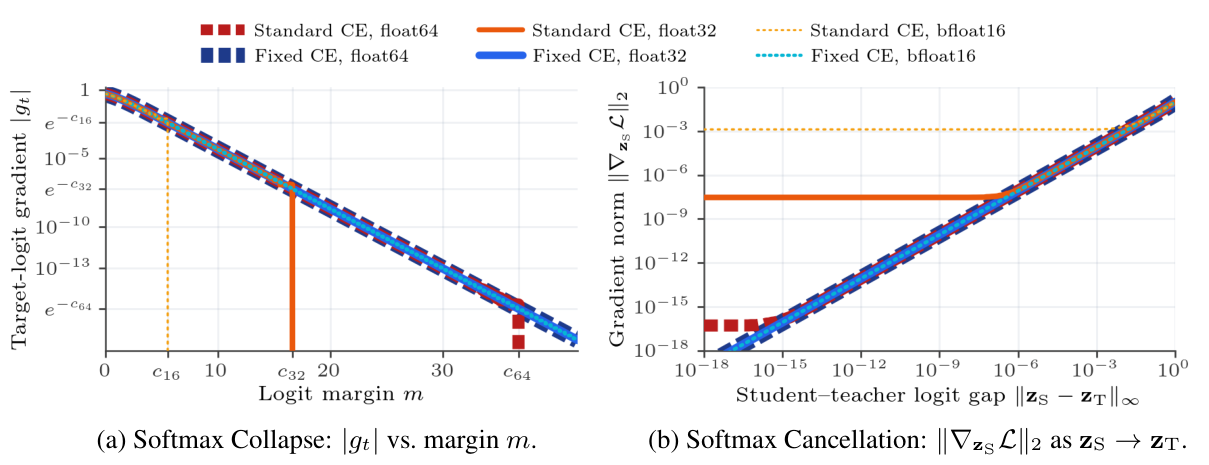
Reading the figure: on the left, standard gradients abruptly become zero at precision-dependent thresholds. On the right, a noise floor remains as the student approaches the teacher. The repaired curves continue following the small gradients that should remain.
Change the computation while preserving the objective
For hard-target cross-entropy, the authors define the margin as the target logit minus the log-sum-exp of the other logits. They exclude the target term and compute the loss through stable softplus. The target gradient becomes the negative sum of the other gradients, avoiding a probability rounded near one followed by subtraction of one:
General log-softmax instead excludes the maximum term before combining through softplus. The distillation repair accepts teacher logits directly, constructs a log probability ratio from student–teacher differences, preserves near-zero information using expm1 and log1p, and corrects the gradient sum. This changes the numerical implementation while retaining the learning objective. A distillation pipeline storing only teacher probabilities must account for the logits input requirement.
How a small error becomes a training spike
The authors connect Collapse to Adam’s state. Once target gradients vanish, second moments decay. When examples cross back below the precision threshold, restored gradients are amplified by a very small denominator, producing a Slingshot spike. The repair lets gradients decay continuously instead of switching abruptly.
For addition modulo 31, the authors train a one-layer, width-64 ReLU Transformer on a 50% training split for 10,000 epochs using full-batch AdamW, learning rate 0.001, and weight decay 1. Across five seeds at ε=10⁻⁸, standard fp32 cross-entropy reaches 94.3±5.4% test accuracy, compared with 100.0±0.0% after the repair. Experiments compare bf16, fp32, and fp64. At ε=10⁻¹⁶, even standard fp64 encounters its own precision cliff, supporting an algebraic repair over simply moving computation to double precision.
The distillation experiment initializes a student with exactly the teacher’s weights on addition modulo 53. It runs 2,000 Adam steps with temperature 4, learning rate 0.002, ε=10⁻⁸, and no weight decay. The student should remain stationary. Standard bf16 drifts and fp32 exhibits a brief KL spike; the repair preserves zero KL and 100% accuracy across precisions. This tests stability at an equivalence point, not how efficiently a new student learns from a teacher.
The value lies in the operator mechanism and its diagnostic boundaries. The paper has no suitable architecture diagram, so the complete error-mechanism figure illustrates the issue here. Evidence mainly comes from small modular-arithmetic tasks. The authors also note that extreme margins and nearly zero student–teacher gaps are uncommon in ordinary large-scale training. There is no production throughput benchmark supporting direct extrapolation; practical benefit depends on the actual loss implementation, precision, and optimizer conditions.