Several studies make agent reliability concrete through inspectable system boundaries. BASIN explains how a brief surge becomes a persistent cache failure. DistDebug-Bench shows why reaching relevant code is insufficient for trustworthy diagnosis. Small-model RCA asks why final decisions can contradict propagation analysis.
Exo and RTP-LLM examine which state and authority should remain stable as policies or models change. A web-fetch study shows that a successful status code need not deliver usable content. Together, these works connect performance and capability claims to state lifecycles, evidence quality, and failure boundaries.
Exo: Editable harnesses with independent state and replacement controls
Exo: An Architecture for Self-Improving Systems at Runtime
Alexander Krentsel, Sylvia Ratnasamy, Ion Stoica, Martin Casado, Ankur Goyal · arXiv · First submitted: 2026-10-30
Exo brings harness revision into an ongoing task. The agent can edit tools, context construction, model calls, and its own improvement procedure, then request a replacement executor. Its distinctive concern is continuity while policy changes.
The architecture separates editable policy from protected mechanisms. History is append-only, artifacts retain earlier versions, and an independent guardian controls activation. Replacement preserves the task environment and execution record. Cost and cache annotations expose opportunities for improvement. In SREGym, the agent developed an incident-snapshot tool that gathered unhealthy pods, revision anomalies, and suspicious logs.
Using gpt-5.6-sol against the same starting policy with editing disabled, evaluation after 21 learning incidents on 20 held-out incidents from the same fault families on different applications reduced median diagnosis time from 81 to 53 seconds and mean model cost from $0.892 to $0.584, with comparable correctness reported by the authors.
The protection is conditional: the default guardian checks build success, which does not establish behavioral correctness or improvement. Rollback cannot undo external effects. The useful AgentOps principle is to separate permission to propose a change from permission to activate it.
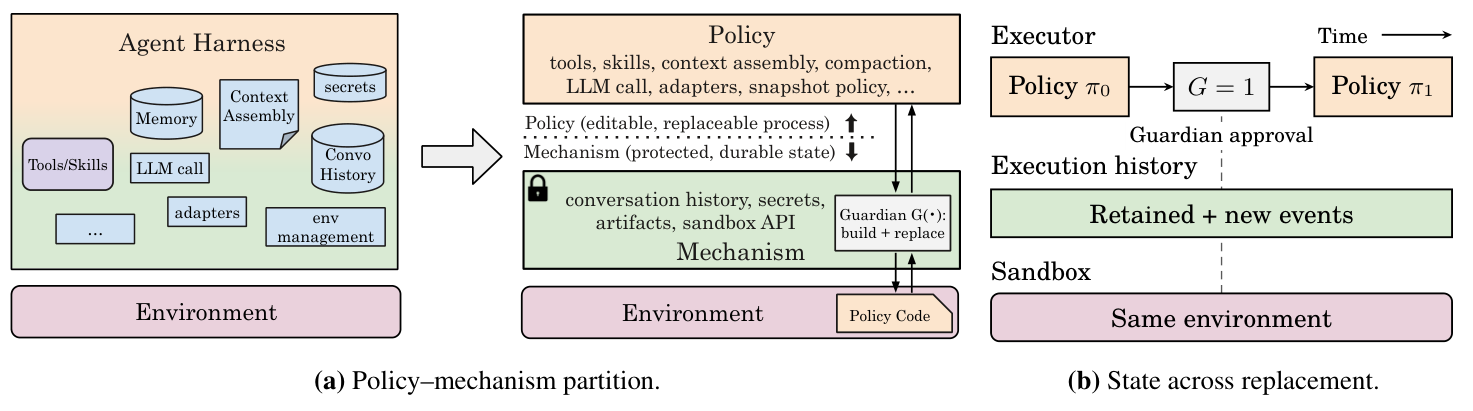
Policy can change tools and context assembly; history storage and activation checks remain behind an independent boundary.
BASIN: Why serving can remain trapped after a traffic surge
When Cache Pressure Becomes a Trap: Metastability in Agent Serving
Chengzhi Lu, Boxi Zhou, Yanying Lin, Dmitrii Ustiugov · arXiv · First submitted: 2026-11-02
A surge can end while the serving system continues to deteriorate. This study connects agent workloads to metastability: service stays degraded at an arrival rate it previously sustained because slower calls increase the population of active sessions, which in turn increases cache pressure.
Agents alternate between model calls and tools, repeatedly reusing growing histories. When a call slows down, its session remains active longer. New sessions continue arriving, expanding the aggregate context working set. Evicted prefixes require more prefill computation on the next turn, delaying departures further. Sessions executing tools still create future reuse demand, so current decode KV occupancy misses part of the pressure. Reserving decode KV before prefill can further amplify waiting.
The real-system experiment replays 216 Terminal-Bench trajectories containing 7,108 calls on SGLang, serving Qwen3.6-35B-A3B in FP8 with one prefill and one decode H100 NVL. At a base rate of 3.3 sessions per minute, a ten-minute doubling of arrivals drives prefix hit rate from about 0.95 to 0.27. For sessions arriving during the following hour, goodput falls from 138 to 17 sessions per hour, roughly 88%. Goodput requires slowdown no greater than four and at least 95% of decode steps meeting a 50 ms inter-token-latency target; it is not simply completed-call throughput. An intervention that terminates residual burst sessions restores service, providing stronger evidence for the feedback mechanism than correlated time series alone.
BASIN coordinates three controls. A fixed priority derived from arrival time and predicted peak context orders admission, prefill, and decode queues consistently. Idle decode memory retains reusable state between calls and is reclaimed preferentially for active decoding. Admission reserves predicted peak working sets, with cache-hit feedback adjusting the budget; sustained excess demand can trigger shedding. The combination protects resident contexts while addressing the long entry queues that ordering alone can leave behind.
The evidence has two layers. The real H200 1P3D prototype uses arrival-time ordering and current-context admission, achieving 1.20–1.70 times Continuum’s goodput across four scenarios. Broader evaluation of the full predictor-driven policy uses a calibrated simulator. The fluid model flags all 17 cache-first simulated deployments but also flags eight decode-first deployments, so its classification is conservative rather than exact.
The contribution is a session-level account of overload that includes tool gaps and future cache demand. Benefits depend on the bottleneck: lending helps little when decode saturates first, and a large cache budget can still admit too much decode concurrency. The most useful parts to read are the intervention, session lifecycle, and goodput definition.
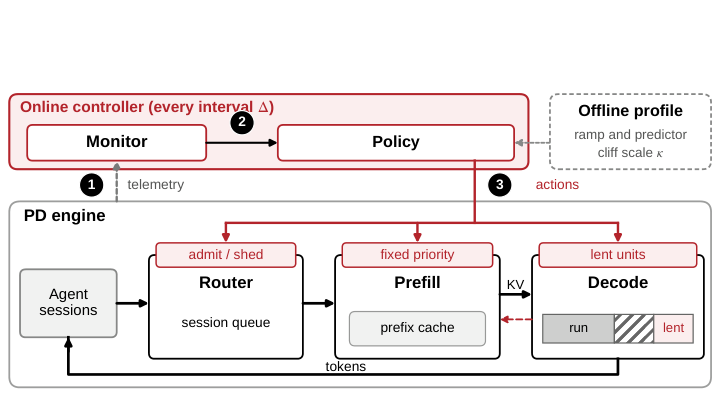
The controller coordinates entry, service order, and lent cache capacity rather than treating them as independent controls.
DistDebug-Bench: Relevant files are only the start of diagnosis
DistDebug-Bench: Can LLM Agents Diagnose Bugs in Distributed Systems?
Yuxuan Jiang, Chenglin Liu, John Rose, Mason Miller, Ruthesh Thavamani, Juntao Wu, Yinwei Huang, Jiahao Xu, Peng Huang · arXiv · First submitted: 2026-11-02
Distributed-system diagnosis requires explaining how causal code produces the observed failure. Finding an error-bearing file or producing a passing patch does not fully measure that capability. DistDebug-Bench instead provides a pre-fix repository, incident report, and available artifacts, then asks agents to identify the code blocks that embody the failure mechanism.
The benchmark contains 120 historical bugs from 11 production-scale systems in five languages, with 218 gold blocks. Three annotators independently inspect each case before reconciliation, excluding tests, incidental refactoring, and defensive changes unrelated to the minimal cause. Multiple blocks are needed in 45% of incidents, about 23% span files, and the median block is only five lines. Effective diagnosis therefore requires both non-local exploration and precise conclusions.
Evidence is uneven: 83 reports do not name the gold method, and 75 lack a usable project-internal stack trace. Workspaces remove future commits and disable network access. A guard checks visible reasoning and tool records for withheld issue identifiers. These measures reduce answer leakage, but cannot rule out pretraining exposure. Selection also favors bugs diagnosable from issue-side evidence with clearly labelable fixes, limiting representativeness.
Across the complete 120-bug comparison, scores average three valid attempts per bug. GPT-6 Astra with Mini-SWE-Agent reaches 83.9% file coverage, 67.7% block coverage, and 42.7% block precision. The 95% bootstrap interval for block coverage is 60.4–74.9%. This is a gap between reaching relevant code and locating causal regions, not an end-to-end repair success rate. Fifteen bugs still have a block-coverage spread greater than 0.2 across attempts.
Trace analysis makes the failure concrete. Searching within the wrong subdirectory can produce a coherent investigation that never sees the causal file. Reading a log fragment rather than searching for exceptions changes the evidence available to the model. Agents often deepen their first plausible explanation instead of reopening alternatives. Naming more code can raise coverage while reducing precision, making tool behavior and context organization part of what the benchmark measures.
The labels have limits too. A different intervention point can explain the mechanism without matching the minimal gold block. In a human audit of 20 zero-coverage diagnoses, four fell into this category. That motivates reading explanation quality alongside localization scores. For AI SRE research, the useful direction is to evaluate evidence acquisition, hypothesis revision, and final localization separately, and to examine performance by evidence strength rather than only aggregate rank.
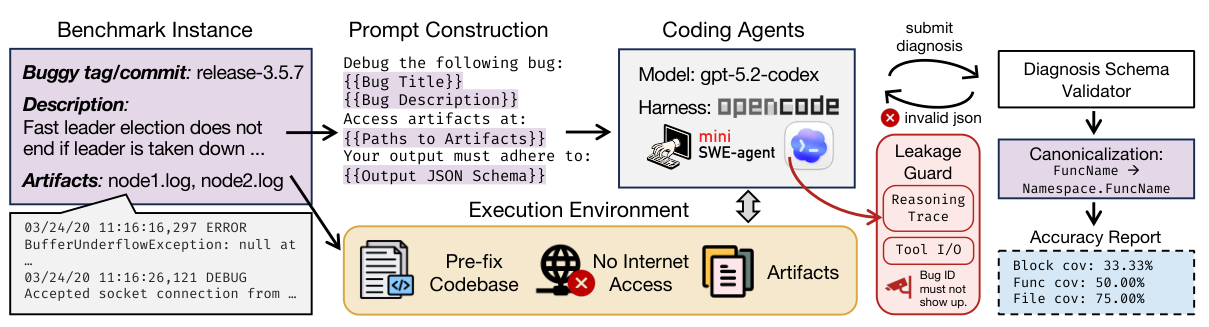
Fixes and answer-revealing clues are withheld; structured diagnoses undergo schema checks, symbol normalization, and localization scoring.
Small-model RCA: Normal-behavior context and decision-level correction
Fault-Free Profiles and Decision-Level Training for Root Cause Analysis via Small Language Models
Kyoohyun Lee, Woohyeok Park, Taeyoon Kim, Sungyong Baik, Kyungyong Lee · arXiv · First submitted: 2026-11-02
Large anomaly scores need not identify causes, and a model can disregard its own propagation analysis when choosing an answer. This study separates input construction from final decision-making. Short reference windows can misclassify routine cycles as anomalies; the model may then prefer the largest score despite reasoning that points elsewhere.
In OpenRCA Bank, one JVM memory signal exceeds a short-window threshold in 97% of fault-free windows. Using statistics from the complete fault-free period reduces that rate to 4%. The root-cause component appears among candidates in 99% of incident windows, but has the largest anomaly score in only 8%. Candidate availability and evidence interpretation are different problems.
Historical Frequency Profiling adds an Expected Outlier Baseline: how often each metric or log signal is flagged during fault-free windows. Prompts show anomaly magnitude alongside this frequency and place normally rare anomalies first; traces are compared with normal latency. Rarity supplies context rather than proving causality. Candidate components still come from metric filtering: logs and traces do not introduce additional candidates, so reasoning cannot recover a cause excluded upstream.
Biased-Decision Correction resamples continuations from the same reasoning prefix to create preference pairs leading to correct and incorrect decisions. DPO applies loss only after that prefix and updates a LoRA adapter. When ordinary sampling never succeeds, privileged hints can help generate offline positive examples; hints are removed from the training input, and selected explanations are checked against the original evidence. A reviewer model participates in offline data construction, even though online diagnosis can remain local.
With a random 60/40 incident split within each system and scores averaged over eight independently graded responses per incident, the 4B system achieves Exact scores of 39.3%, 48.7%, 11.9%, and 21.1% on Telecom, Bank, Market, and AIOps 2025. Exact requires every requested element—component, fault type, and time—to be correct, so it is not interchangeable with component ranking. Market remains difficult. On component-only GAIA, transfer achieves 68.6%, below FoundRoot-14B’s 88.6%.
The useful contribution is the separation of normal-behavior context from decision training, rather than a blanket small-model victory. Profiling requires identifiable fault-free intervals and reasonably stable normal behavior. Experiments also use fault-free data before and after incidents, so they do not establish strictly past-only online performance. Profile maintenance under operational drift remains a deployment question.
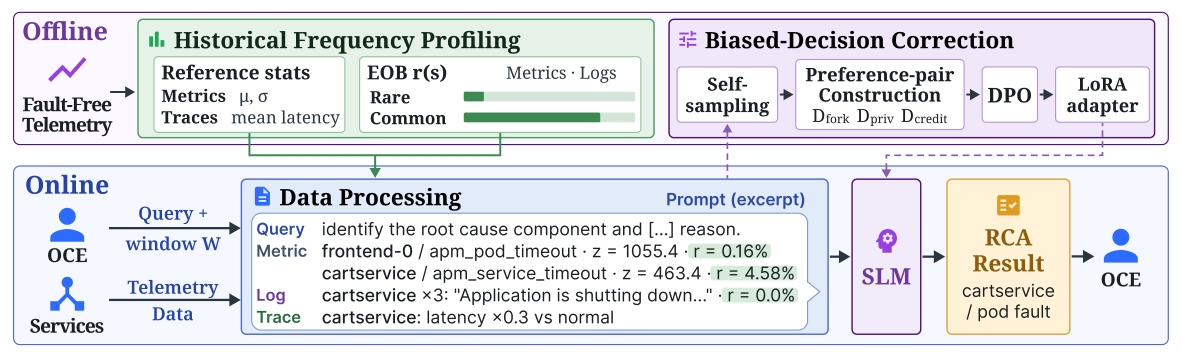
Offline profiling estimates normal-period anomaly frequencies and trains a LoRA adapter; online diagnosis combines those frequencies with incident telemetry.
RTP-LLM: Separate model evolution from state lifecycles
RTP-LLM: Building an Evolvable and Reliable LLM Inference Engine at Alibaba Scale
Jiarui Guo, Zhi Zhang, Boyu Tan et al. · arXiv · First submitted: 2026-10-31
RTP-LLM documents Alibaba’s transition from a Python service layer to C++-first integration, then to separated model execution and serving control. Model semantics now live in Python/PyTorch, while scheduling, KV management, and resource coordination remain in C++, reducing repeated translation of reference implementations.
The reliability mechanisms are especially useful: submitting an asynchronous cache transfer does not make its destination reusable. Requests, transfers, and retained cache entries hold separate references; blocks become available only after every owner releases them. A response timeout does not immediately free KV still used by asynchronous work. New state types can still require changes on both sides of the interface.
Of four model-enablement examples, three change fewer than 100 serving-layer lines, while DeepSeek-V4 requires 5,207, illustrating the boundary of reuse. Production performance covers seven days in one cluster for each of three applications. Reported hourly mean TTFT stays below two seconds and TPOT below 20 milliseconds; these are not per-request or tail-latency guarantees. The report is valuable for Ops4LLM teams studying cancellation, cache consistency, and regression coverage.
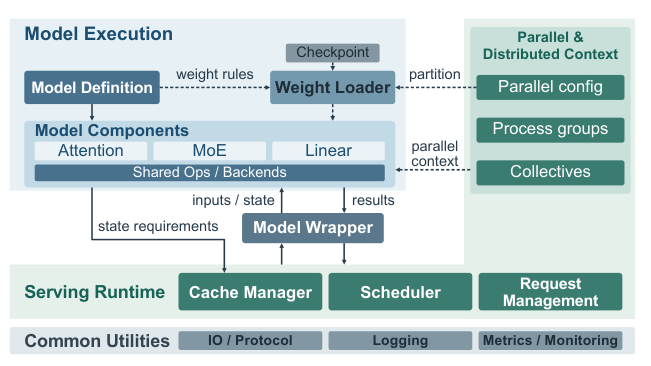
Models describe computation, weights, and state needs; the shared runtime handles scheduling, allocation, and reclamation.
Silent fetch failures: HTTP 200 can contain no usable page
When 200 OK Is Not an Answer: Silent Fetch Failures in Agentic Web Content Acquisition
Shuyang Zhang · arXiv · First submitted: 2026-10-31
A web agent treating HTTP 200 as successful reading may actually receive an application shell, challenge, or substitute homepage. This study fetches 10,307 URLs over three days using static and rendered clients, including ordinary pages, random nonexistent paths, and ExpertQA citations, then classifies the returned content.
Automatic labels mark 20.9% of static-200 pages unusable. Reweighted review lowers the held-out test estimate from 25.5% to 20.0%. Review primarily used another LLM; an independent human blind check agreed on usability for 82.5% of decidable items, so the dataset is not wholly human-validated. Status-only treatment also inflates apparent citation drift from 5.8% to 21.9%.
Combining text length, random-path similarity, and redirect-to-root checks recalls about 86% of unusable reviewed responses at roughly 6% false alarms. Absolute rates depend on the single vantage point and collection window, and rendering can fail too. The transferable lesson is to report what a fetch contains and distinguish missing content from genuinely changed evidence.
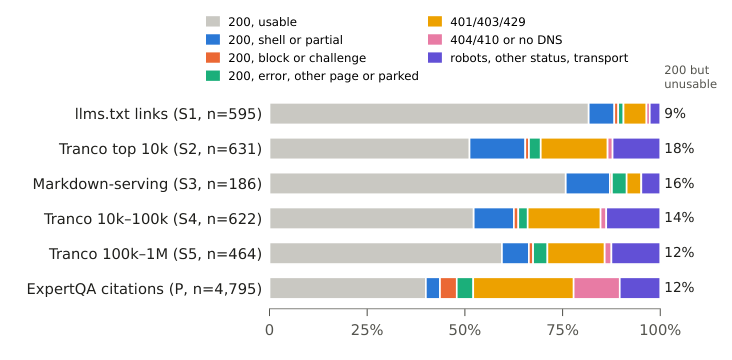
The chart uses all pages as its denominator; the 20.9% in the text applies only to pages returning 200.
Community: Deterministic simulation for verification
The Workers IO announcement describes running systems with their dependencies inside a deterministic hypervisor, injecting network delays, disk errors, clock skew, and process failures, then reproducing failures. It targets verification after rapid code generation. Whole-system exploration and replay are worth following; the claimed millions of scenarios and hardening efficiency remain vendor statements without coverage, overhead, or independent measurements in the short post. The original post was published on 2026-11-02 UTC.
Community: Paige keeps investigation in a shared evidence space
PagerDuty’s post links a complete engineering article, published on 2026-11-03, about SRE Workbench, Deep Investigation, and code-derived topology. Investigations retain competing hypotheses, direct and circumstantial evidence, and rejected explanations, updating as telemetry, incident transcripts, and human guidance arrive. Topology primarily combines static extraction with cross-repository facts; AI helps extend extraction rules offline. The contribution is traceable evidence and hypothesis revision beyond simply adding tools. The authors acknowledge incomplete incident replay and a live benchmark that cannot reproduce all the value of human input. This vendor engineering report does not establish general cross-product superiority.
Community: Identify where observability tasks fail
This APEX-SWE discussion distinguishes missing evidence, incorrect diagnosis, and failed repair. Mercor’s official leaderboard lists Opus 5.5 at 69.8% in Observability, consistent with the post’s description of roughly three in ten tasks not passing. The domain evaluates diagnosis and remediation with production-style telemetry. Its score is not directly comparable to DistDebug-Bench’s block coverage, and failed tasks need not share the same diagnostic error. Stage-specific failure records would better indicate whether retrieval, reasoning, or validation needs improvement. The original post was published on 2026-11-03 UTC.