Every service can return successfully while the user’s result deteriorates. Mallika Rao’s architectural article places that problem in distributed-systems terms: once a system chooses tools, evidence, and subsequent steps at runtime, reliability must observe whether decisions are appropriate as well as whether requests complete. This is design analysis and a discussion of patterns, without performance experiments for a new algorithm.
Original: From Microservices to Agents: the Next Evolution of Distributed Systems
Mallika Rao · Reviewed by Rafał Gancarz · First published: 2026-10-19
Where additional uncertainty enters
The article contrasts decomposing functionality in microservices with decomposing decisions in agent systems, discussing control flow, contextual state, and failure semantics. This highlights a design emphasis, but should not imply that traditional distributed systems lack dynamic paths, semantic errors, or quality degradation. A more precise engineering interpretation is that model-driven execution choices require explicit runtime records of decision quality previously hidden within business logic.
Consider a hypothetical retrieval system that reads three sources quickly and without errors. If its first step selects the wrong sources, even accurate downstream ranking cannot recover excluded evidence. Network success rates do not explain that failure. Diagnosis requires knowing the available candidates, the basis for selection, what was actually retrieved, and whether the final task satisfied user intent.
This example also shows why more recorded text does not automatically mean better observability. Keeping only the final answer hides where information was lost; retaining all intermediate outputs without relationships still makes reconstruction difficult. A practical goal is structured events connecting inputs, selections, actions, and outcomes, rather than dependence on unverifiable descriptions of internal thinking.
Checkable boundaries between planning and execution
The article discusses separating planning from execution, specialized agents, runtime evaluation, and tool abstraction. These address variability in reasoning, responsibility, output quality, and interface differences, while also adding coordination costs.
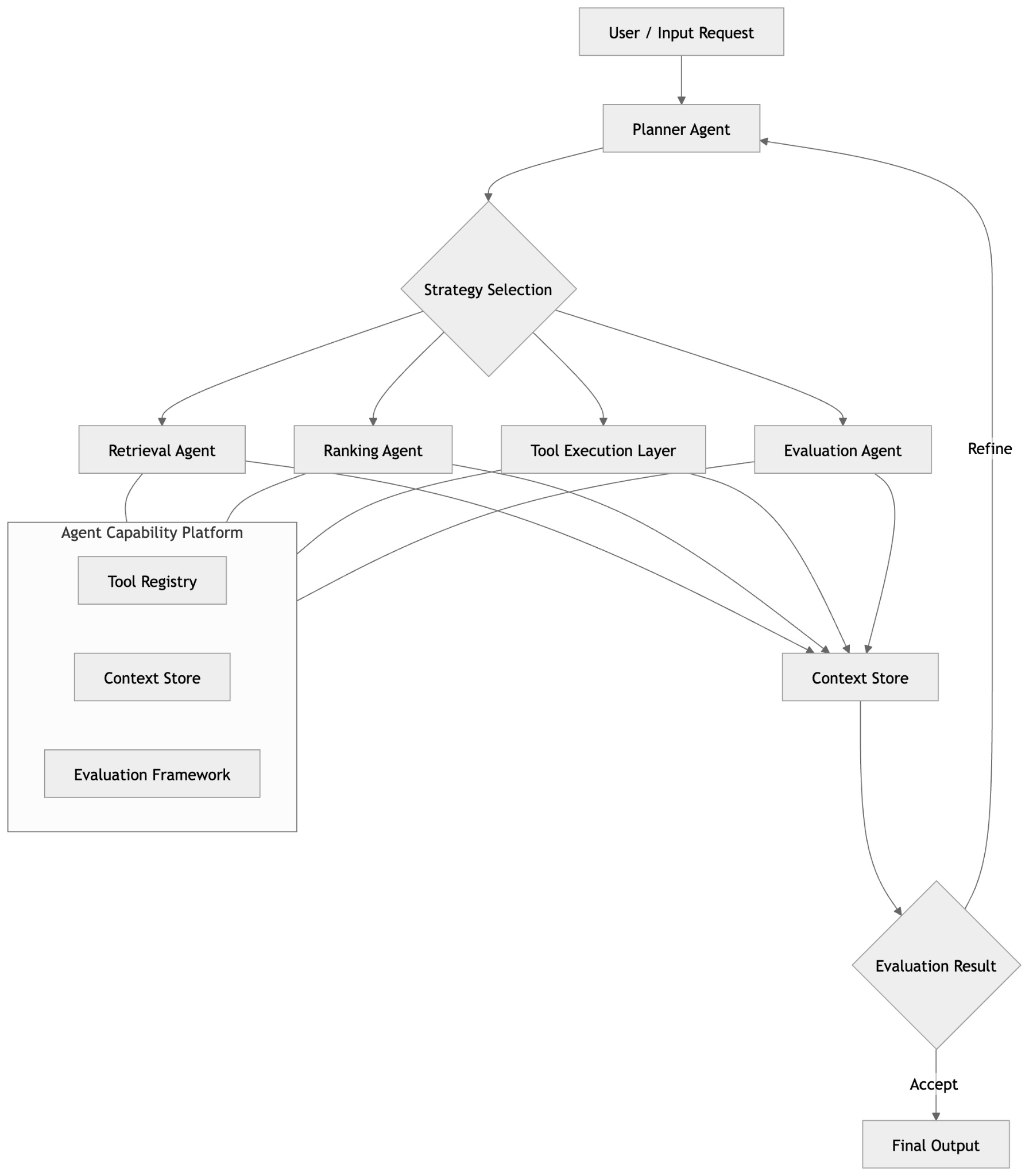
Reading the diagram: follow the request into planning, then the capability branches; evaluation at lower right accepts the result or returns to planning. The original author created this conceptual illustration with ChatGPT; it is not a validated deployment topology.
An implementation principle follows: a plan should be treated as an execution input that still needs validation. Tool-argument validity, operation permissions, and downstream output contracts can be checked independently of the model. A problematic plan may then be caught before its effects expand. Passing formal checks still does not establish that the plan satisfies the user’s goal; interface validation cannot replace semantic evaluation.
Decomposition also has costs. An evaluator adds waiting, context transfer, and another source of mistaken judgments. A specialist agent requires an account of who owns shared state. More modules are not inherently more reliable. Decomposition has a clear benefit when responsibility boundaries help localize errors and coordination overhead remains acceptable.
Quality feedback can amplify load
The article emphasizes retries driven by quality judgments: an insufficient output triggers more investigation, rewriting, or planning. Each step may be reasonable while the overall loop fails to converge. A persistently dissatisfied evaluator can keep consuming inference and backend resources.
An engineering consequence is that retry budgets should follow the whole task rather than being calculated independently at every node. Multiple planning attempts upstream combined with tool-level retries downstream can produce more requests than either module’s designer anticipated. Individual call latency does not reveal total task cost; cumulative time, invocation counts, and exit reasons need to be connected.
Exit conditions should also distinguish satisfying the goal, exhausting the budget, and lacking evidence. All three end execution, but mean different things to users and subsequent processing. Labeling them all successful hides quality degradation behind healthy infrastructure metrics. This is a concrete interpretation of bounded autonomy, not a protocol validated by the article.
Context is state that changes decisions
Agent state can include retrieved documents, tool outputs, a current plan, and the user’s latest constraints. Sharing that state raises questions beyond delivery: which version arrived, to which step it applies, and whether earlier conclusions remain valid.
Imagine that a user changes a requirement while one branch continues with the old goal and another evaluates against the new one. Each branch might produce a reasonable result, yet their outputs contradict one another. Shared storage alone does not resolve the semantic conflict. Task versions, visibility, and which results may continue downstream still need definitions.
This is where established state-management experience remains relevant. Agents do not remove ownership, consistency, or stale-data problems; they make those problems more likely to appear through answer quality. Architecture must specify state lifetimes and update rules rather than treating a context-store box as a completed memory design.
From health metrics to task evidence
The article proposes observing tool choices, evaluation outcomes, fallbacks, and retries, together with bounded autonomy, deterministic fallback, and progressive rollout. As an engineering extension, those signals should be connected to task-success samples. A sudden change in tool usage could indicate a problem or a change in incoming tasks; a behavioral metric alone cannot determine the cause.
Fallbacks also need explicit capability boundaries. A fixed path may be more predictable but support a narrower task. Quality evaluation should distinguish full completion, degraded completion, and inability to complete. Shadow execution can compare paths, but output agreement alone may mistake a shared error for stability.
One way to apply these principles is to begin with a valuable task path, define its input contract, state updates, and success criteria, and then add autonomous decisions incrementally. This leaves an interpretable reference for comparing behavior. Changing tools, memory, planning, and evaluation simultaneously makes responsibility difficult to locate when quality shifts, even with additional telemetry.
Use this article as a framework for architectural review questions. It provides no quantitative baseline, fault-injection experiment, or reliability guarantee for a particular architecture, so it does not establish that multiple agents outperform existing services. Its useful emphasis is bringing decision paths, state versions, and task-exit conditions into system design, with inspectable evidence behind quality judgments.