A prefix in GPU memory is not equivalent to one on host memory, disk, or shared storage. sference describes how its scheduler turns those different reuse costs into routing inputs across a heterogeneous serving fleet.
Original: Tracking the KV Cache Across a Heterogeneous GPU Fleet · Peter Us / sference · 2026-10-27.
Build the view from engine events
A relay beside each engine subscribes to block-store, removal, and clear events. The scheduler maintains a per-model prefix-block tree whose nodes record replicas, tiers, and data-parallel attention ranks. Walking a request down the tree estimates each replica’s reusable prefix and where it must load that state from.
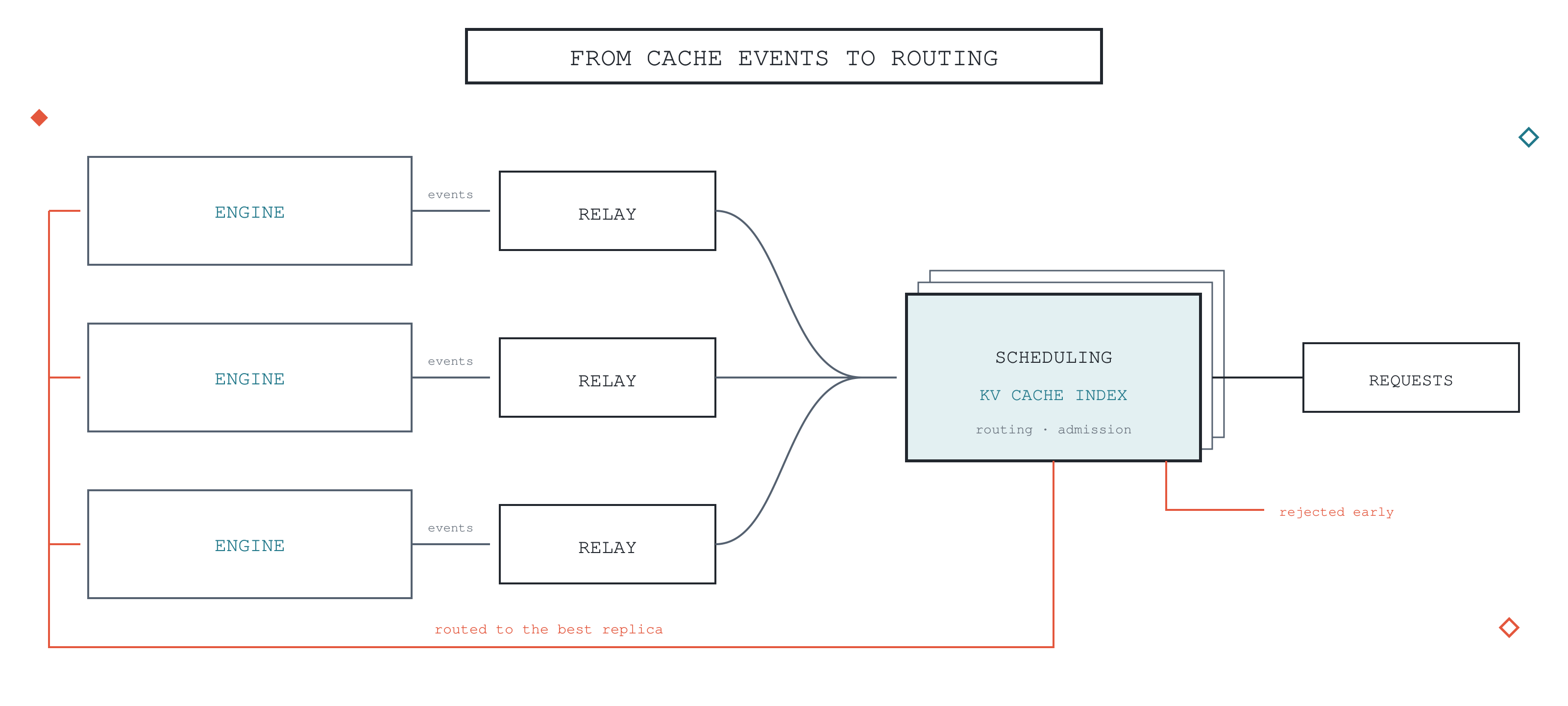
Events build the global view; the scheduler then routes to a suitable replica or rejects a request early.
Normalization must preserve semantics: eviction may invalidate descendants in one engine but not another; hashes differ; speculative decoding can use token-pair keys. The relay adapts these differences, and engine upgrades require event-stream checks. This is not a stable standardized protocol.
Staleness remains observable
A tier move creates a removal and a store. Tracking all locations prevents the index from confusing movement with complete loss. Relay snapshots rebuild the index shallow-prefix-first, with staggered replay to avoid synchronized load.
Eviction can still occur after routing but before execution. The scheduler optimistically credits recently dispatched prompts to reduce event-lag effects, while conservatively dropping states whose reusability cannot be established. These address different uncertainties; the view is neither always conservative nor exact.
Hybrid models also need matching recurrent-state checkpoints. Retained KV alone may not support resumption. Missing state-eviction events make indexed prefix length an upper bound.
Compare predictions with actual reuse
The system records predicted cached tokens at routing and compares them with engine-reported reuse after completion. For a typical day, the article reports 93.1% of prompt tokens actually reused, 99.6% coverage of reused tokens by the index, and 0.3% erroneous credit. These have different denominators; none should be casually renamed a 99.6% cache-hit rate. No independent routing control experiment establishes a particular latency or cost gain.
The contribution is a decision-oriented cache view with explicit uncertainty. Prefetching, proactive replication, and globally informed eviction remain proposed next steps, rather than measured benefits of the deployed index.