Dhvani Chheda, Kai Wombacher · NVIDIA · 2026-09-23 · Original article
NVIDIA Cluster Readiness Engine (NVCRE) targets the gap between healthy individual components and reliable distributed execution. It organizes real workloads on Kubernetes, combines topology-aware grouping with hierarchical fault isolation, and turns readiness into a judgment with an explicit test scope and measurements.
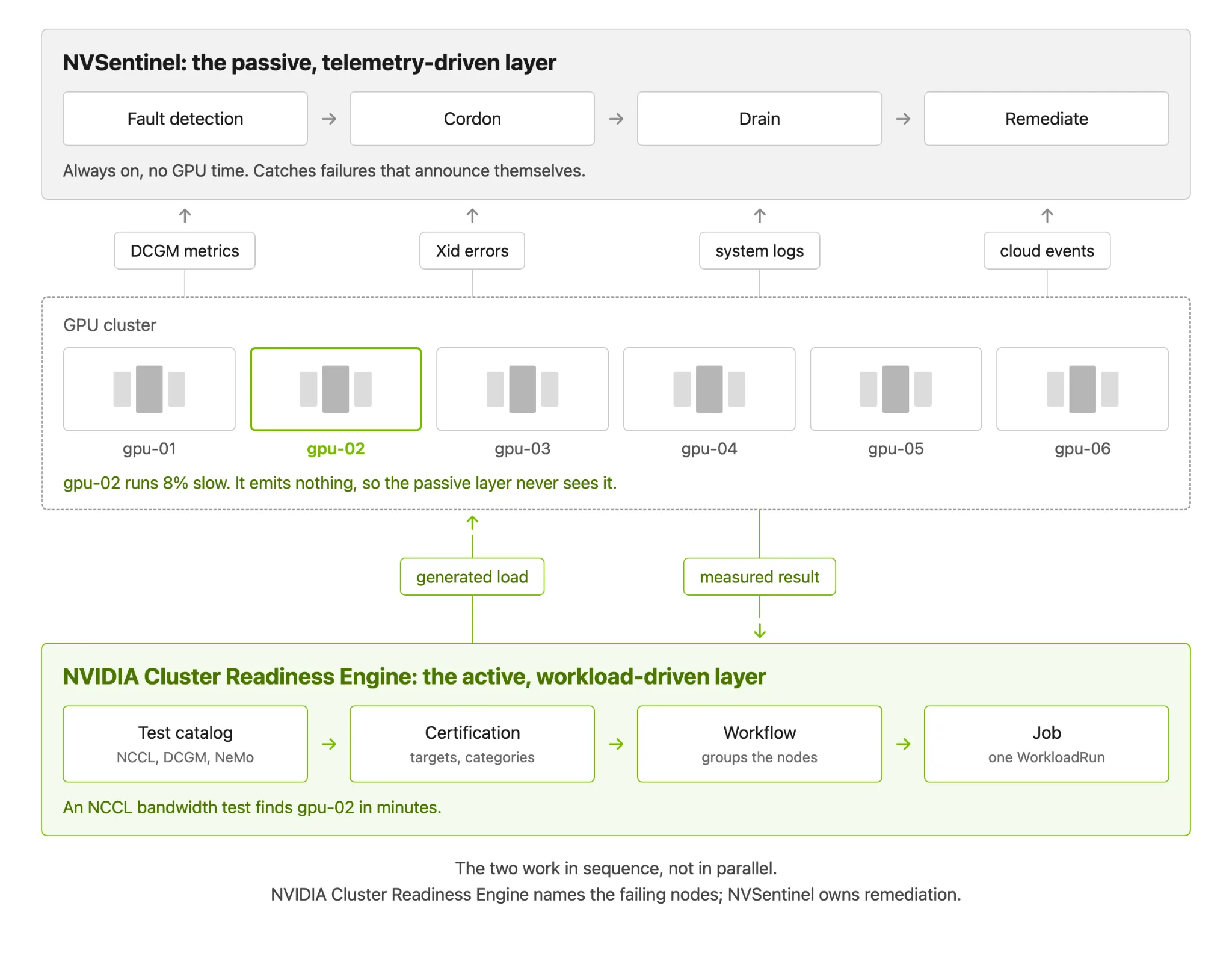
The original illustration contrasts active workload validation with passive telemetry; the slow node is a mechanism example.
Connect execution with attributable results
The official documentation separates Certification, Workflow, and Job: the certification target, category orchestration, and workload execution with results. WorkloadRun offers a lighter interface for ad-hoc runs. Reported reasons distinguish hardware-health findings, threshold violations, and workload failures for downstream operational workflows.
The engineering value is traceability. A failure should lead back to its test category, participating nodes, hardware and software configuration, and measurement conditions. Otherwise a successful retest cannot distinguish a real repair from a changed environment or changed test.
Test scope bounds the conclusion
Single-node, intra-rack, and cross-rack tests exercise different paths. Attach a scope description to each result: nodes, interconnects, message sizes, concurrency, and duration. Passing that test establishes only what its chosen conditions support, not a universal guarantee for future training jobs.
Synchronous execution can amplify a local slowdown into global waiting. Inspect total useful throughput and participant variation instead of checking only whether processes exit. A consistently slow participant can reduce output without producing an explicit failure.
Thresholds also need versions. Hardware generation, communication software, topology, and scale can change their meaning. Loose thresholds conceal degradation; overly strict ones turn normal variation into repeated false alarms.
Group isolation has interaction boundaries
The article’s diagnostic mode divides failing groups and retests them to narrow suspicion. A useful extension is to test whether the symptom survives partitioning. A problem limited to a particular node pair, cross-switch path, or high concurrency may disappear in smaller groups.
Preserve the result “both subgroups pass, the original group fails” rather than treating it as resolution. It points toward group interactions, shared resources, or scale effects. Keep the original failing combination and vary the partitions to test sensitivity to the grouping strategy.
The tests consume GPU and network capacity themselves. Bounding concurrency helps prevent test-generated congestion from replacing the problem being investigated.
Make readiness evidence operationally useful
Active validation and continuous telemetry serve complementary roles. Active tests impose load to reveal latent problems; telemetry follows behavior during production execution. A certification can inform admission or post-repair checks, but it should not become a permanent health label.
An operational extension would define invalidation events: driver changes, NIC firmware updates, topology changes, or repairs should trigger the relevant retests. Before automatically isolating nodes, consider confidence, affected workloads, and rollback.
For chaos engineering, this suggests a concrete experiment: inject known slowdowns, link failures, or configuration deviations, then measure detection coverage, suspect-set size, and isolation overhead. The objective is an accurate, actionable conclusion at bounded cost, not simply a larger count of completed tests.