Benjamin Chislett (NVIDIA) · Official vLLM engineering report
Original: Hyper Optimizing Kimi K3 in vLLM: Moving Fast and Responsibly
How a specialized path is bounded
The article connects faster Kimi K3 decode kernels with the problem of reviewing and maintaining highly specialized code. Its peak speed attracts attention, but the larger contribution is execution designed jointly for hardware, model, and request shapes, accompanied by correctness and performance evidence that actually exercises that execution path.
A general serving framework supports many models and configurations. Its small matrix operations, reductions, and memory handoffs cannot all be ideal for one workload. This CuTe DSL path covers attention, MoE, and communication on eight or sixteen Blackwell GPUs in one multicast-capable NVLink domain. It targets decode batches of 1–64 and selected long-context DCP configurations. These are bounded optimizations, not a universal kernel replacement.
Recovering time between operators
For small-batch decode, matrix shapes and launch overhead often matter more than peak compute. The authors use small-matrix projection kernels at batches 1–2 and split-K at larger batches to expose more parallel work. KDA scheduling also depends on batch size and heads per GPU. For long contexts, DCP shards KV across GPUs; each processes local history before partial results, value projection, and gating are combined.
Handoffs offer further savings. Attention output projection, all-reduce, and residual processing are fused together. Partial results enter NVLink-accessible buffers and receivers continue computation. Some small-batch configurations fuse producers and consumers; larger batches use two-stage reduction to reduce traffic. The target is both individual operator time and when dependent work can begin.
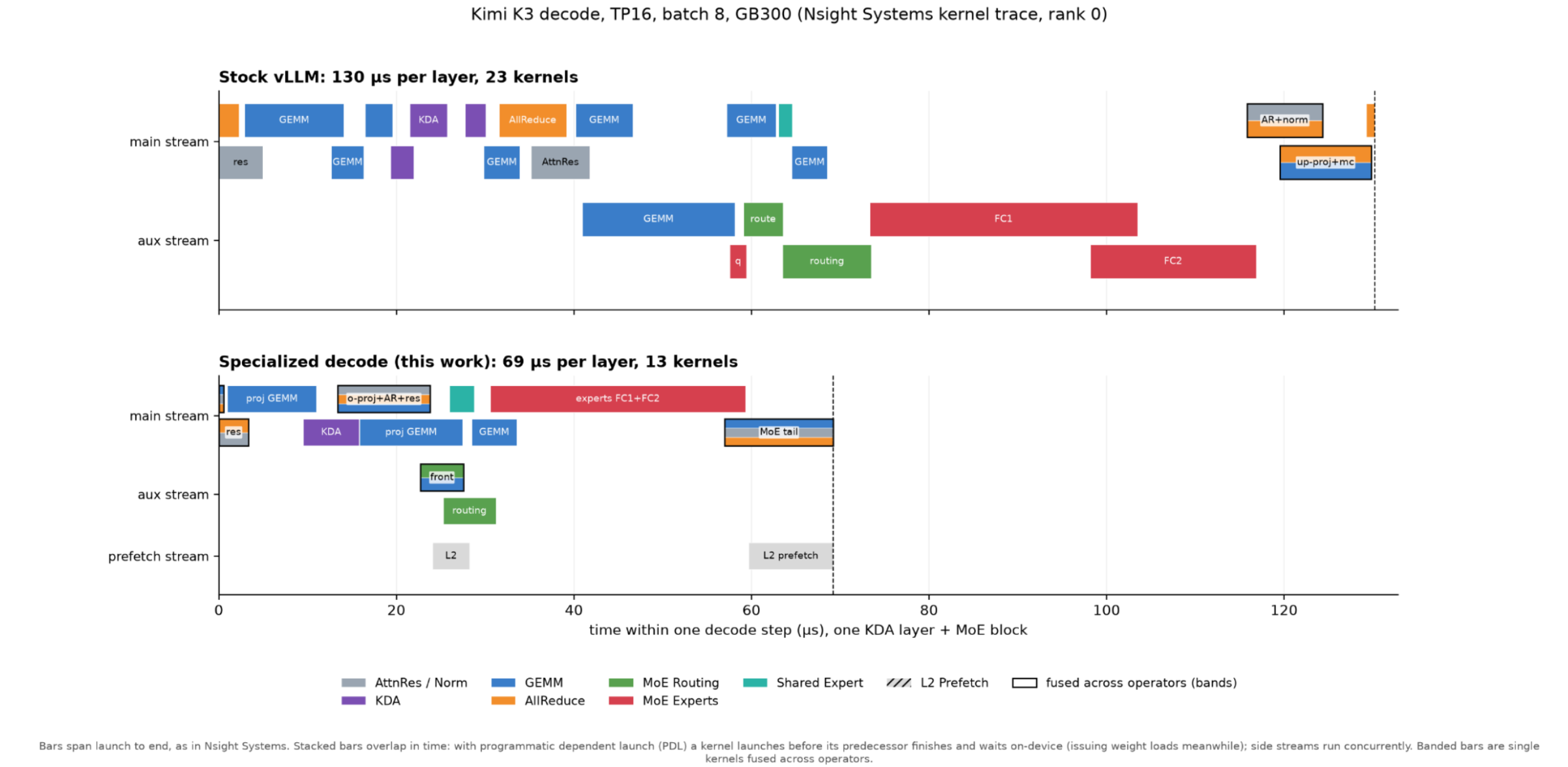
Reading the diagram: this TP16, batch-8 layer trace shows 23 kernels and 130 microseconds above versus 13 kernels and 69 microseconds below. Main, auxiliary, and prefetch streams overlap. A layer-level ratio is not an end-to-end speedup.
MoE preparation repeats work across GPUs in the baseline: each computes full router scores and the latent input projection. The specialized path splits them across TP ranks, combines each rank’s portion into a matrix multiplication, and exchanges results over NVLink. The shared expert runs on another stream, overlapping routing or selected-expert computation. Resource allocation must prevent contention; concurrency otherwise just relocates the bottleneck.
The path also prefetches upcoming weights into cache during communication. Small-batch execution often waits on weight reads, while communication may leave memory bandwidth underused. An auxiliary stream can load weights before their consumer starts. This makes idle intervals and dependencies as relevant as the number of fused kernels.
Three performance comparisons answer different questions
The headline 842 tokens/s uses sixteen GB300 GPUs, TP16, batch 1, DSpark with seven draft tokens, synthetic acceptance length AL=6, input length 1, and approximately 1K output. Stock vLLM reaches 488 tokens/s under the same speculative setup, giving 1.73×. This is decode-only throughput excluding prefill. Fixed acceptance does not predict acceptance on real prompts.
Non-speculative tests better isolate the base decode path. At TP16, the authors report 256.4 tokens/s and 1.88× at batch 1, and 3,606.1 tokens/s and 1.62× at batch 64. TP8 reaches 193.3 and 2,375.9 tokens/s at those endpoints, with gains of 1.58× and 1.31×. Throughput is for the entire TP group; large-batch aggregate throughput is not per-user speed.
AgentX preserves coding-agent session lengths, turns, tool pauses, and reuse patterns while replacing private content with synthetic text. At concurrency 1, reported P90 interactivity rises from 223.7 to 403.2 tokens/s/user, approximately 1.8×. However, this compares an earlier eight-GPU result with the optimized sixteen-GPU result, so software cannot receive all the credit. Pure decode, workload-shaped replay, and comparisons with different GPU counts answer different questions.
The batch-dependent gains also offer a clue: reducing launches, duplicate weight reads, and synchronization waits can matter more at small batches. As actual matrix work grows, fixed-overhead savings may become a smaller share. This is an engineering interpretation of the reported curve, not an attribution of gains to a particular kernel. The figure covers one KDA layer plus MoE block on rank 0; it does not describe every layer, rank, or request’s tail latency.
For speculation, draft length and acceptance length must remain distinct. One controls how many candidates are proposed; the other determines retained work. Deeper drafts add generation and verification cost. Fixed-AL comparisons help isolate the target execution path, while production evaluation still needs completed-request costs under real acceptance behavior. The conditions belong alongside the peak number whenever it is quoted.
Faster code needs targeted validation
One debugging example is particularly useful: the compiler moved activation reads before a synchronization wait. The fix restricted that load type to static weights. Ordinary functional tests may miss such timing errors. Tests that silently fall back to the stock path provide no evidence about the optimization. Long-context MRCR and long-generation AIME25 evaluations also exposed numerical issues absent from isolated kernel tests with mock inputs.
Validation therefore needs both operator-level checks over shapes, inputs, and numerics, and model-level checks of the complete path’s answers. Performance sweeps must cover batches, contexts, and parallelism. MoE tests need real prompts because expert selection changes weight access and reuse. Full-context serving, temperature sampling, and structured output remain required serving features, not optional omissions for faster benchmark numbers.
The proposed fast-track workflow confines specialization to model code and requires runtime clarity about selection, state changes, and return to the stock path. Shared sampling, input preparation, and KV management have a wider impact and still need closer core-maintainer involvement. Isolation sacrifices some optimization opportunities but makes review scope clearer. A Bring-Your-Own-GPU evaluation proposal would let contributors submit standardized result bundles and share validation compute. These remain proposals, not evidence that every evaluation facility is already complete.
Deciding whether the work applies
For comparable GB300, small-batch, low-latency serving, the timeline, supported configurations, and linked PR deserve further reading. Workloads limited mainly by prefill, queueing, or communication across domains cannot inherit the headline ratio. A practical evaluation starts by confirming that the optimized path runs, then compares outputs and persistent state, and finally measures latency and throughput on the target request distribution.
The report does not guarantee quality or cost across all hardware and tasks. Its publication date also does not establish that a stable release enables the path by default. Its most useful engineering lesson is to tie each speedup to specific shapes, execution dependencies, and validation coverage so that performance and maintainability can be reviewed together.