A GPU fault can stall an entire distributed training job, but restoring the workload and repairing the hardware need not finish together. NVIDIA Mission Control 2.5 extends autonomous recovery to Kubernetes workloads managed through NVIDIA Run:ai. The useful change is the division of responsibility: move work toward healthy capacity, remove suspect nodes from scheduling, and complete diagnosis and repair alongside workload recovery. The article explains the workflow without presenting controlled MTTR or training-throughput comparisons.
Original: How NVIDIA Mission Control 2.5 Brings Autonomous Recovery to Kubernetes
Ryan Prout and Casey Dugas · NVIDIA · 2026-10-26
Three components answer different questions
The scheduler determines placement, job recovery determines how execution can continue, and hardware recovery determines which devices should stop accepting work. In the article, Run:ai manages queues, policies, and available capacity. Job recovery uses topology, placement, and failure history to guide recovery. The hardware service monitors node and GPU health and handles isolation, diagnosis, and remediation.
A communication timeout illustrates why the separation matters. It is a symptom visible to a job, not sufficient proof of a damaged GPU. Immediately removing the node could waste healthy capacity; merely retrying could repeatedly place work on the same faulty node. The recovery services need to exchange evidence without sharing one completion condition. Scheduling can use established availability without waiting for every root-cause question to be resolved.
“Autonomous” still operates within policy. How restarts, requeues, and replacement placement occur depends on resource-manager integration and workload type. Teams with other Kubernetes scheduling arrangements should read this as a specific product integration, rather than assume identical behavior on every cluster.
One failure creates two recovery paths
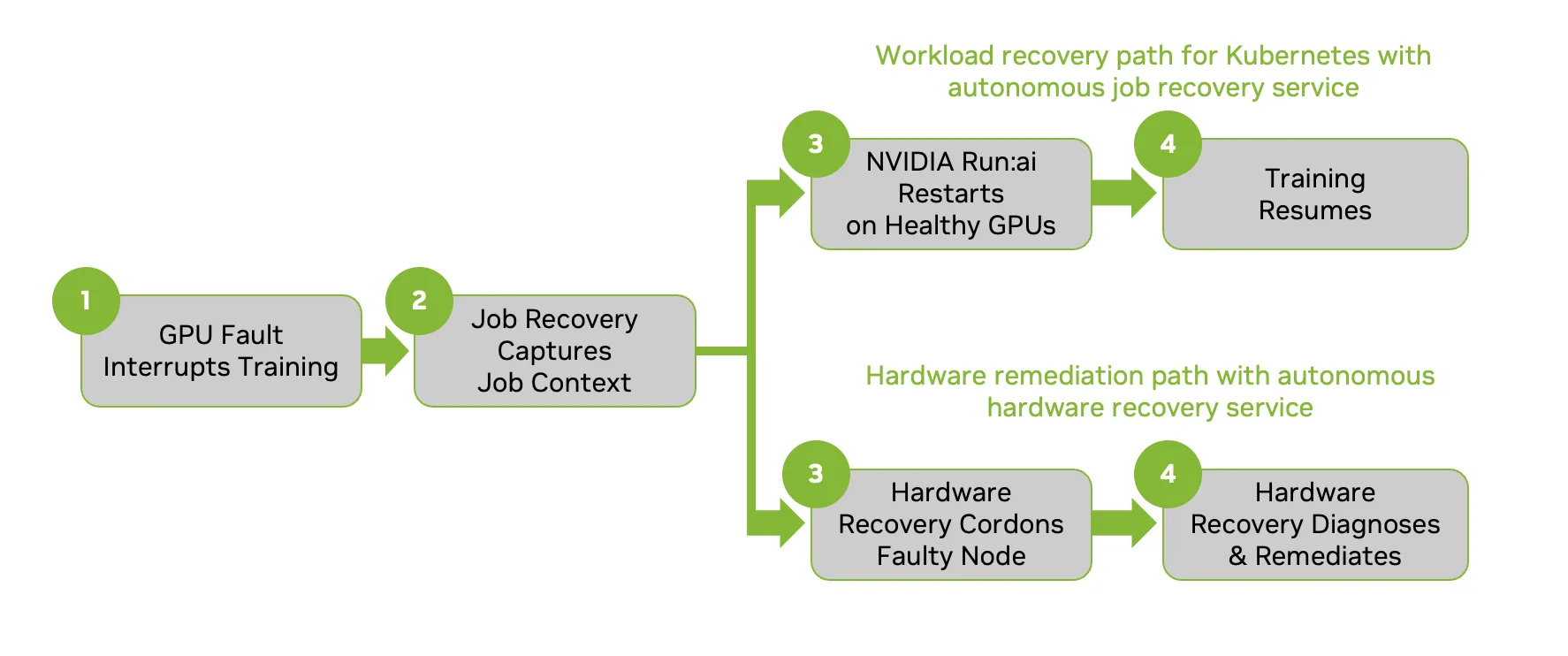
After capturing job context, the upper path restores training on healthy GPUs while the lower path isolates and repairs the faulty node.
The first scenario is a hardware anomaly during training. Job recovery captures context, and scheduler integration advances restart or replacement on healthy capacity. Hardware recovery separately isolates the suspect node, records the reason, and starts diagnosis. The benefit is a shorter dependency chain for workload restoration while preventing immediate reuse of faulty resources.
An engineering implication is that placement logic must observe the unschedulable state promptly. Otherwise a replacement request could be submitted before isolation takes effect, creating a window in which work returns to the suspect node. This is an integration check inferred from the workflow; the article does not measure that window or specify a consistency protocol. Evaluation should track state propagation and repeated failures, rather than only whether a restart command was issued.
The second scenario is a transient software failure. Retry decisions follow failure history and scheduling policy. Hardware monitoring continues, but remediation stays out of the path unless new evidence implicates hardware. Restraint matters: a program defect recurring on healthy nodes can shrink the resource pool if each failure triggers quarantine. Repeated or non-retryable errors should instead escalate rather than extend an automatic retry loop indefinitely.
The third scenario catches degradation before a job fails. Repeated GPU warnings or connectivity problems can trigger preventive isolation, keeping new workloads away from suspect nodes. Earlier intervention introduces a false-positive trade-off: excessive isolation strands healthy capacity, while delayed isolation exposes additional workloads.
Recovery speed depends on recoverable state
Placement on healthy GPUs addresses where execution happens. Training progress still depends on readable, consistent checkpoints, data-loader state, and a working recovery entry point. The article describes checkpoint-based restart but does not establish lossless continuation for every training framework. Automatic recovery therefore does not imply zero lost progress, and a node returning online does not establish that its original job has recovered.
A useful evaluation decomposes downtime into detection, capacity isolation, waiting for healthy resources, state restoration, and the return of productive training steps. This is engineering analysis, not a published product metric. If capacity shortages or checkpoint reads dominate, faster diagnosis may change little of the total interruption. If suspect nodes repeatedly contaminate later placements, consistent isolation may matter more than a fast individual restart.
Normal operation also pays costs. Health checks and diagnostics consume resources, reserve capacity lowers instantaneous utilization, and aggressive migration adds restoration work. GPU busy time can include failed computation repeated later. Productive training progress, repeat-failure counts, and time spent unnecessarily isolating healthy capacity are more informative measures.
Job failures and node failures also need separate accounting. One device can restart a multi-node job, or affect several successive jobs; dividing these counts directly confuses their denominators. Comparisons before and after an update should hold job scale, checkpoint frequency, and queue load reasonably comparable. Otherwise a change in recovery time may reflect a different workload rather than the recovery integration.
Returning capacity completes the loop
Once a node leaves the scheduling pool, explicit health validation should govern its return. Otherwise automation may accelerate an action without reducing recurrence. Conversely, a repaired node that remains unschedulable strands capacity. The article’s distinction between hardware health and scheduling eligibility highlights both losses: risky capacity that remains eligible and healthy capacity that cannot receive work.
Practical validation can use the three scenario types described in the article: an isolatable hardware fault, a retryable software failure that does not require isolation, and degradation detected before workload failure. Track the separate outcomes for jobs and nodes: repeated triggers, restored productive progress, and the point at which a node becomes eligible again. These are evaluation recommendations, not independent experiments already reported by the authors.
The update deserves attention because it places Kubernetes workload recovery within a broader infrastructure control process. Focus on how the three failure types take different paths and how scheduling state connects to recovery evidence. The eventual benefit depends on the cluster’s failure mix, spare capacity, and training recovery support. The article establishes a mechanism and integration direction, not a portable performance multiplier.