Original: Introducing TorchNeuron: Native PyTorch backend for AWS Trainium · 2026-10-19
Authors: Nafea Bshara, Robert Hundt, Ron Diamant, Colin Brace, Rahul Solanki, Maen Suleiman, Khaled ElGalaind, Temesghen Kahsai, Cyril Bortolato, Indu Thangakrishnan, Shauheen Zahirazami, Sarang Ozarde, Adarsh Singh, Hanbo Wang, Esha Lakhotia, Jianying Lang.
The change is between the framework and the chip
TorchNeuron matters as a change in how Trainium connects to PyTorch, rather than as a new set of model scores. The announcement presents a native device backend using PrivateUse1 and accelerator-agnostic APIs to bring models, training libraries, and performance tools to Trainium2 and Trainium3. The goal is to reduce hardware-specific workflow rewrites while sharing model definitions between research debugging and production compilation.
The official examples select the device with .to('neuron') and compilation with backend="neuron". These identify entry points; they do not establish that arbitrary CUDA-specific code or dynamic models need only a string substitution. Portability depends on actual operator, dtype, shape, and communication coverage. The tests and limitations explain that scope better than a minimal example alone.
One frontend, two execution paths
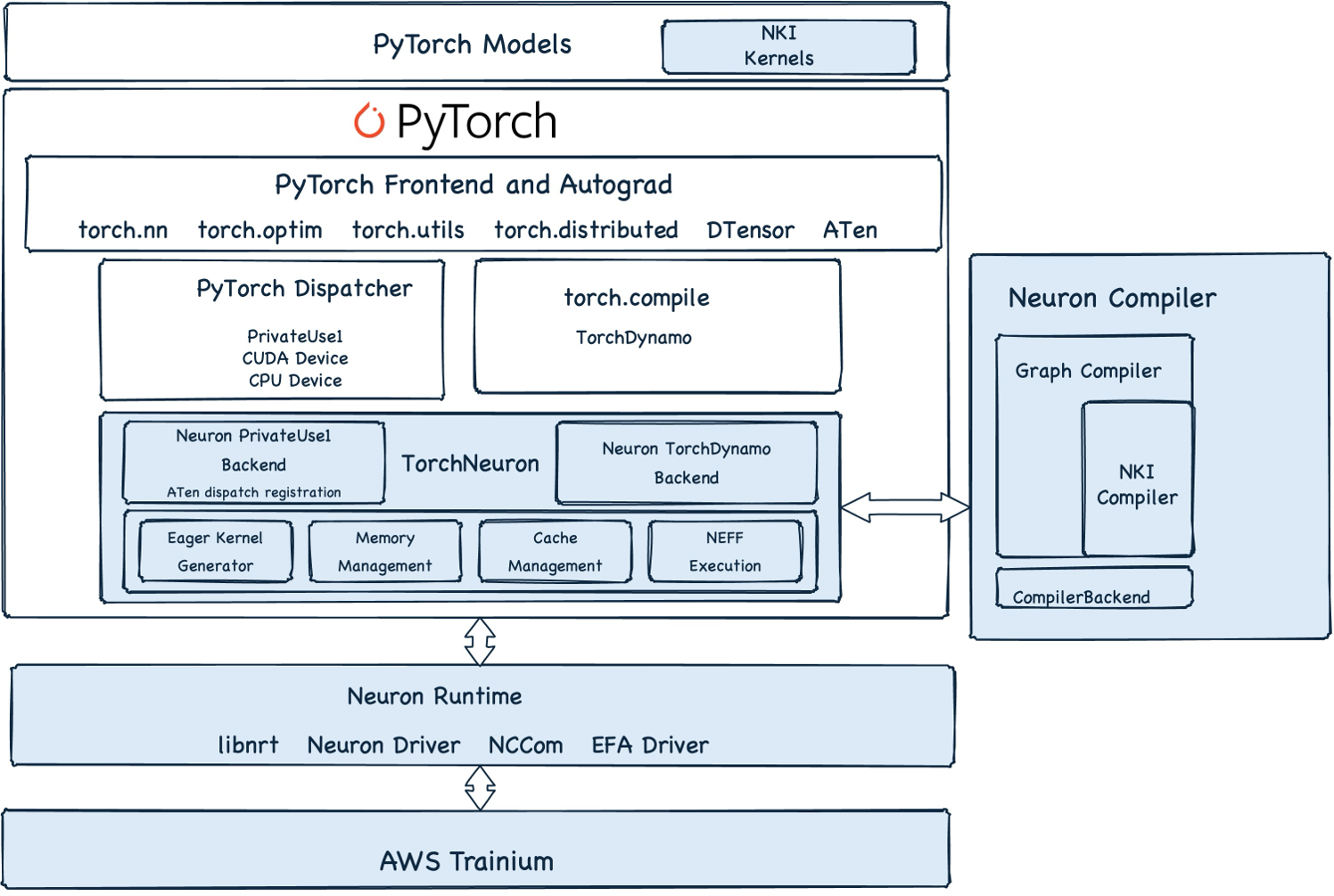
Read downward from the shared PyTorch frontend through eager dispatch or graph compilation, then the Neuron compiler and runtime to Trainium.
Eager execution dispatches operations individually, preserving Python control flow, prints, and breakpoints. Its flexibility can mean separate compilation into NEFF executables, device launches, and HBM traffic for intermediates. Familiar interfaces do not eliminate compilation, launch, or transfer overhead.
The announcement also introduces experimental adaptive eager execution to reduce launch cost and create more fusion opportunities, approaching compiled-graph performance. It supplies no universal speedup for all models, so this is a developing execution path rather than evidence that eager execution already equals complete graph optimization.
Stable workloads can use torch.compile: TorchDynamo captures an FX graph, AOTAutograd handles the backward graph, Torch-MLIR lowers the result to StableHLO, and the Neuron compiler produces NEFF. This enables optimization across operations but requires clear graph and shape boundaries. Dynamic and symbolic shapes are explicitly outside the first release; native PyTorch integration does not imply complete support for dynamic behavior.
Native APIs retain hardware-specific semantics
Distributed interfaces include DDP, FSDP2, SimpleFSDP, tensor and pipeline parallelism, DTensor, and DeviceMesh. Collectives use dedicated communication cores within nodes and EFA between nodes. This reduces application-level migration work, but topology, sharding, and model size still determine efficiency. Matching APIs do not imply matching communication costs.
The stream and event details deserve particular attention. Ordering is maintained within a stream, while cross-stream dependencies require explicit events. Non-default streams multiplex onto one hardware queue rather than receiving independent engines. Creating more streams therefore need not increase physical parallelism. Asynchronous errors surface at the next synchronization point with the earliest exception’s context preserved; diagnosis must follow dependencies rather than stopping at the line where the error appears.
NKI supplies a lower-level path for custom operations in both eager and compile execution, with official NKI-lib implementations for attention and MoE workloads. The trade-off is familiar: general operators preserve portability, while hardware-specific kernels can target hotspots but require continued maintenance of numerical behavior, autograd integration, and correctness on the device.
Observability connects framework events to execution
TorchNeuron integrates with torch.profiler, using NeuronConfig to control runtime and device collection. Neuron Explorer correlates framework, runtime, and hardware events with source code, exposes call hierarchies and waiting dependencies, and exports per-operation and per-engine Parquet data for programmatic analysis.
This can shorten the path from a slow step to the computation or transfer it is waiting for. It supplies investigative evidence rather than guaranteeing automatic root-cause identification. Analysis still needs to distinguish compilation, loading, warm-up, and steady-state execution; otherwise compilation can hide steady-state hotspots, or warm-cache numbers can hide startup costs.
Coverage figures need their denominators
The team reports continuously sweeping 100,000 Hugging Face models representing 99.9% of usage by download count. Runs use reduced but representative configurations to check loading, forward and backward execution, compilation, and CPU fallback. This does not mean all 100,000 models trained successfully at original scale. Download coverage is neither architecture coverage nor a correctness rate.
An August 2026 upstream-test run generated roughly 154,000 outcomes, including about 69,000 skips. Around 30,000 came from PyTorch’s own eligibility checks; roughly 39,000 were deliberate Neuron skips, including about 22,000 for operators without native lowering. These omissions explain why a pass rate over enabled tests alone can overstate complete compatibility.
First-release exclusions also include sparse tensors and operations, NestedTensor, forward-mode autograd, arbitrary attention masks, and selected interpolation and quantization features. BF16, FP32, and FP16 are announced model dtypes; TorchAO and FP8 remained in private beta with a later release planned. Supported, experimental, privately tested, and planned capabilities should be read separately.
Evaluate migration along the dataflow
For a particular model, first establish execution coverage: which operations run natively, which fall back to CPU, and whether shapes or tensor types depend on first-release exclusions. Next establish expected outputs: forward results, gradients, and long-run convergence answer different questions. Passing an operator test does not replace full training validation. Performance comes next: whether compilation reduces intermediate writes and whether communication becomes the next source of waiting.
CPU fallback is particularly easy to hide behind a statement that a model runs. Repeated host–device transfers can preserve correctness while missing throughput expectations. The announced sweep explicitly records fallback, so loading successfully, executing successfully, and executing entirely on the device should remain separate readings of coverage. This is an interpretation of the test design, not a claim that fallback is widespread among tested models.
Optimization can also proceed incrementally. Research needs observable, debuggable execution; stable workloads can compile hot paths; hardware-specific kernels have a clearer maintenance justification when evidence identifies a critical operator. This explains why eager, compile, and NKI coexist instead of implying that a native backend has one execution strategy.
What to follow next
The October 19 announcement planned an Apache 2.0 release and public beta on October 20; this note does not independently establish that the package and repository had gone live that day. Architecture, test denominators, and feature boundaries are the most useful next reading before evaluating a real model’s migration.
Within this batch, TorchNeuron addresses development interfaces and toolchain integration, while DIFFLET addresses compiling, retaining, and serving diffusion components at a different layer. A useful engineering comparison for a candidate workload should retain output quality, CPU fallback, startup cost, steady-state throughput, and tail latency. The announcement does not establish a universal advantage across those dimensions.