What matters in this issue
Start with E4 and the persistent-memory study. E4 constrains an operations agent to checkable, reusable dataflow, exploring the balance between diagnostic reach and execution cost. The memory study separates smaller per-call contexts through agent decomposition from better accuracy through cross-question recall. A running system and an ablation switch alone do not establish that a component works.
Four other papers add a state-management perspective: TRANSIT uses host memory to reduce the GPU requirement for training; FailBench separates everyday fault-tolerance overhead from recovery cost; Lachesis uses context lifetime to reduce flash writes; and NeMo-DCR makes delta weight synchronization bit-exact. Their objectives differ: per-GPU efficiency, completion time, device lifetime, and synchronization latency need separate interpretation. A companion FBTriton note explains why reorganizing sparse execution matters more than simply changing a kernel’s programming language.
01 · E4: organizing root-cause analysis as checkable dataflow
Agentic RCA for Internet-Scale Services Using Constrained Creativity
Sayan Sinha, Vipul Harsh, B. Aditya Prakash, Vyas Sekar, Hui Zhang · 2026-10-06
Where should diagnostic freedom live?
Evidence about a production incident is distributed across metrics, events, traces, and user cohorts. A general agent that writes arbitrary scripts can explore new hypotheses, but may repeatedly read large datasets and produce analyses that are hard to inspect. Fixed playbooks are easier to explain but may lack a route for an unfamiliar failure. E4 introduces a typed DSL between these approaches: the LLM selects and connects analysis operators, an executor processes the data, and the output is a ranked list of root-cause leads.
The restriction concerns program structure, rather than permanently fixing the diagnostic algorithms. Operators generate candidates, score them, and summarize results: finding abnormal cohorts, comparing historical windows, or using service dependencies to downweight propagated symptoms. Acyclic dataflow makes the analysis behind a lead traceable and lets branches share intermediate results. This is a harness and execution-layer design, not a newly trained foundation model.
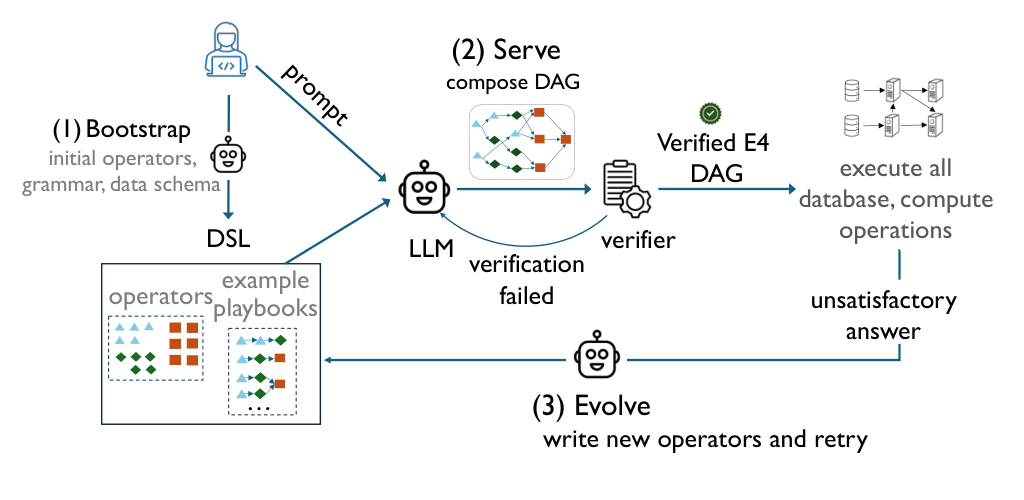
Reading the diagram: the left builds operators and examples; the middle generates and verifies a DAG; the right executes it. An unsatisfactory result triggers operator expansion below and another diagnostic pass.
Expand the search space in stages
At deployment, the system reads telemetry schemas, the task description, and examples, checking initial playbooks against synthetic data. For an incident, it first chooses an existing playbook. If that fails, it composes a new DAG from existing operators. Only after that proves insufficient does a coding agent propose new operators. An operator is retained only after it helps identify the true cause, confirmed through user feedback. Automatic evolution therefore retains a human judgment boundary.
Before execution, a verifier checks that operators exist, connected types match, the graph is acyclic, and it ends in exactly one answer. Ray executes independent branches and caches intermediate results. Local operators process full telemetry; the LLM primarily sees the incident description, schema, and operator catalog, reducing the cost of repeatedly placing raw data in context. Type correctness and executability establish conformity to the program constraints, however, not the causal truth of the diagnosis.
How to interpret the evidence
The authors use the same Gemini-3.1-Pro model for E4, a direct telemetry-analysis LLM, RCA-Agent, and Terminus-2, evaluating an extended DeathStarBench, three OpenRCA deployments, and ORCA-bench. On DSB, E4 improves over the strongest baseline by 34.7 percentage points, or 62% relatively. Accuracy@3,3 allows up to three attempts and examines the first three leads in each; it is not single-answer accuracy. ORCA-bench instead uses Recall@5,3 for multiple root causes, so the two metrics should not be pooled as one measure.
Total analysis cost includes inference and system costs. Against the least expensive baseline on each dataset, the reported reduction averages a factor of 5.4 and reaches 12.1 on DSB. The production pilot contains only six incidents: five cohorts were correctly identified, with analyst hints needed in two of those cases. The prototype ran on one M3 Pro laptop. These results support the feasibility of constrained analysis, but do not establish unattended operation at internet scale.
Reading judgment: a systems design worth studying closely. Read operator composition, verification, and admission before the staged evaluation. The useful development is turning exploration into reusable executable analyses. Its reach still depends on telemetry quality, operator coverage, and feedback quality; reducing token use does not remove that engineering work.
02 · Persistent memory: decomposition saves cache, recall remains unproven
Persistent Memory in Multi-Agent LLM Inference: What It Costs, What It Buys, and When You Can Tell
Hochan Son, Kyungdoe Han, Jaehan Koh, Xiaowu Dai, Wenlu Xu, Guang Cheng · 2026-10-06
Separate two meanings of a memory benefit
Multiple agents can divide a long task into shorter calls, each receiving relevant evidence and distilled predecessor outputs. That can reduce the peak KV working set of an individual call. A separate design stores reasoning traces for retrieval by later questions. These often coexist, but one concerns working-set size and the other claims that experience improves answers. A single aggregate score cannot establish both.
The paper studies three tiers: L1 is ephemeral per-call KV, L2 uses Redis to pass typed Communication Units, and L3 uses Qdrant for evidence filtering and trace persistence. COA-PKV and its COA-NOKV control differ only in trace reads and writes, keeping evidence retrieval and the agent workflow unchanged. The subject is persistent traces in this particular system, not a rejection of retrieval augmentation or all long-term memory.
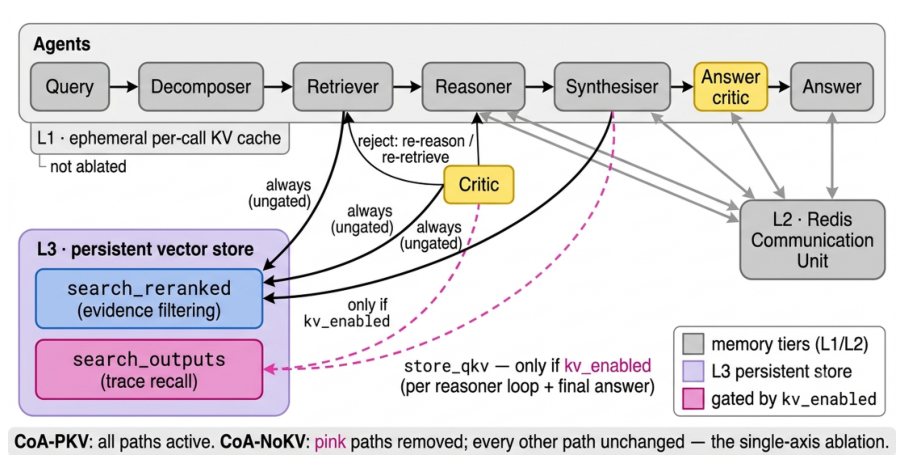
Reading the diagram: the top runs from decomposition to the answer. Black evidence-retrieval paths remain active; only pink trace paths are ablated. L2 on the right continues to carry inter-agent state.
A smaller peak can still mean more cumulative work
Across HotpotQA and LB-HotpotQA, with 100 questions per arm in each condition, the authors report an average per-query peak KV of 14.3 MiB for COA-PKV, versus 35.5 and 35.3 MiB for single-pass answering and retrieval-matched RAG. Cumulative KV traffic is approximately 1.6 times higher. Additional calls distribute the work rather than reducing every cost simultaneously.
These figures are derived from token counts using the served Qwen3.5-35B-A3B-FP8 model’s 10,240 B/token geometry, not direct measurements of total GPU memory. A smaller model also runs on a Jetson. Applying the same conversion overstates its calls’ KV footprint, while omitting linear-attention state, weights, and allocation-page overhead. The result supports a smaller per-call KV working set, not an equal proportional increase in serving concurrency.
What the undetected benefit says about the test
Across eight paired dataset conditions, enabling persistent memory adds 0.368 MiB of peak KV, with a 95% confidence interval of [0.167, 0.590]. The accuracy change is +0.015, with interval [−0.011, +0.046], which does not separate a benefit from noise. The target is 100 questions per arm; actual valid pairs vary with failure records. Counting failures as zero versus dropping failed questions also changes the aggregate effect from +0.015 to +0.003.
The benchmark structure helps explain this outcome. Independent questions come with their own evidence. To stop a rerun retrieving its own previous answers, stored traces must be cleared. Within a clean run, recall then mainly reaches traces from unrelated earlier questions. Only 24% of questions meet the retrieval predicate under the original request-text convention. Testing cross-session memory requires genuinely reusable information between tasks while still preventing answer contamination.
The authors also trace four measurement problems: components that never actually executed, contamination from old traces, ablations that changed other execution conditions, and insufficient replication. Run-order confounding and limited repeats remain after the corrections. Read this as an empirical study whose experiments and appendix deserve attention. It advances how to establish that a component is active and useful, rather than concluding that persistent memory is ineffective. Shared-state, multi-session workloads are the necessary next test.
03 · TRANSIT: lowering the GPU requirement with host memory
TRANSIT: Transparent Scale-in for Multi-Node LLM Training
Hyungyo Kim, Nicholas Satchanov, Hrishi Shah, Gaohan Ye, Jiaqi Lou, Robert Walkup, Shweta Salaria, I-Hsin Chung, Hubertus Franke, Seetharami Seelam, Apoorve Mohan, Nam Sung Kim · 2026-10-06
Insufficient GPU memory can force training onto more nodes, increasing communication. TRANSIT intercepts CUDA allocations in user space, backs them with UVM, and uses prefetching and zero-copy policies to reduce page faults and repeated migration. It avoids rewriting the training application but depends on the relevant CUDA/UVM paths.
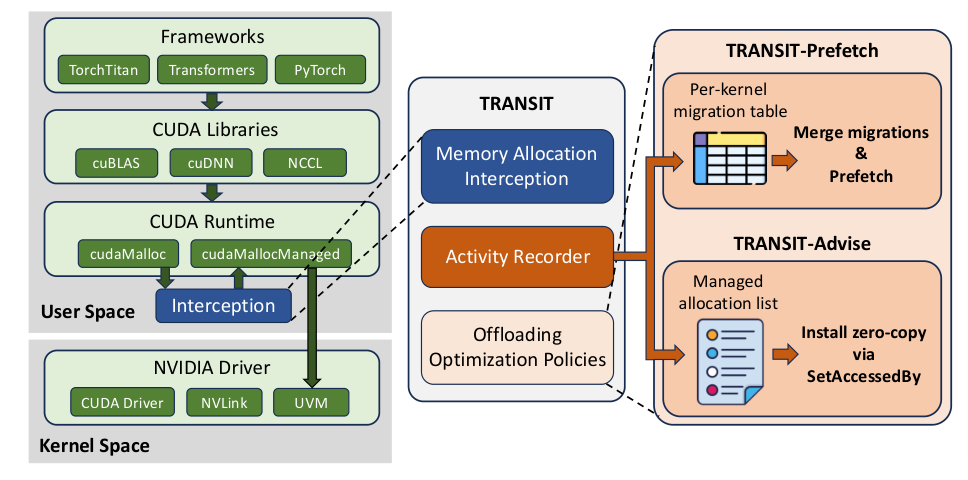
Reading the diagram: the middle records allocations and execution activity; the upper right merges and prefetches migrations, while the lower right enables direct access to host-resident data.
For Llama3-70B on 16 H100 GPUs in Cluster-B, the best variant achieves 433 TFLOPS per GPU versus 258 for TorchTitan-Offload; the 24-GPU non-offloading baseline achieves 418. These are per-GPU efficiencies, not evidence of unchanged total throughput with fewer GPUs. Offloaded volume, PCIe, and network configuration all matter, and phase identification uses a warmed-up kernel-count heuristic. Read the zero-copy/prefetch comparison; cluster-level queueing benefits come from trace simulation.
04 · FailBench: fast restoration does not guarantee faster training
FailBench: Evaluating Fault Tolerance Across Distributed Training Architectures
Khaled Aljbab, Amine Barrak · 2026-10-06
FailBench compares seven training architectures and fault-tolerance mechanisms on eight V100 GPUs across two nodes, covering single, concurrent, and cascading fail-stop faults. Its practical message is to separate state-restoration time, communication re-formation time, and overhead during normal training.
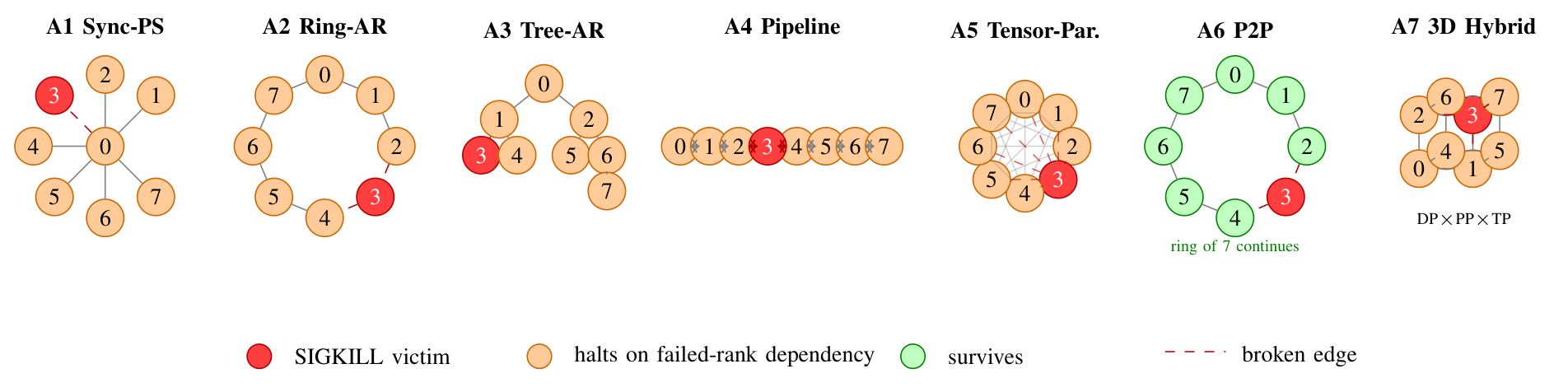
Reading the diagram: red marks the killed rank, orange marks ranks halted by failed-rank dependencies, and green marks continuing gossip ranks. These are the tested configurations.
With Ring All-Reduce, ResNet-50, approximately 205 MB per rank, and a 100-step save interval, disk checkpointing and in-memory replication cost 0.48% and 3.78%, respectively. Their roughly 155 ms and 17 ms restoration values are analytical lower bounds. Halting architectures do not complete end-to-end survivor election and process-group reconstruction in the harness, so this is not 17 ms to resume training. Gossip’s sample throughput rises 17.9% after losing a worker, without a detectable improvement in loss progress. Read the measurement definitions and applicability matrix: ResNet and MLP proxies do not establish absolute costs for full large-model training.
05 · Lachesis: placing KV by context lifetime
Lachesis: Lifetime-Aware KV Cache Placement for Agent Serving across HBM and High-Bandwidth Flash
Jaehoon Yang, Jeongmin Lee, Haneul Park, Seung Yul Lee, Nam Sung Kim, Jae W. Lee · 2026-10-06
High-bandwidth flash, or HBF, offers capacity for KV state, but online writes consume endurance. Lachesis has the harness expose context-segment boundaries: short-lived reasoning prefers HBM, while long-lived lead-agent state goes to HBF. Workers are further ranked by lifetime predicted from spawn-time metadata, and closed segments are freed immediately.
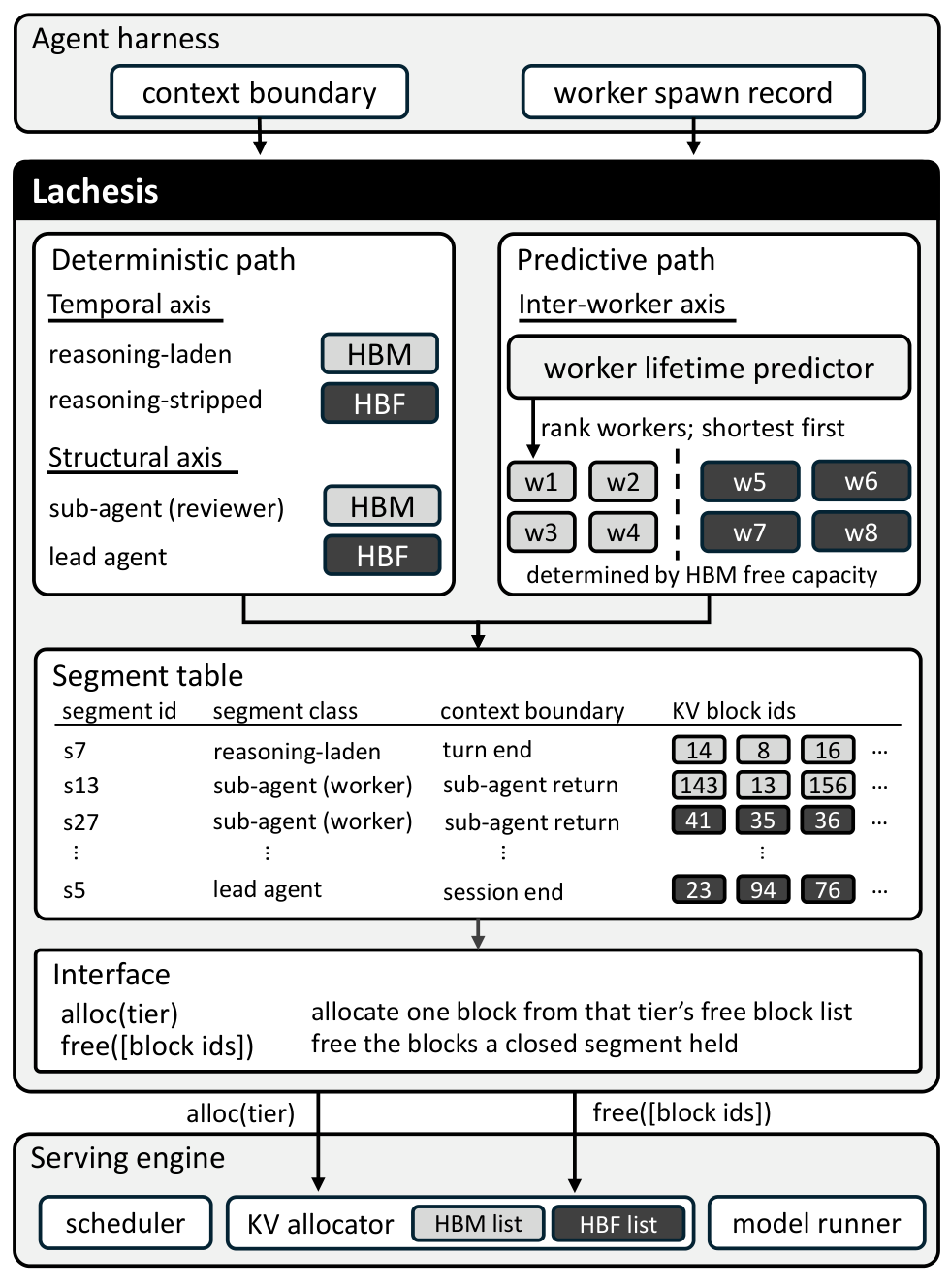
Reading the diagram: segment classes guide the left path; predicted short-lived workers receive HBM priority on the right. The segment table connects lifetime to allocation and release.
The authors replay real agent traces in simulation with Llama-4-Maverick and Qwen3-235B-A22B, using a 2-second TTFT SLO and p99 TPOT limits of 60/100 ms. For the four co-located memory configurations on the multi-agent trace, the tight SLO yields 1.50–2.95 times the HBF lifetime of HBM-first placement. Results depend on 100,000 program/erase cycles, write amplification of 1.02, and modeled user/tool delays. They are not physical HBF endurance tests. The interesting direction is using orchestration semantics to guide storage, not treating all slower cache tiers as interchangeable devices.
06 · NeMo-DCR: transferring changed bits with recoverable updates
NeMo-DCR: Bit-Exact Delta-Compressed Refit for Scalable Agentic RL at Trillion-Parameter Scale
Songlin Jiang, Zhiyu Li, Terry Kong, Yu Yao, Youngeun Kwon, Bernard Nguyen, Ashwath Aithal, Mario Di Francesco · 2026-10-06
Disaggregated agentic RL must synchronize the policy after training updates. NeMo-DCR compares training shards with a baseline, maps changes to canonical checkpoint coordinates, and lets the serving runtime’s native loader determine placement. Bit-preserving paths use XOR; other paths use overwrites. Failed attempts retry with overwrites, and policy version and baseline commit together after all required receivers acknowledge.
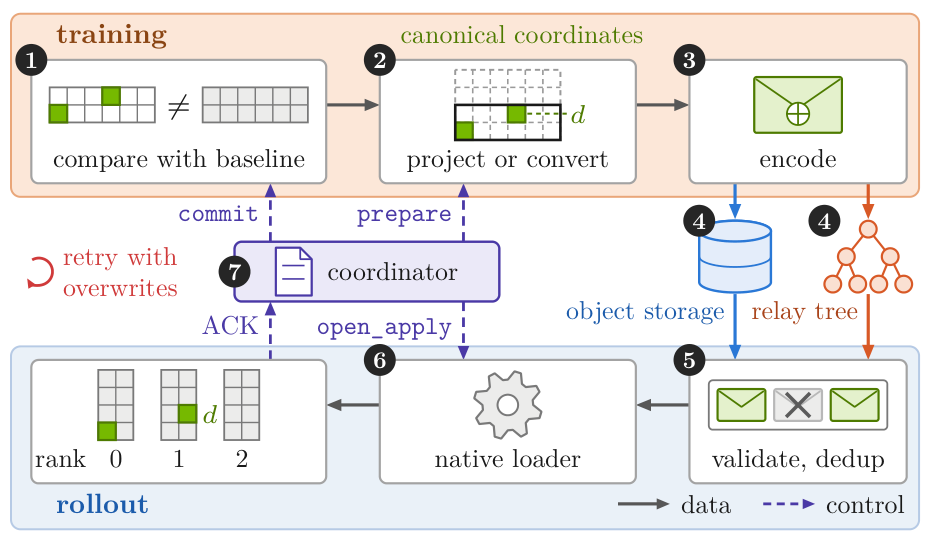
Reading the diagram: changes are found and encoded above, then sent through object storage or a relay tree. Receivers validate, deduplicate, and load in place; acknowledgments and a coordinated commit bind the new version.
In the authors’ cross-AWS-region test, a relay-tree refit at 1T scale with an artificially injected 3% element-change rate takes 150 seconds, versus 87.5 minutes for a transport-only full-checkpoint reference. The 1T checkpoint is constructed by doubling a 550B model’s layers. This measures synchronization, not full trillion-parameter RL training speedup. A separate Qwen3-30B-A3B experiment runs 50 GRPO steps with five repeats and receiver kills. Bit-exactness and retries merit close reading; gains still depend on sparse changes and require roughly one checkpoint’s worth of host baseline memory across the training side.
Community observation: operations evaluation beyond a general leaderboard
Franco Naumow’s original post says that in the October 5 snapshot, Claude Opus 5.5 (Max) leads the Artificial Analysis Intelligence Index with 57.6, yet ranks 12th among 21 current models on ITBench-AA with 38.2%. The post describes 59 Kubernetes incident snapshots, with zero credit for a task if any root-cause entity is missed.
This is a leaderboard observation checked against the original post. Figures are attributed to the poster; the official leaderboard was not independently recomputed. They are not a universal ranking of model capability. The connection to E4 is task definition: general scores cannot replace measurements on a specified diagnostic task, and complete entity localization differs from a hit among the first three leads.
Companion technical note
FBTriton: organizing embedding training around sparse access patterns explains TBE forward/backward execution, short/long-run dispatch, and synchronization correctness.