What matters in this issue
Start with OS-Bench and JointServe. OS-Bench asks whether an agent preserves the original operating system’s behavior after making software work on another. JointServe asks how a multi-model agent can switch experts under a limited GPU budget without repeatedly moving weights and rebuilding context. Both broaden the unit of analysis: from a repair in one environment to correctness on two platforms, and from an individual model request to a complete session.
DiffTry offers a smaller control point: distribute retry opportunities by request value so that overload does not reject every class equally. The accompanying technical readings examine verification budgets, KV transfer, numerical consistency between training and inference, and connecting agent execution to existing observability tools. A successful or faster local step does not, by itself, establish that the full task is reliable or efficient.
01 · OS-Bench: migrate the target without breaking the source
OS-Bench: Evaluating SWE Agents on Cross-OS Code Migration
Qirui Jin, Kenan Li, Liao Zhu, Lingching Tung, Yikai Zhang, Yijia Wu, Zijian Jin, Pengfei Gao, Yu Kang, Qingwei Lin, Wenke Lee · First published: 2026-10-14 · Watchlist: Qingwei Lin is a coauthor
Make correctness on both platforms part of success
Cross-OS migration involves more than recompilation. Paths, processes, encodings, system APIs, and build tools can all change behavior. Tests on the target generally cannot exercise source-only branches. OS-Bench requires the same patch to pass target repair and regression tests while preserving the source tests that previously passed. This makes target functionality and retained compatibility separately measurable.
The authors do not simply turn historical commits into tasks: a migration can span several commits mixed with unrelated changes. They execute each repository on native Linux and Windows environments, use coverage differences to locate platform-specific regions, and apply an LM verifier followed by human filtering to identify conditionals, APIs, paths, encodings, and other compatibility logic. Asymmetric coverage can also result from test selection or dependencies, so differences are not automatically accepted.
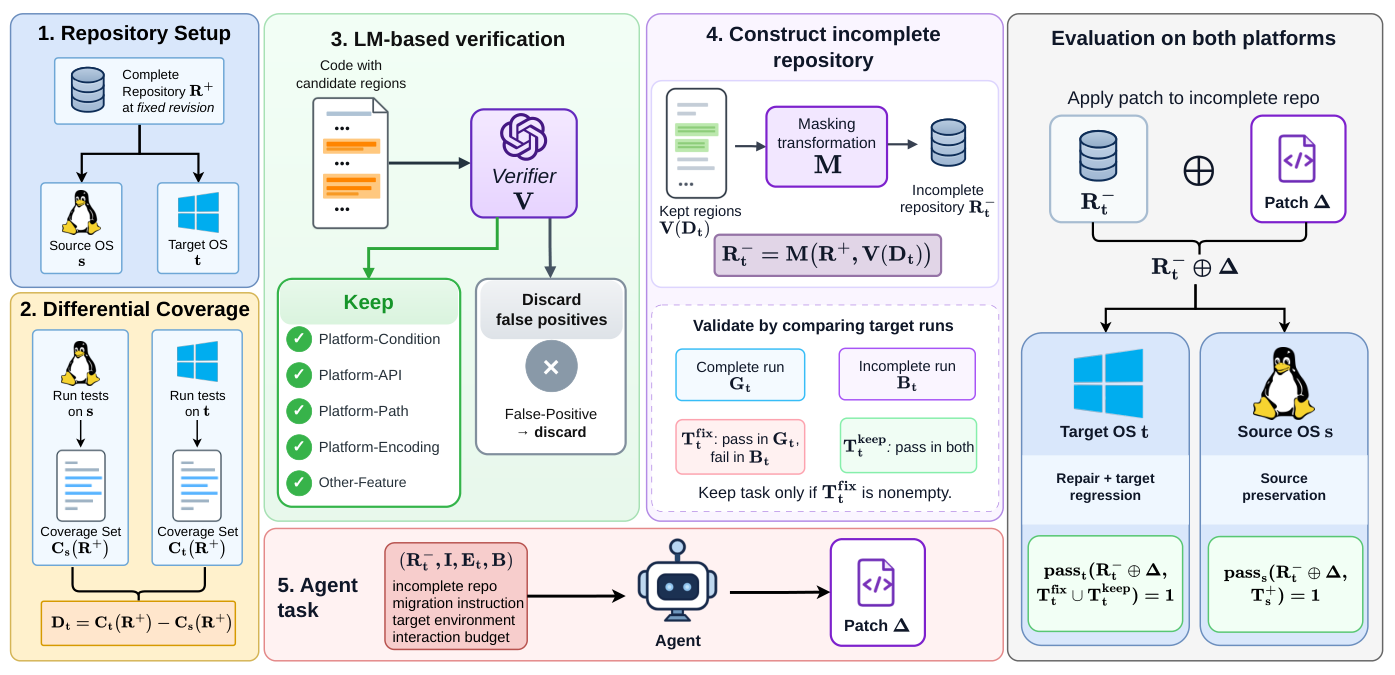
Read left to right: compare coverage, verify and mask target implementations, then test the same patch for target repair and source preservation.
The constructor then masks verified target implementations while retaining the tests. A candidate survives only if at least one target test stops passing and the source reference tests still pass. The agent receives the incomplete repository, a migration objective, and native tools; its patch is checked on both systems. These are restoration tasks derived from existing implementations. They are relevant to new-platform development but do not fully reproduce designing support from scratch.
The gap between two scores is particularly revealing
The benchmark contains 140 tasks from 111 repositories in C, C++, C#, Go, and Rust: 91 targeting Linux and 49 targeting Windows. Six models run at medium thinking effort, with a limit of 100 steps and five hours per run. Linux uses three harnesses; Windows uses Win-agent.
| Representative configuration | Success on both platforms |
|---|---|
| Claude-Opus-4.8 + OpenHands, Linux target | 24/91, 26.4% |
| GPT-5.6-Sol + Win-agent, Windows target | 10/49, 20.4% |
For GPT-5.6-Sol with Claude Code, 50 Linux-target patches pass the first stage, but only 22 obtain a pass on both platforms: success falls from 54.9% to 24.2%. The other 28 lack a validated source-platform pass. They should not all be labeled confirmed code regressions, but the gap shows how target-only evaluation overstates validated completion.
An audit of 35 explicitly recorded target-stage failures finds unrestored implementation in 18 runs and incomplete verification scope in 19; categories overlap. These observations suggest concrete improvements: track migration scope across files and ensure local verification includes the required tests and build modes.
Assessment: read the construction pipeline and two-stage protocol closely. Scores also change when the same model uses another harness, so they reflect model and tool capabilities together. The migration directions have different task compositions; their score gap does not isolate OS difficulty. C/C++ samples are particularly small. Differential coverage misses abstractions that execute the same paths on both systems, and passing tests establishes only the behavior they cover.
02 · JointServe: one GPU budget for weights and session KV
JointServe: Serving Multi-Model Agents on Memory-Constrained GPUs
Daijin Hu · First published: 2026-10-14
Switching experts has an outbound and a return cost
A planner calling several independent experts may not fit all their weights on a GPU. Loading a whole model delays the next call; evicting KV to make room forces context reconstruction when a session returns. Faster model loading addresses only part of that waiting. JointServe treats weight layer groups and session KV blocks as residency objects, selecting them jointly using estimated reuse, recovery cost, and byte size.
The decision concerns what stays in memory, beyond request ordering. Existing session routing and host-KV recovery systems also preserve state. This paper adds finer-grained weight/KV allocation inside one GPU and preparation before a call arrives.
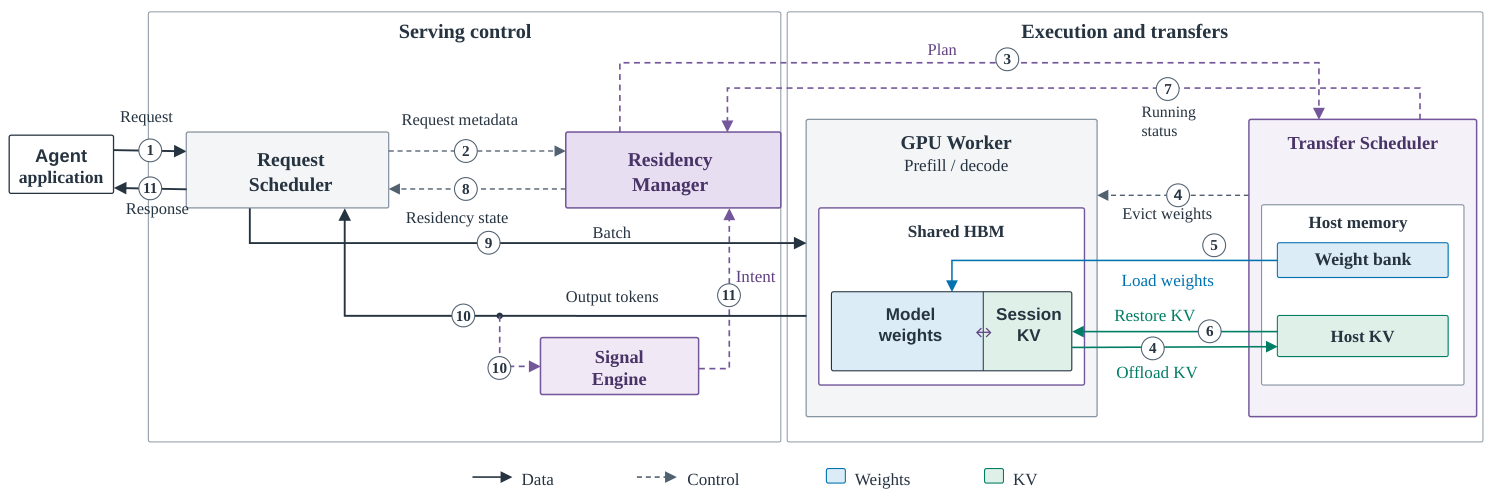
The signal engine reads intent from output; the residency manager allocates shared HBM; the transfer scheduler moves weights and session KV.
A signal module reads the caller’s streamed tool-call header to identify the next expert while arguments are still being generated. The residency manager retains the layer groups needed to start and prefetches the rest. Ready events gate layer execution; a missing group causes a wait. Without explicit intent, it falls back to transition statistics and popularity, so benefit depends on visible signals and actual overlap opportunities.
KV can be restored when a valid host copy exists; otherwise it must be recomputed. Different recovery costs make size alone a poor eviction criterion. The transfer scheduler reserves a default minimum 15% bandwidth share for live-session KV traffic, protecting restoration from large weight transfers. Weight and KV allocations change with demand, while in-flight state and committed startup regions remain protected. A target residency plan is also distinct from data being ready.
Read the gains against capacity pressure and session structure
The testbed is one A800-SXM4-80GB GPU with 1 TB host RAM and measured host-to-device bandwidth of about 24.3 GB/s. The standard pool contains five 7B-class experts. A 40% allocation of the 80 GB card, minus an 8 GB runtime reserve, leaves 24 GB usable. The author reports a median session completion time of 516 seconds, about 21.7% below the strongest whole-model swapping baseline.
Ablations clarify the combination: removing partial residency raises completion time to 608 seconds; removing the host-KV tier raises it to 793; removing adaptive control together yields 641. Avoiding recomputation on return matters alongside early loading. SWE-bench trace experiments report a 49.1% session-time reduction, whereas τ-bench improves only 5.2%. The latter still gains first-token responsiveness because user-thinking gaps already hide part of baseline switching cost.
Assessment: joint weight/KV management merits follow-up; extreme-capacity results need cautious interpretation. The normal hot-swap path says that all model weights are resident before decode, yet the paper also reports completion when a whole model does not fit. These descriptions do not clearly establish the complete execution path under the smallest budgets. Accordingly, the reported “46×” in that regime is not treated here as an ordinary speedup. The current prototype also overwrites buffers in place; double-buffer handoff remains a target design. Prioritize the cost model, execution protocol, and ablations. Link bandwidth, call gaps, host capacity, and visible intent all affect the practical gains.
03 · DiffTry: protect valuable requests with differentiated retry limits
Prioritizing Microservice Requests via Retries
Ofek Lavi, Jhonatan Tavori, Hanoch Levy, Anat Bremler-Barr · First published: 2026-10-14
DiffTry places priority in retry budgets: valuable requests get more opportunities, while low-priority requests give up earlier. Each service uses a propagated priority header to set the local retry limit, without waiting for a global overload signal or changing application code.
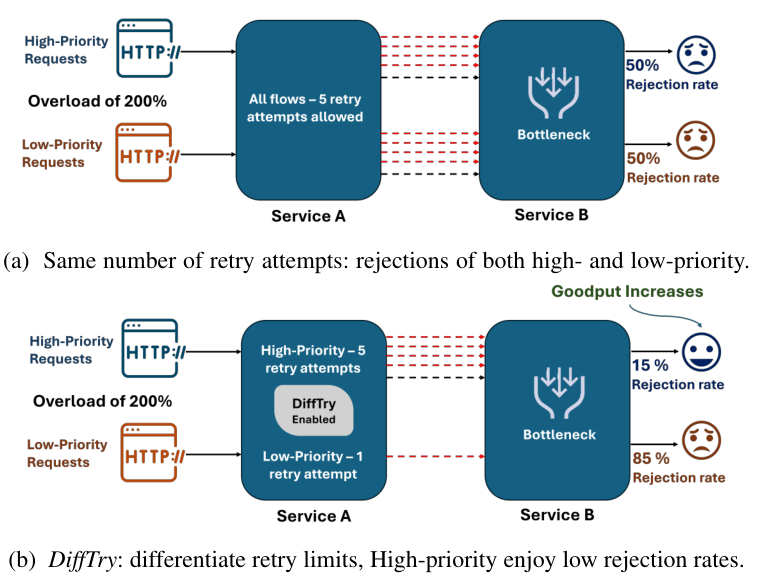
Above, both classes can retry five times; below, the low-priority budget falls to one. Percentages illustrate the two-service example, not all results of the network experiment.
On DeathStarBench hotelReservation in Kubernetes/Istio, high/low budgets are 5/1 versus a 5/5 baseline. High-priority arrival rate is fixed at 50 while low-priority traffic rises from 50 to 250. At the heaviest load, about 2.1 times capacity, high-priority rejection falls from approximately 54% to 15%; low-priority rejection is about 61%. This redistributes rejection rather than benefiting every request. The analysis uses approximations including independent retry rejection, discusses correlations from long service times, and does not settle equilibrium uniqueness for every network. The lightweight control point and network analysis are worth reading, assuming that business priorities are trustworthy.
Community observations: task-level evidence for availability and trust
LinuxSecurity’s original post (2026-10-13) warns that a successful health response can coexist with stalled inference. Its account of a vLLM scheduler issue motivates combining a bounded real-generation probe with queue depth and completed-request counts. The post does not supply complete affected configurations or vulnerability validation materials, so this observation supports monitoring design rather than a definitive affected-version or fix-version claim.
Nancy Wang’s original post (2026-10-13) describes SRE-agent work with Mercor, emphasizing rigorous evaluation, read-only access, and human oversight. It reports 95% accuracy and a 57% reduction in median time to remediation. These are the poster’s project results; the post does not specify sample size, the accuracy definition, or the comparison protocol, so they do not establish a general SRE-automation benefit. Designing permission boundaries alongside evaluation is the more transferable practice.