Prepared with AI assistance from the TensorLean technical report published by Columbia University (Wei Qiang, Ganxiang Yang, Yi Rong, and Ronghui Gu) and CertiK (Xupeng Li and Ronghui Gu) on
November 20, 2026, together with pinned inspection ofTensorLean/TensorLean@3e83208(November 22, 2026) and live upstream issue/PR state as ofNovember 23, 2026. All 10 figures are preserved verbatim fromtensorlean.aias requested. Note a critical release boundary: as of commit3e83208, the public repository contains onlyREADME.md(listing 39 discovered bugs) and banner assets; the paper, Lean 4 PTX semantics, 1.8K-LoC PTX parser, and proof scripts are marked “coming soon.” All analysis here relies strictly on public primary text, embedded structured figure datasets, and upstream GitHub records; no local Lean 4, SMT, or GPU experiments were executed.
Confidence in modern AI kernels still rests largely on sampled inputs and numerical tolerance checks—yet once kernels adopt warp specialization, asynchronous TMA transfers, WGMMA, and Blackwell tcgen05 pipelines, catastrophic bugs rarely crash; they corrupt tensors silently under untested shapes and rare thread interleavings. TensorLean bridges the gap between toy academic prototypes and production kernel libraries without asking engineers to rewrite CUDA, CuTe, or Triton source code. Instead, it inspects compiled NVIDIA PTX assembly against a declarative Lean 4 tensor specification, discharging four machine-checked obligations via Lean and SMT solvers (cvc5 / Z3): data-race freedom, termination, exact algebraic equivalence over real numbers, and linear-time floating-point round-off bounds.
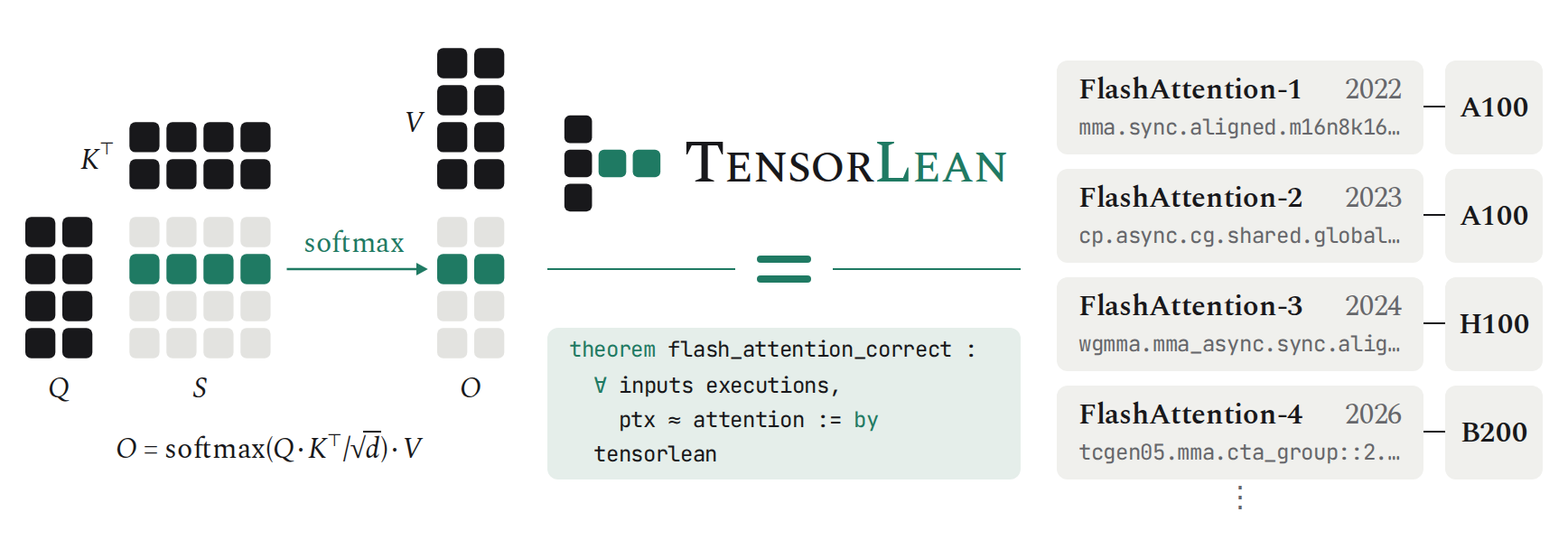 Enlarge original figure ↗
theorem flash_attention_correct): across valid inputs and thread schedules, TensorLean proves compiled PTX spanning Ampere mma.sync / cp.async, Hopper wgmma, and Blackwell tcgen05 meets the tensor formula (Source: tensorlean.ai).Examining the report prose alongside its embedded interactive figure datasets, the TensorLean@3e83208 commit delta, and all 15 upstream pull requests reveals both why TensorLean reaches a 15:1 code-to-spec ratio and 50-minute verification of Hopper FlashAttention-3 Forward (31,402 proof goals), and where its real Trusted Computing Base (TCB) sits: ptxas SASS lowering, undocumented Tensor Core rounding assumptions, and out-of-scope atomic acquire/release multi-GPU communication kernels.
Why testing and fixed-shape equivalence checkers miss frontier kernel failures
The report opens with a familiar pattern of silent AI failures: ChatGPT’s incoherent outputs in February 2024, a Claude miscompilation incident in September 2025, and Google DeepMind’s October 2026 finding (arXiv:2610.31642) that even standard PyTorch/JAX softmax and cross-entropy implementations dropped small gradients. Across these failures, the shared danger is silent correctness degradation: normal smoke-test shapes pass cleanly while tail batch sizes, rare head dimensions, unaligned tiles, or subtle compiler rewrites corrupt gradients or KV caches without throwing an exception.
Contrasting TensorLean against dynamic test suites and recent GPU equivalence checkers (specifically citing Dubey et al., OOPSLA 2026, and Wu et al.’s SentryWard, 2026), three structural gaps stand out:
- Concrete-configuration unrolling misses combinatorial corners: Checkers that unroll loops for concrete sequence lengths or batch sizes prove only the exact launch geometry inspected. TensorLean’s authors report that
19of the23new bugs discovered in FlashAttention (82.6%) appear only under specific combinations of shapes and optional features that developers rarely exercise together (such as 32-bit offsets wrapping past2^31, zero-column page tables, or partial last blocks). - Low-level synchronization races hide from brute-force testing: The block-sparsity data race caught in FlashAttention-4 (
#3195) never failed across17,760test runs. - High-level source analysis misses compiler miscompilations: In
tile-ai/tilelang#2699/#2700, the user source program was valid, but TileLang’sThreadSyncpass omitted the shared-write annotation for Blackwell (sm_120)st.bulkinstructions, emitting unsafe PTX without barriers. Verifying compiled PTX captures front-end logic bugs, synchronization races, numerical wraps, and compiler lowering flaws in a single net.
Evidence: TensorLean Introduction and PTX-Level Verification, TileLang PR #2700.
Extensional specification: how math-from-memory decoupling reaches a 15:1 code-to-spec ratio
Classic systems verification suffers extreme specification and proof overhead (the authors point to seL4’s 20 person-years and 200,000 proof lines for 8,700 lines of C, as well as Verus specs and hints frequently exceeding code size) primarily because specifications fuse mathematical intent with low-level memory representations.
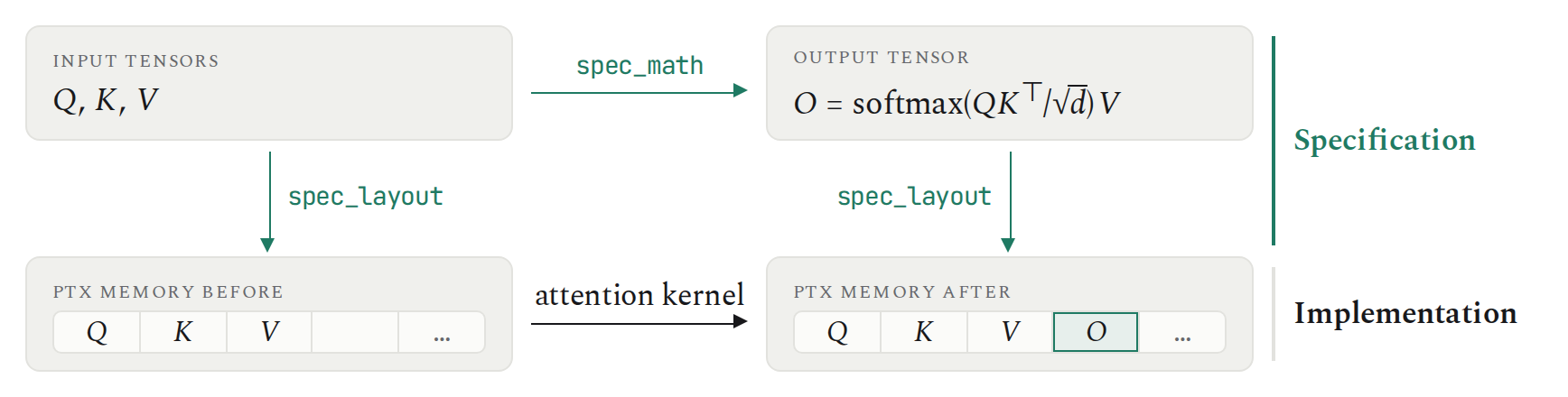
TensorLean leverages a clean structural property: GPU kernel correctness is extensional. A specification only constrains pre-launch and post-completion GPU memory state on valid inputs across every execution schedule—meaning how warps specialize, swizzle shared memory, or overlap copies never enters the spec.
 Enlarge original figure ↗
spec_math on abstract tensors map downward to pre- and post-launch PTX memory solely through spec_layout (Source: tensorlean.ai).Accordingly, each Lean 4 specification (KernelSpec) splits into five decoupled fields:
spec_math: A pure mathematical function over abstract tensors of real numbers , written via a Mathlib-backed tensor library matching PyTorch operator semantics (@,softmax,tanh,repeat_interleave).spec_mut: In-place memory updates mapping mutablestateandinputtostate'(such as appending newK, Vtokens to a KV cache ).spec_layout: Pure index-to-address maps placing each tensor element in PTX memory without clutteringspec_math—even for multi-level paged KV caches:
-- Mathematical dimension signature stays aligned with PyTorch tests
structure Attn (H G L D : ℕ) where
  q : Tensor ℝ [H * G, L, D]
  k v : Tensor ℝ [H, L, D]
  scale cap : ℝ
  mask : Tensor Bool [H * G, L, L]

-- Memory layout binds abstract indices to PTX pointers separately
{ tensor := state.k[b, p, g, d]
  var    := k_ptr
  layout := block_table[b, p / page_size] * k_batch_stride
            + (p % page_size) * k_row_stride
            + g * k_head_stride + d }
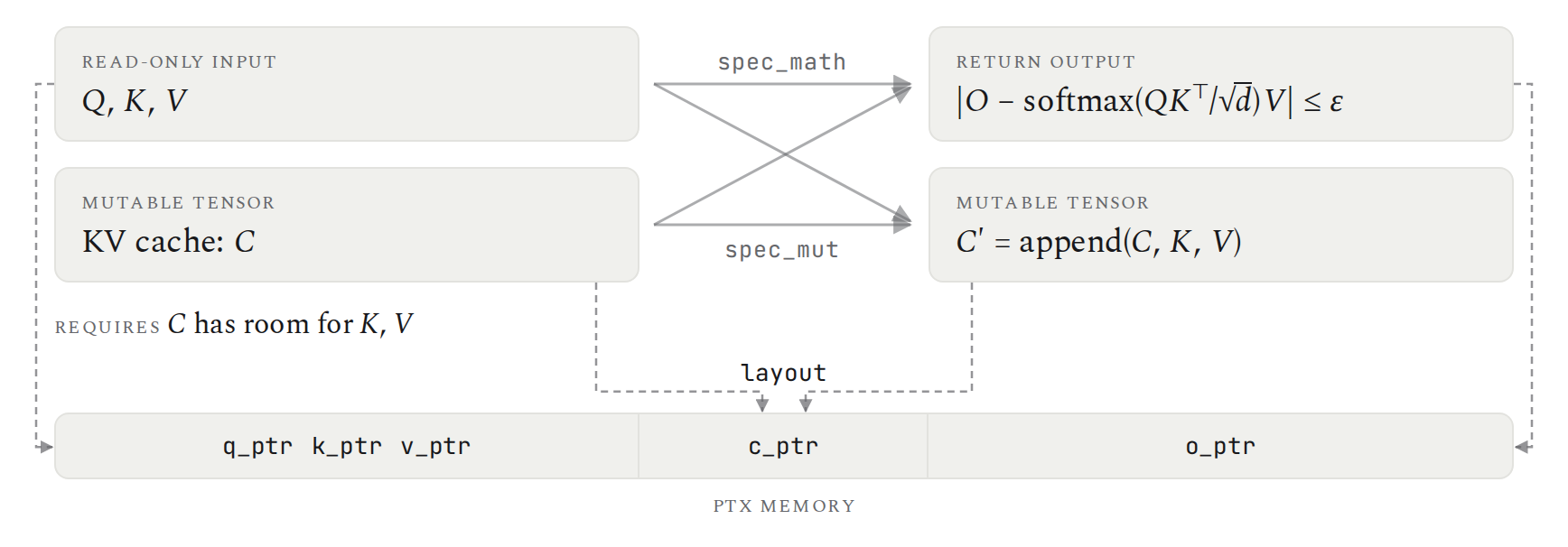
spec_tolandrequires: Allowable error bound per output/state tensor, plus preconditions on inputs and capacity bounds (such as sufficient room in the KV cache).
 Enlarge original figure ↗
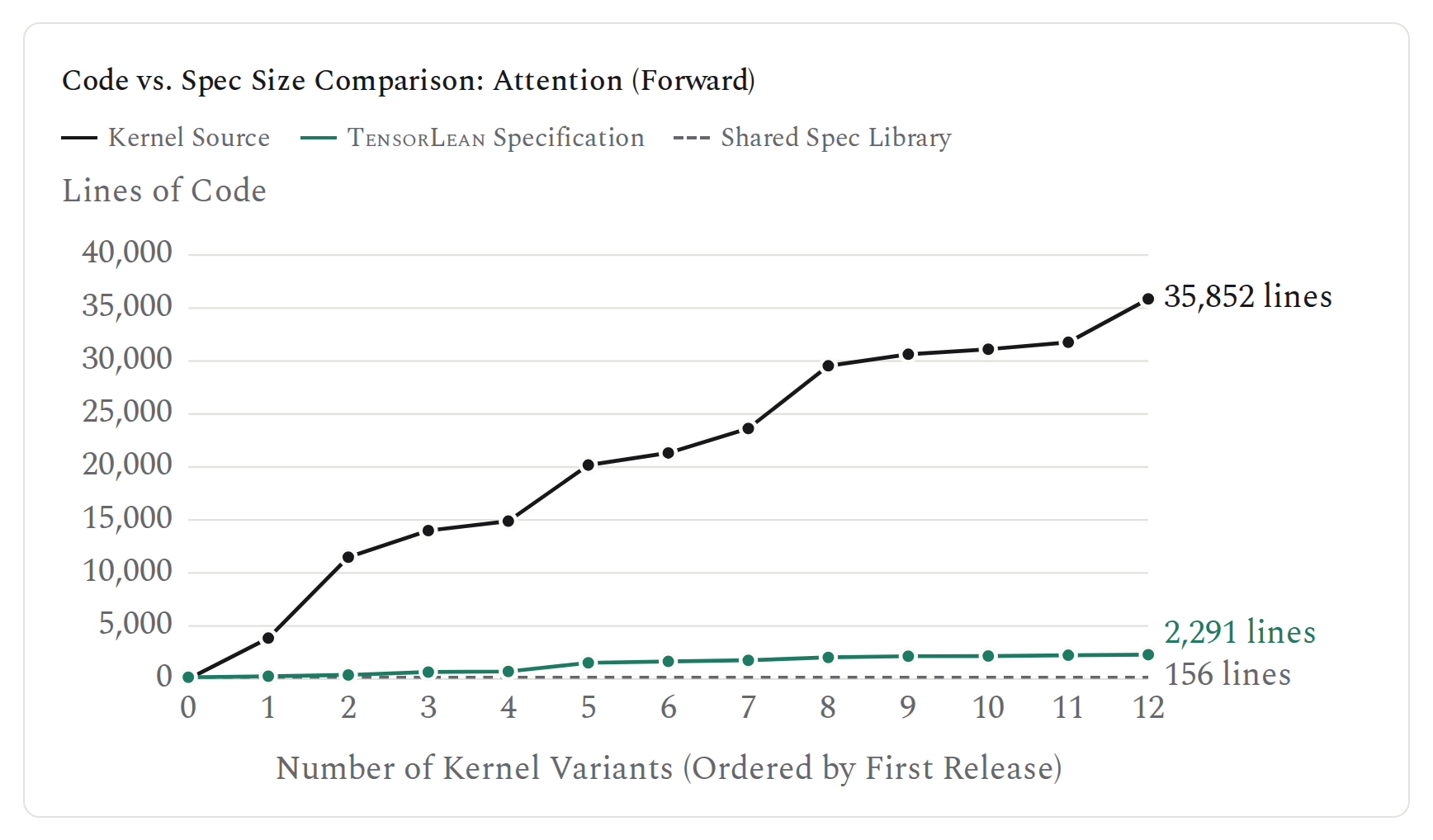
Q, K, V, mutable cache C, precondition requires, output tolerance ε, and pointer layout regions in PTX memory (Source: tensorlean.ai).Across the 12 Attention Forward variants supported by a shared 156-LoC operator library, source size climbs monotonically to 35,852 lines while cumulative specifications flatten near 2,291 lines:
 Enlarge original figure ↗
35,852 source lines require 2,291 spec lines including a 156-line shared tensor library (Source: tensorlean.ai).Across embedded datasets from Figure 4 and Figure 6, this abstraction covers 72 open-source kernels spanning 9 operations, compressing 151,285 lines of kernel source into 10,278 lines of specifications (~14.7:1, summarized as 15:1):
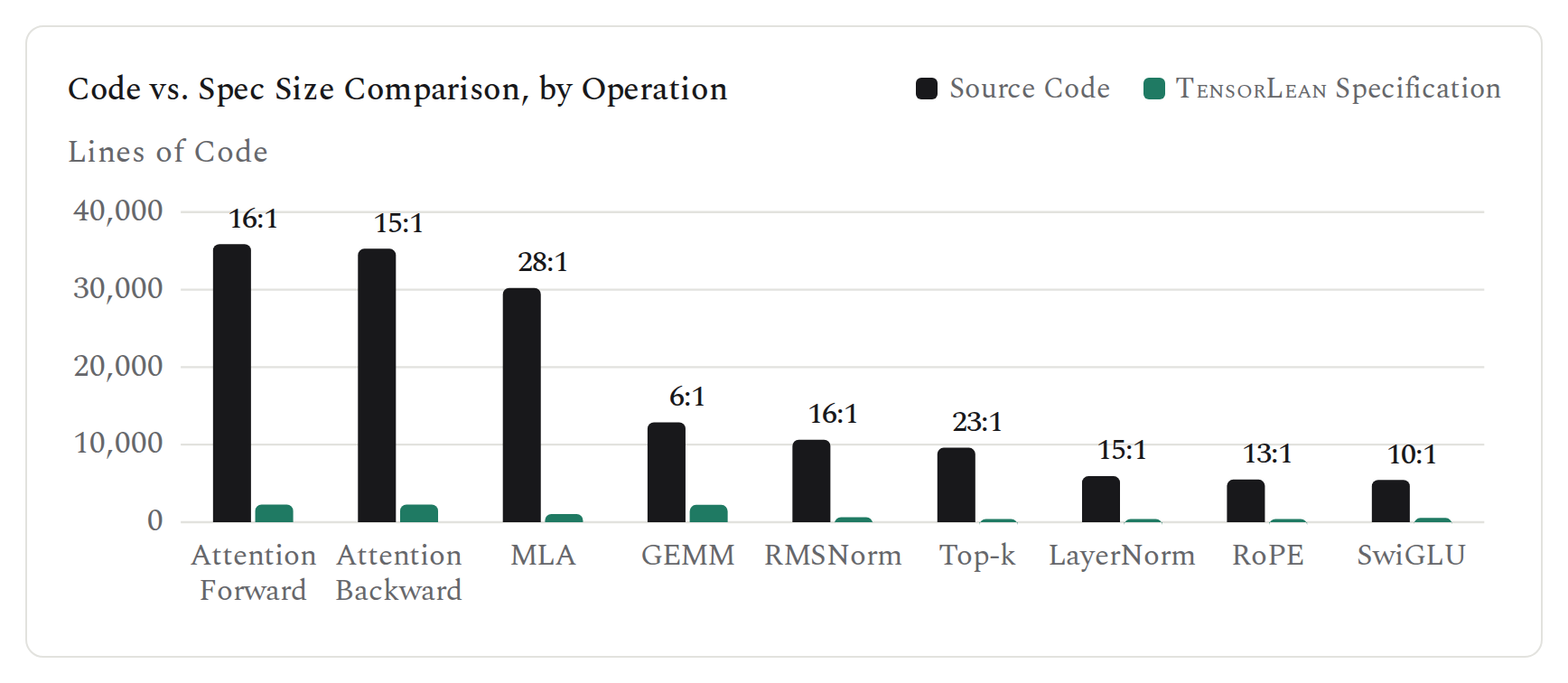 Enlarge original figure ↗
151,285 vs. 10,278 LoC, Source: tensorlean.ai).| Operation / Family | Variants | Source LoC | Spec LoC (Own + Shared Lib) | Code : Spec | Engineering Observation |
|---|---|---|---|---|---|
| Attention Forward | 12 | 35,852 | 2,291 (2,135 + 156) | 16:1 | Spans FA-1..4, CUTLASS, FlashInfer SM100/120, ThunderKittens, FlashMLA, vLLM sparse; only 156 LoC shared library |
| Attention Backward | 10 | 35,254 | 2,285 (2,178 + 107) | 15:1 | Backward differentiation shares core mathematical primitives |
| MLA | 6 | 30,194 | 1,070 (956 + 114) | 28:1 | High implementation bloat relative to compact multi-head latent attention math |
| GEMM | 16 | 12,866 | 2,220 (2,110 + 110) | 6:1 | Lower ratio due to diverse scaling/grouped/E8M0 layouts across 16 matmul variants |
| RMSNorm | 9 | 10,646 | 646 (545 + 101) | 16:1 | Short reduction math amortized cleanly over 9 hardware variants |
| Top-k | 6 | 9,594 | 419 (348 + 71) | 23:1 | Control-heavy sorting/selection code vs concise extensional spec |
| LayerNorm / RoPE / SwiGLU | 4 / 4 / 5 | 5,929 / 5,499 / 5,451 | 408 / 408 / 531 | 15:1 / 13:1 / 10:1 | Baseline per-operation layout wiring floors near 300–420 spec LoC |
| FlashAttention-2 (Ampere) | 6 | 3,669 | 1,223 (1,085 + 138) | 3:1 | Earlier, smaller kernels pay fixed specification setup cost without massive code bloat |
| FlashAttention-3 (Hopper) | 8 | 10,065 | 1,993 (1,853 + 140) | 5:1 | Adding TMA + WGMMA triples source size while spec grows only +63% |
| FlashAttention-4 (Blackwell) | 23 | 42,176 | 3,026 (2,892 + 134) | 14:1 | CuTe DSL kernel count & complexity explode across 23 variants while math stays constant |
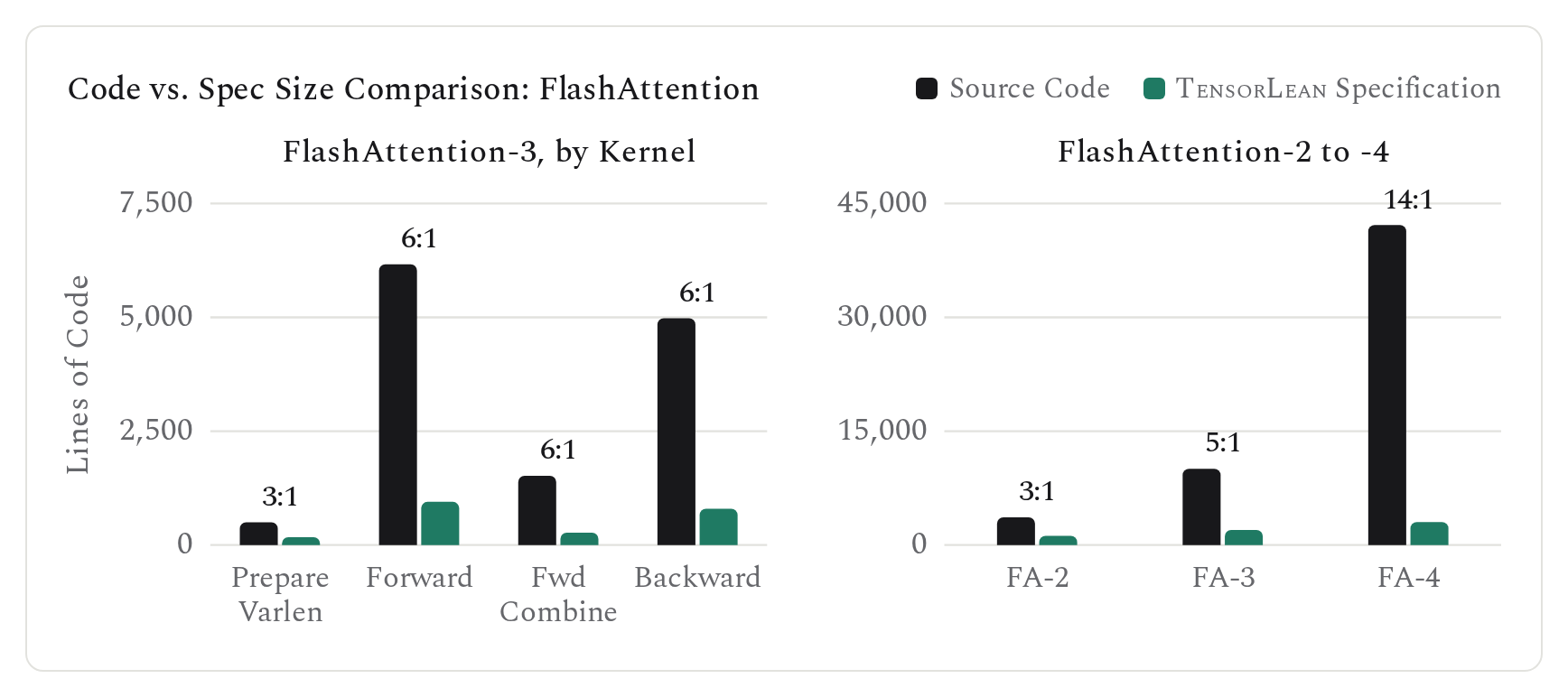 Enlarge original figure ↗
FlashAttention-3 component kernels (left) and the FA-2 to FA-4 generational progression (right, original Fig. 6, Source: tensorlean.ai).Analytical takeaway: Notice the two parallel baselines in the report—15:1 (151,285 : 10,278) holds across the 72-kernel cross-section of 9 operations, whereas the end-to-end FlashAttention-2 to -4 suite (37 kernels, 55,910 LoC source vs 6,242 LoC spec, including FA-3 kernel breakdown PrepareVarlen 3:1, Forward 6:1, FwdCombine 6:1, and 3 Backward kernels 6:1) averages 9.0:1. What drives the ratio from 3:1 in FA-2 up to 14:1 in FA-4 is architectural complexity bloating implementations on Hopper/Blackwell while tensor mathematics remains invariant.
Evidence: Embedded JSON datasets from Figures 1, 4, and 6 on tensorlean.ai.
Inside the PTX verifier: happens-before sequentialization, semiring invariants, and tolerance bounds
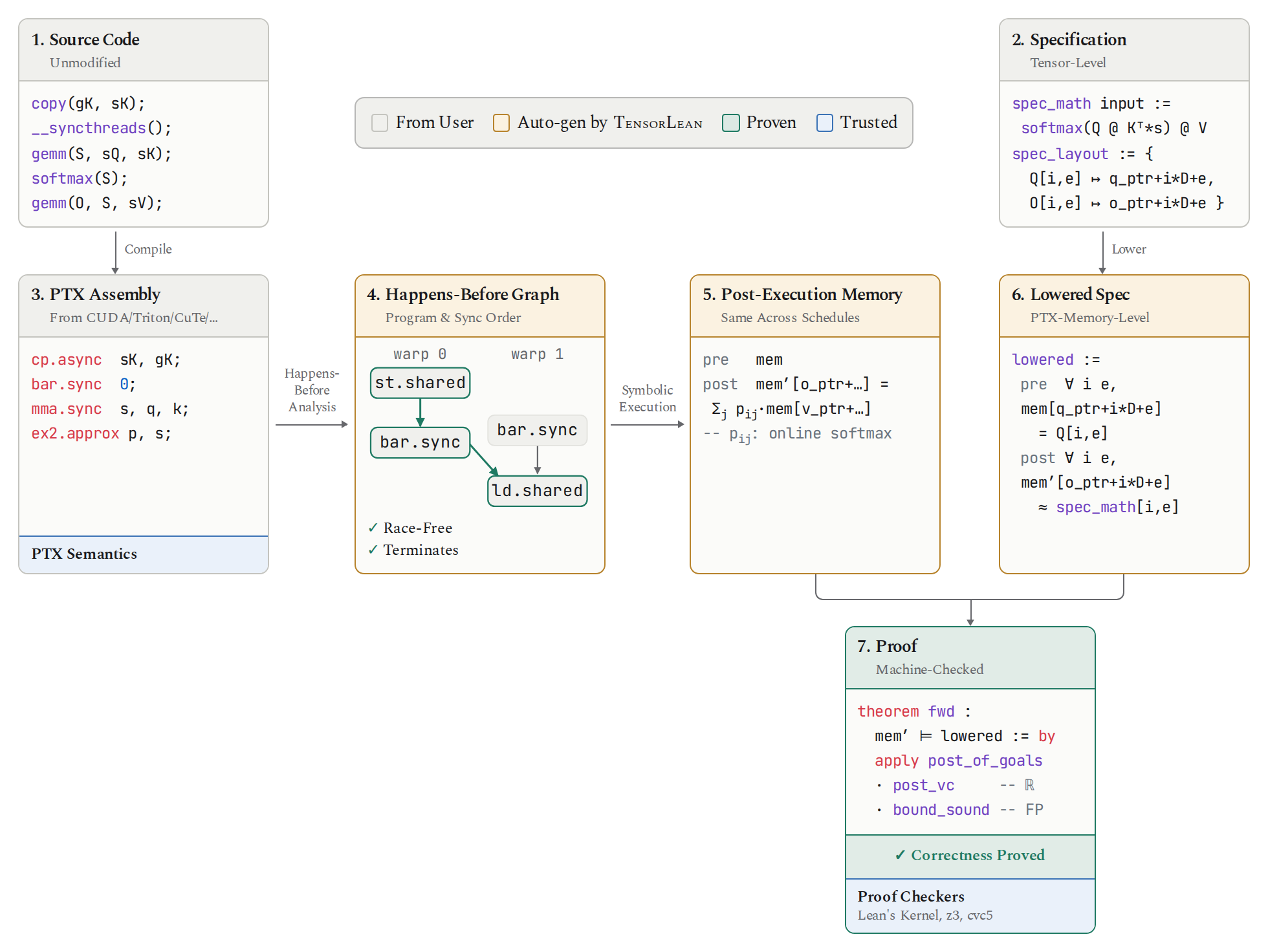
Clean specifications do not verify themselves; the heavy lifting happens in translating massively concurrent PTX (mma.sync + cp.async on Ampere, TMA + WGMMA + mbarrier warp specialization on Hopper, Tensor Memory tmem + tcgen05 on Blackwell) into decidable SMT/Lean proof obligations across symbolic launch parameters.
 Enlarge original figure ↗
tensorlean.ai Chapter 3): separates user inputs (gray), TensorLean synthesis/lowering (amber), proved obligations (green), and trusted base components (blue: PTX semantics, Lean's kernel, Z3, and cvc5; Source: tensorlean.ai).1. Reducing fine-grained concurrency via a symbolic Happens-Before graph
Rather than exploring exponential warp interleavings, TensorLean constructs a symbolic Happens-Before (HB) graph over the relaxed PTX memory model parameterized by all CTAs, threads, and loop iterations:
- Data-race freedom: Every pair of conflicting accesses to the same memory address (at least one a write) must be ordered by program order or PTX synchronization edges (
bar.sync,mbarrierarrive/wait, async copies). Any unordered pair fails with a race counterexample. - Termination: Every loop is bounded and every
waitmatches its correspondingarrivewithout cyclic waits—crucial because a kernel that hangs would satisfy postconditions vacuously. - Sequentialization by warp role: With race freedom and termination proved in Lean, final memory depends solely on the last write to each address regardless of thread schedule. Each homogeneous thread role (e.g., producer warp vs consumer warps) executes symbolically once in program order, pushing writes out at
arriveand pulling arriving writes in atwait.
2. Automatic semiring loop invariants and 298 cut-rule tensorlean_assert hints
Because tensor dimensions and loop trip counts arrive dynamically at launch, TensorLean must verify loops with symbolic bounds. Rather than demanding manual invariants for loops like FlashAttention-3’s split-KV combine kernel—which carries 86 live loop variables—TensorLean exploits three properties common to compute loops (tiled iteration, accumulative updates, and data-independent control flow) to model carried values as affine semiring recurrences:
By inspecting one symbolic iteration of the loop body, TensorLean extracts and discharges the closed-form invariant by induction in a single SMT query. For FlashAttention’s online softmax over key blocks :
| Carried Value | Semiring | Rescaling Factor | Block Contribution | Auto-Inferred Closed Form |
|---|---|---|---|---|
| Running max | (identity) | |||
| Softmax denom | ||||
| Unnormalized |
Where semirings hit their limit, developers insert inline tensorlean_assert statements (298 total across FlashAttention 2–4 and DeepGEMM) invoking Lean’s logical cut rule:
- Case 1 — Pruning massive WGMMA expression trees: In Hopper backward
flash_bwd_sm90.py, register accumulatorsdK,dV,dQexpand into thousands of arithmetic terms. AssertingsdK[r, c] == softmax_scale * dK[j, c]right afterepi_barrier.arrive_and_wait()proves the tile sum once through the(+, ×)loop and replaces giant symbolic expressions with the cleanspec_mathslice for all downstream TMA global stores. - Case 2 — Non-semiring persistent schedulers: In
DeepGEMMsm90_fp8_paged_mqa_logits.cuh, each CTA walks a variable-length range of querieslens[q]and resetskv = 0per query (data-dependent trip counts). Three invariants placed at thewhileheader ((q, kv) < meta[sm+1],num_kv == ceil_div(lens[q], 64),kv % SPLIT == 0 && (kv == 0 || kv < num_kv)) are proved by induction to bound every block-table lookup, KV read, and logit write.
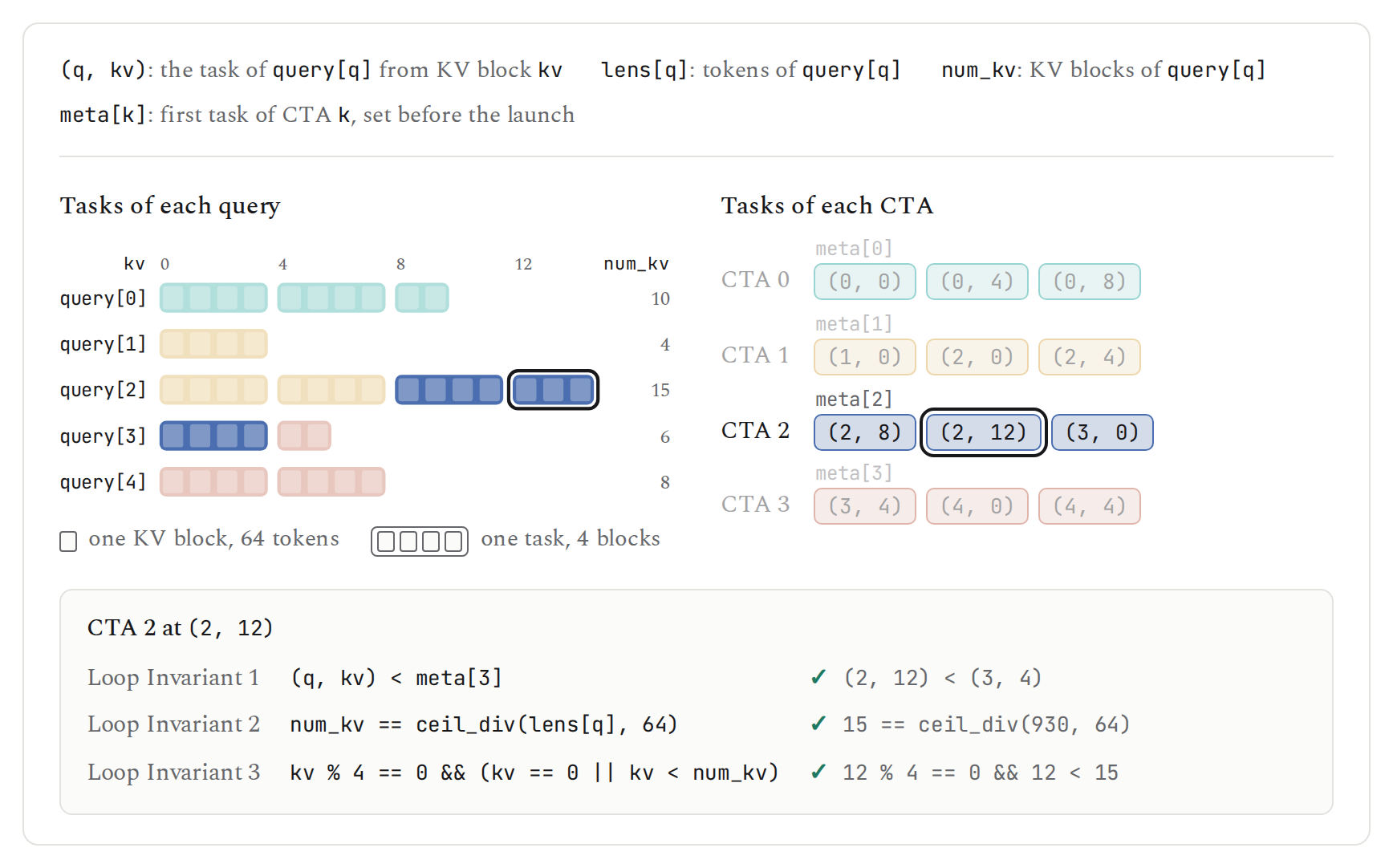 Enlarge original figure ↗
DeepGEMM paged MQA (original Fig. 5): three header tensorlean_assert invariants proved by induction keep table and KV cache accesses in bounds despite data-dependent lens[q] and kv = 0 resets (Source: tensorlean.ai).3. Splitting exact algebra from linear round-off error propagation
Comparing floating-point outputs directly against real specifications drags SMT solvers into bit-blasting non-associative IEEE-754 operations. TensorLean avoids exponential search via an intermediate real-valued PTX model (): first proving zero algebraic/indexing error over , then propagating instruction-level rounding errors (ex2.approx, mma/wgmma, FP8/BF16/FP32) through the computation tree in linear time:
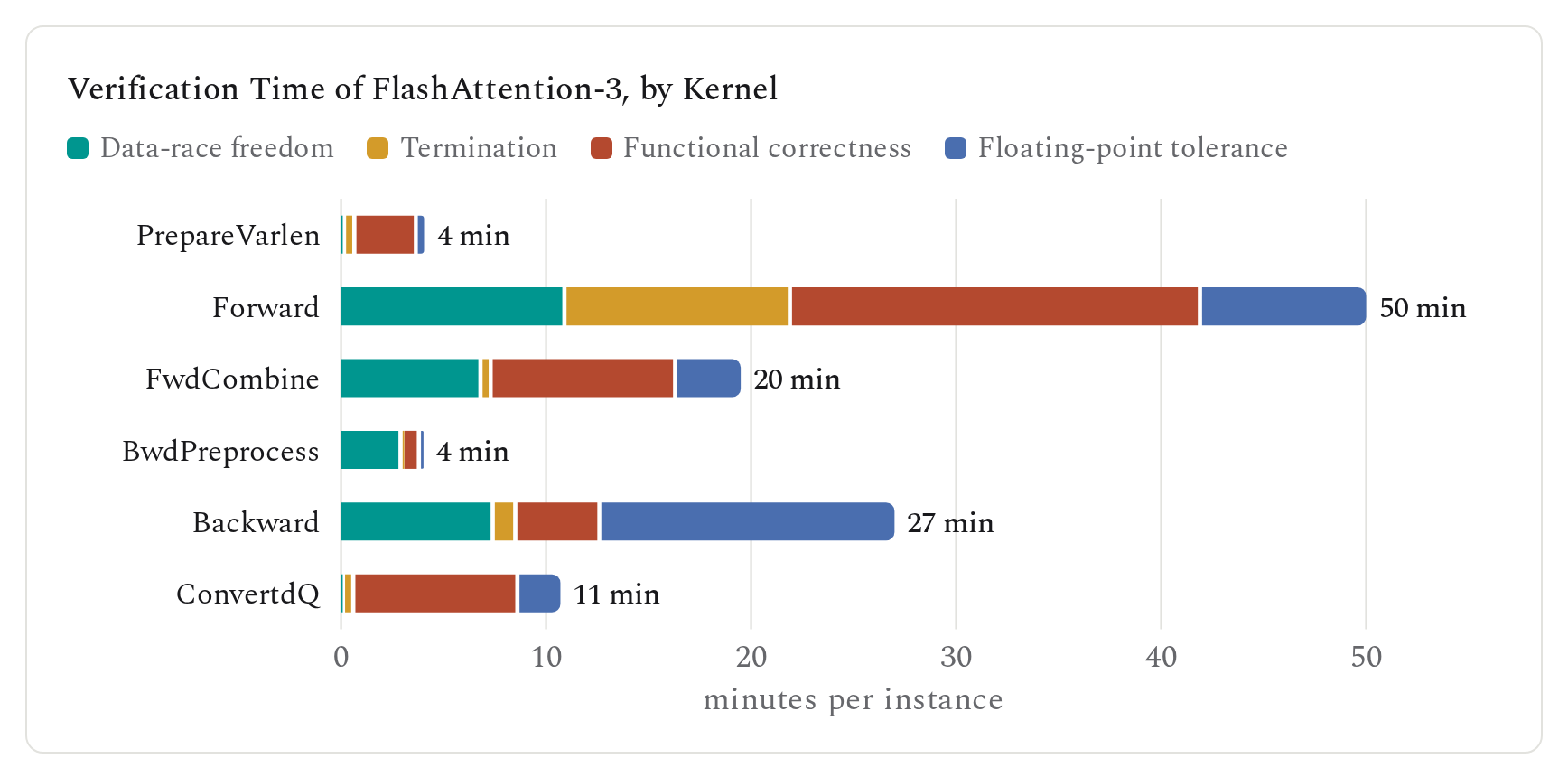
Measured runtime (16-core workstation): Median ~10 minutes per PTX instance. On Hopper FlashAttention-3 (Dao-AILab/flash-attention@68bd095), per-instance runtimes span 4 min (PrepareVarlen, BwdPreprocess), 11 min (ConvertdQ), 20 min (FwdCombine), 27 min (Backward), up to 50 min for Forward (FlashAttnFwdSm90, discharging 31,402 proof goals).
 Enlarge original figure ↗
FlashAttention-3 kernels on a 16-core workstation (original Fig. 7; Forward completes in 50 min across 31,402 proof goals, Source: tensorlean.ai).Evidence: tensorlean.ai PTX-Level Verification & Figures 5, 7, FA-3 flash_fwd_kernel_sm90.h.
Empirical audit: 149 instances, 39 bug reports, and live upstream PR status
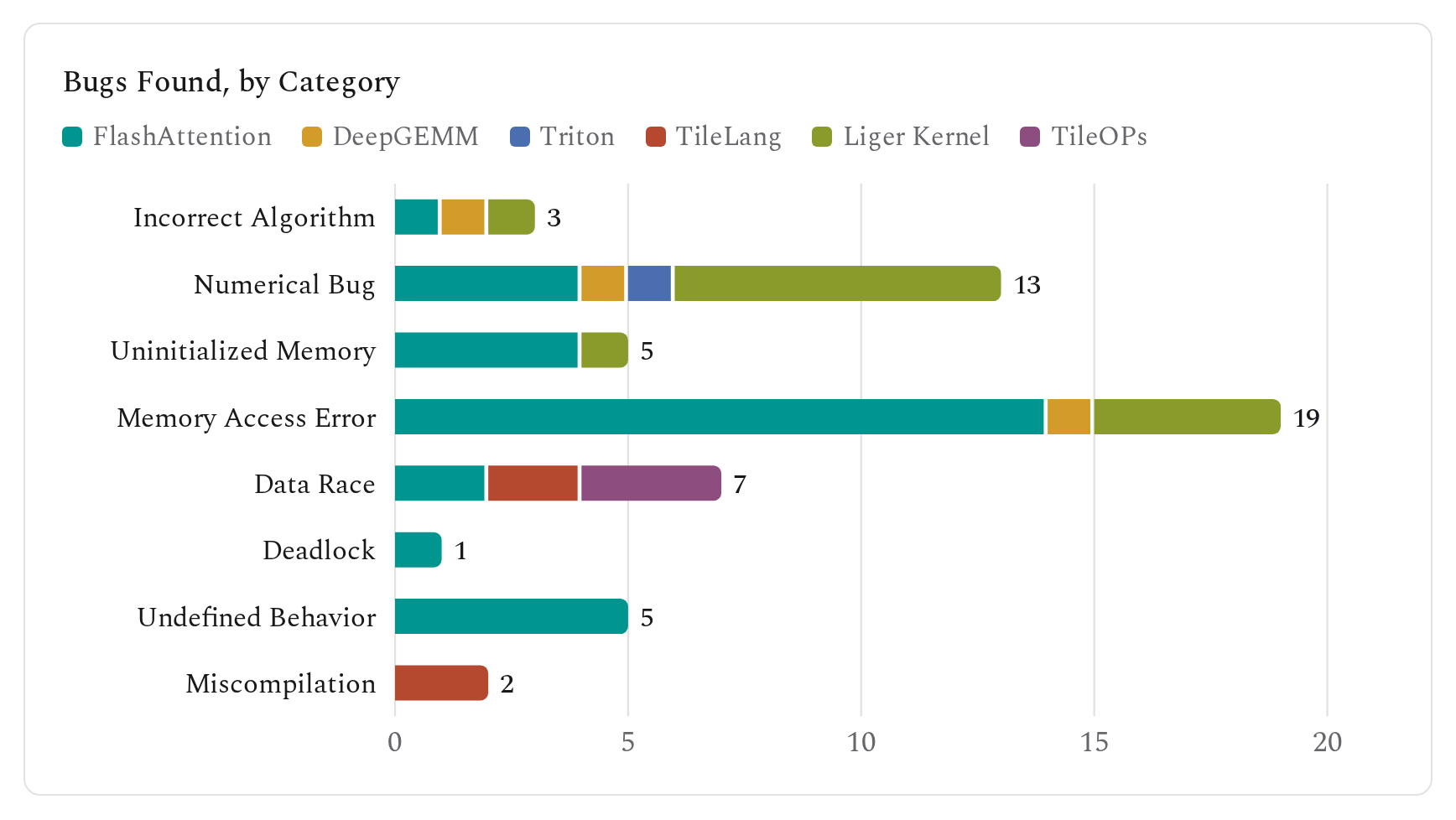
Cross-checking the November 20 blog (38 listed bugs) against commit 3e83208 in TensorLean/TensorLean (November 22, 2026, adding DeepGEMM #514/#515 for 39 total entries), and querying all 50 upstream GitHub links (35 issues + 15 PRs) as of November 23, 2026 yields the complete empirical picture:
 Enlarge original figure ↗
38 findings published Nov 20, led by 19 memory access errors and 13 numerical bugs; commit 3e83208 on Nov 22 added DeepGEMM #514/#515 for a total of 39 entries, Source: tensorlean.ai).| Library | Verified Scope Note | Public Bugs (@3e83208) |
Upstream PR Status (2026-11-23) |
Representative Root Causes |
|---|---|---|---|---|
| FlashAttention 2–4 | 102 instances (56 proved / 46 failed across all 37 kernels) | 23 (FA-4: 4 · FA-3: 10 · FA-2: 9) | 1 merged (#3152) · 7 open |
FA-4 #3195 unbarriered reduction_buffer race (missed in 17,760 test runs); FA-3 #3193 latent warp deadlock masked by ptxas 13.0; FA-3 #3014 silent KV corruption on odd head dims |
| Liger Kernel | Part of 47 additional instances (softmax / CE / swizzle / embedding) | 7 | 0 merged · 1 open (#1525) |
Widespread int32 offset/tile wrap past 2^31 (#1570, #1573, #1658, #1659, #1661); NaN in CE/GRPO when first block logits are all -inf (#1660) |
| DeepGEMM | Part of 47 additional instances (SM90 FP8/BF16) | 3 (2 in blog + #514 added Nov 22) |
0 merged · 2 open (#477, #515) |
#476 fp8_einsum silently drops accumulator c; #490 int32 scale index wrap; #514 unaligned masked grouped GEMM writes past boundary into group g+1 |
| TileOPs | Reported kernel defects | 3 | 2 merged (#1728, #1730) · 0 open |
Shared-memory stride write-write race (#1584), missing intra/inter-CTA barriers |
| TileLang | Blackwell sm_120 compiler lowering defect |
2 (#2699, #2703) |
1 merged (#2700 fixes both) |
ThreadSync missed ptx_st_bulk_shared (st.bulk) write effect, dropping barrier (20/20 failures before fix) |
| Triton | Scaling utility defect | 1 | 0 merged · 1 open (#12226) |
FP16 underflow/overflow converting E8M0 scales in _upcast_from_mxfp |
| Total | 149 PTX instances (83 proved / 66 failed) | 39 entries | 4 merged PRs (5 entries) · 11 open · 0 closed unmerged |
Top categories (38-bug blog multi-label): Memory Access 19(+1), Numerical 13, Data Race 7(+1), Uninit 5, UB 5 |
Four diagnostic cases showing why PTX verification finds what testing misses
- A latent deadlock currently hidden by
ptxas 13.0SASS reconvergence (FlashAttention-3 #3193): In Hopper forwardmainloop_fwd_sm90_tma_gmma_ws.hpp#L805, producer warp 0 omits__syncwarp()afterbarrier_O.waitupon reconverging from divergentNumProducerThreadschecks. Becauseptxas 13.0happens to insert SASS reconvergence ahead of the wait, no hardware run hangs today and no reproducer exists—yet the PTX diverges from NVIDIA’s independent thread scheduling guarantee and risks deadlock on future compilers. - A
max_m = 4096power-of-two blind spot causing cross-group races (DeepGEMM #514/#515): Added on November 22, this bug stems from constructing a 2D TMA descriptor ofM * Grows forD. WheneverMis not divisible byBLOCK_M, groupg’s tail block overwrites rows belonging tog + 1in race withg + 1’s CTAs—silently corrupting valid outputs without raising any error, undetected because DeepGEMM’s test generator hardcodedmax_m = 4096. - Silent KV-cache corruption on non-standard rotary dims (
FlashAttention-3 #3014/#3015): Non-interleaved RoPE combined withflash_attn_with_kvcachesilently corrupts KV cache contents when head dimensions fall outside{64, 96, 128, 192, 256}. - Blackwell
st.bulkmiscompilation fixed within days (TileLang #2699/#2700): Merged on July 21, 2026 (#2700), eliminating silent races onsm_120whereThreadSyncfailed to trackptx_st_bulk_sharedas a memory write.
Accounting nuance: Keep the three numbers distinct when reading the report: 149 PTX instances (102 FA-2..4 + 47 from DeepGEMM/Liger Kernel, yielding 83 proved and 66 buggy) measure compiled kernel instantiations; 39 represents distinct upstream bug entries across six libraries (including compiler/library bugs reported to Triton, TileLang, and TileOPs, which sit in the same compilation/operator stack); and 72 kernels (151,285 source LoC) represent the spec-size study across 9 operations. One root bug routinely causes multiple compiled PTX instances to fail (23 FA bugs across 46 failed FA instances).
Evidence: tensorlean.ai Findings & Figure 8, TensorLean@3e83208 README, GitHub API state checked 2026-11-23.
Proved vs. trusted: dissecting the five-layer TCB and scope boundaries
To its credit, the TensorLean report’s Limitations section refuses to oversell its guarantees. Any engineering team evaluating PTX-level verification for release gates needs an exact inventory of what stays outside the machine-checked proof:
| Boundary Layer | What the Report Discloses (Limitations) |
Critical Engineering Takeaway |
|---|---|---|
1. PTX ISA & ptxas -> SASS |
Trusts NVIDIA PTX ISA 9.4 documentation, ptxas, and hardware fidelity |
PTX is virtual assembly; register allocation, SASS scheduling, and reconvergence remain inside closed-source ptxas (FA-3 #3193 shows PTX vs SASS divergence cutting both ways) |
| 2. Undocumented Tensor Core rounding | Explicitly notes PTX ISA does not specify Tensor Core rounding behavior; TensorLean trusts its own rounding model | Soundness of rests on an empirical hardware model that must be re-validated per microarchitecture or format (NVFP4/E8M0) |
3. 1.8K-LoC PTX parser & user spec |
Trusts its unverified 1.8K-LoC PTX parser and developer-written five-tuple spec |
As shown in Verified but Vacuous, overly restrictive requires clauses yield vacuously green proofs; lower spec size eases human audit but does not automate spec-adequacy auditing |
4. Lean 4 kernel + external cvc5/Z3 |
Explicitly trusts both Lean’s kernel and external cvc5/Z3 solver answers |
Obligations discharged by SMT solvers are trusted directly rather than replayed via an independent proof-reconstruction checker inside Lean’s kernel |
| 5. Scope caps & unreleased artifacts | ① Pure spec functions exclude stochastic kernels (Dropout, Top-p); ② Does not model atomic acquire/release order, placing NCCL / DeepEP multi-GPU kernels out of scope; ③ Missing requires, loose bounds, or SMT timeouts still fail (incompleteness) |
Independent reproducibility awaits open-sourcing: as of TensorLean@3e83208, Lean PTX semantics, parser, and proofs are not yet public for external verification |
Judgment: Leaving cvc5/Z3, a 1.8K-LoC parser, and a Tensor Core rounding model inside an explicit TCB is a deliberate, high-leverage engineering tradeoff—shipping an automated verifier that actually proves 37 real FlashAttention kernels and uncovers 39 upstream bugs beats spending a decade reconstructing every SMT arithmetic proof inside Lean over toy matrices. The key discipline is never conflating “proved in TensorLean” with “proven down to bare silicon without TCB assumptions.”
Evidence: TensorLean Limitations, TensorLean@3e83208.
System positioning: contrasting arXiv:2611.04447 and pairing with VeriServe
Readers following formal AI systems work in November 2026 should carefully separate three distinct efforts rather than conflating similar Lean/verification headlines:
| Dimension | Koska et al. (arXiv:2611.04447) |
TensorLean (Columbia & CertiK) |
vstack + VeriServe (Hao AI Lab) |
|---|---|---|---|
| Verification layer & target | Hand-written simplified PTX ops (WGMMA GEMM, scalar FA, 3-kernel sequential MoE pipeline) | Compiled PTX from existing production libraries (FA-2..4, DeepGEMM, Liger), single-kernel extensional correctness | Distributed PD serving control plane & KV-page capability ledger (PdLedger, GPUDirect RDMA, prefix sharing) |
| Effort & automation | Manual Lean proofs: 454 PTX instructions -> 34,034 proof lines (~75:1 proof bloat) |
Automated HB sequentialization + semiring invariants + SMT: 151,285 LoC -> 10,278 LoC spec (15:1) + 298 hints |
Anti-reward-hacking S0–S8 agent gates + TLA+/TLAPS (517,493 obligations, explicit 4-instance/cache caveats) |
| Concurrency & memory model | Models acquire-release, proxies, multi-kernel state handoff, data-dependent control; partial correctness + manual witness | HB graph for barriers/mbarrier/cp.async/TMA/WGMMA/tcgen05, proves race-freedom + termination; omits atomic acquire-release (no NCCL/DeepEP) |
Models one-sided RDMA DMA races, lease expiry, and 9-field LAYOUT_COMPARED handshakes; isolates uncertain pages in QUARANTINED |
| Numerical & release transparency | Floating point idealized as exact real numbers (cannot catch rounding/NaN); arXiv paper details 81 instruction subset |
Real equivalence + linear FP error bound catching 13+ numerical bugs; 39 bugs / 4 merged PRs live, but prover/PTX semantics still unreleased |
Focuses on monotonic (page, gen) integrity (no tensor arithmetic); full codebase, specs, and 42-bug ledger open for inspection |
Three architectural takeaways for verifiable AI infrastructure
- Data-plane and control-plane verification click together:
VeriServeenforces viaPdLedgerthat stale RDMA traffic from request A never overwrites request B’s KV page—yet its verification treats the internal attention invocation (k_launch()) as a trusted oracle.TensorLeanverifies the exact opposite seam: ensuring that each production attention or GEMM PTX kernel neither suffers 32-bit offset wraps, CTA races, uninitialized reads, nor unexpected NaNs. - Formal CI gates must target lowered IR/PTX with symbolic shapes:
19/23shape/feature-combination bugs in FlashAttention,DeepGEMM #514slipping past hardcodedmax_m = 4096generators, andTileLang #2700breaking only in Blackwell PTX lowering jointly demonstrate that leaving tensor dimensions symbolic and verifying post-compiler artifacts is indispensable—both for human kernels and coding-agent kernel synthesizers. - What to inspect once TensorLean opens its codebase: When the authors release their paper and Lean repository beyond
3e83208, three audit points will decide its long-term impact: (a) instruction coverage and self-testing of the1.8K-LoC PTX parser acrossPTX 9.x, (b) whether agent-generatedtensorlean_asserthints on non-semiring scheduler loops preserve soundness without vacuous preconditions, and (c) extending HB reasoning toacquire/releaseatomic flags so multi-GPU kernels likeDeepEPandNCCLcome into reach.
Evidence: TensorLean technical report, TensorLean@3e83208, Formalizing PTX in Lean (arXiv:2611.04447), vstack and VeriServe close reading.
vstack & VeriServe Close Reading · arXiv:2611.04447 (Formalizing PTX in Lean) · DeepMind Softmax Numerical Fix · Verified but Vacuous Close Reading